Why FITS,
and never JPEG.
Two formats walk into a frame. One was designed by photographers. One was designed by astronomers. The difference is what they think you're allowed to throw away.
A FITS file is what the telescope wrote down. A JPEG is what someone decided the FITS file ought to look like, after most of the data was already gone. 1snob AstroRoom never asks you to start from a JPEG. The reason is the reason astronomy exists.
— 01What a JPEG actually is
A JPEG is an image format invented for photographs of holidays. It assumes the human eye is the final reader. It quantises colour into eight bits per channel, throws away high-frequency detail with a discrete cosine transform, and treats the difference between almost-black and very-almost-black as zero. For a snapshot of a beach, that's a beautiful trade. For a frame from Chandra ACIS-I, in which a single photon from twenty-six thousand light-years away is one pixel above a Poisson background, it is a tragedy.
— 02What a FITS file actually is
FITS — Flexible Image Transport System — was standardised by the International Astronomical Union in the late seventies. It is a header, then a number array. The header is text, infinitely extensible, and includes the World Coordinate System mapping that says this pixel is this point on the sky. The number array is whatever you measured: counts of photons, voltage on a CCD, brightness temperature in Kelvin. It can be eight bits, sixteen bits, thirty-two bit floats. It can be stacked, sliced, time-tagged. Nothing is thrown away because nothing was ever assumed to be unimportant.
— 03How 1snob AstroRoom handles it
When 1snob AstroRoom ingests a frame, it reads the FITS header, picks up the WCS, checks the band and the instrument, and writes the original payload to disk unchanged. From that point forward, the user works on derived products. The original is the source of truth. Every preview the interface shows you — the PNG thumbnails in the gallery, the on-screen render in develop mode — is a projection of the FITS data, reversible, regenerable, never a replacement for it. The projection layer lives in backend/app/services/fits_service.py and backend/app/services/fits_composite_v3.py.
— 04What a JPEG actually loses
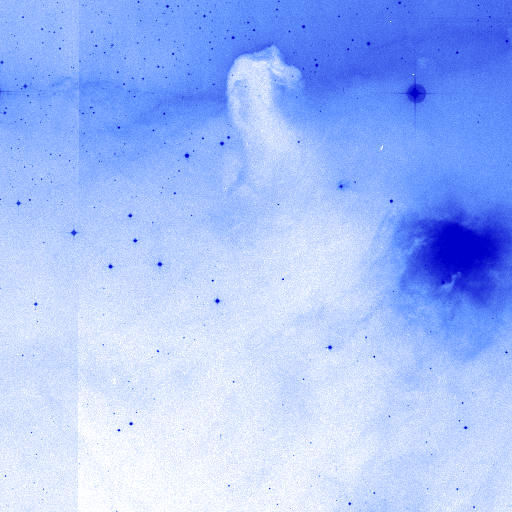
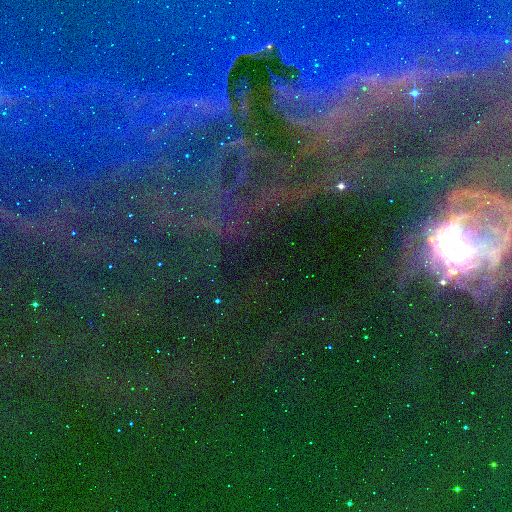
Take the Horsehead in a single DSS exposure. The original FITS measures photon counts at sixteen bits per pixel, between roughly 0 and 65,000 in the brightest spots. Save it as a JPEG. The JPEG must compress that range into 28 = 256 levels. The faintest emission in the IC 434 dust lane — the part that gives the silhouette its shape — sits in the bottom 1% of the dynamic range. After the JPEG, that 1% is one level. The dust lane goes from a gradient with structure to a single flat patch.
— 05Why this matters for the picture
There are real images in the public archive that exist only as JPEGs. We use them when we have to. We never base a stack on them. A stack is an averaging operation; averaging discards a JPEG's compression artefacts only if the artefacts are random, and they are not — they correlate with the underlying image. Averaging fifty JPEGs of M31 does not give you a deeper exposure of M31. It gives you a deeper exposure of fifty JPEGs of M31. There is a difference, and the difference is what your photograph is.