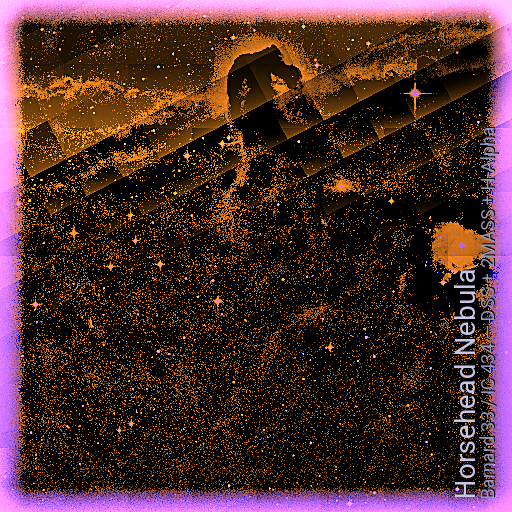
 B33 master
The published master.
The plate the room refers back to. Sixteen frames stacked, the dust lane reading red against the IC 434 emission.
Thirty-four photographs, each restacked from public archive data. Each one carries its band, its instrument, its integration time, and a recipe identifier. Every plate has a Merkle root on file — the picture is no longer just a picture.
The same target — Barnard 33 — developed under twelve different recipes and band combinations. Same FITS source, same crop. Different decisions about colour, stretch, and which photons get the spotlight.
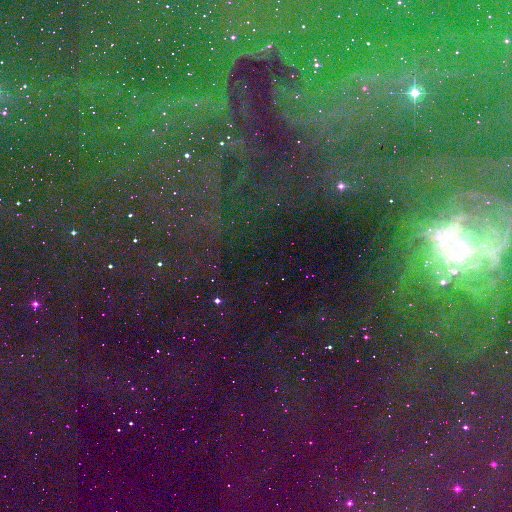
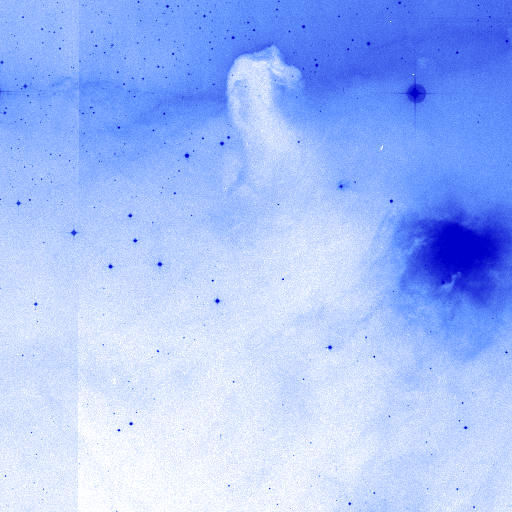
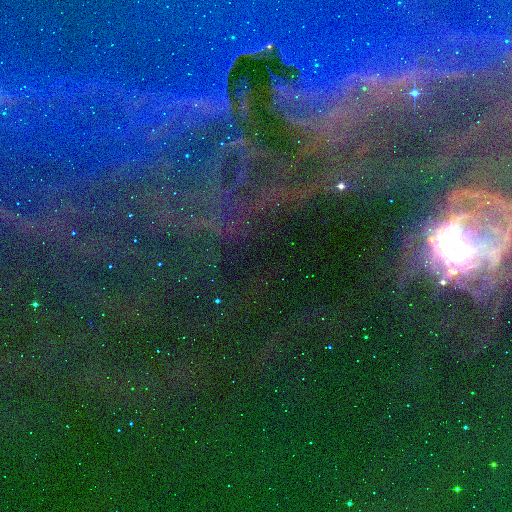
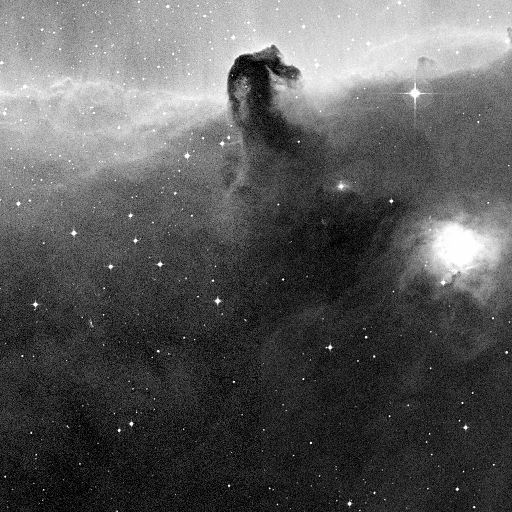
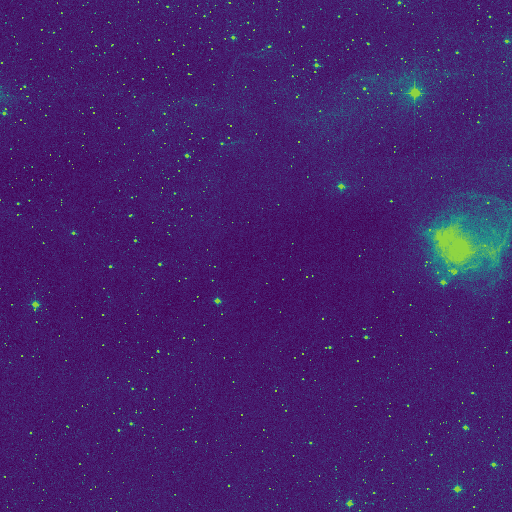
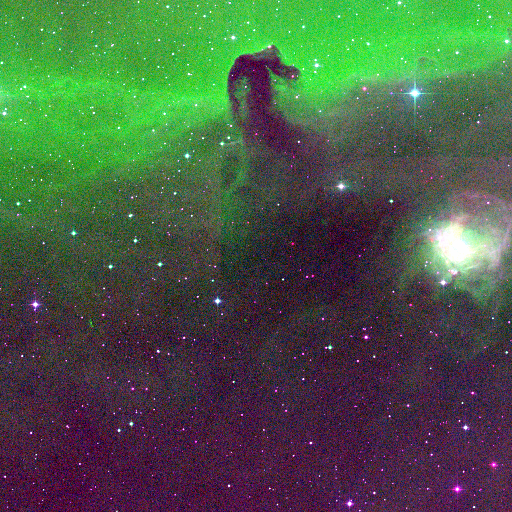
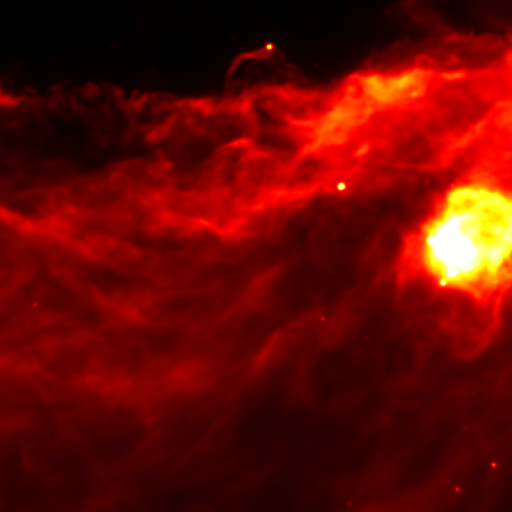
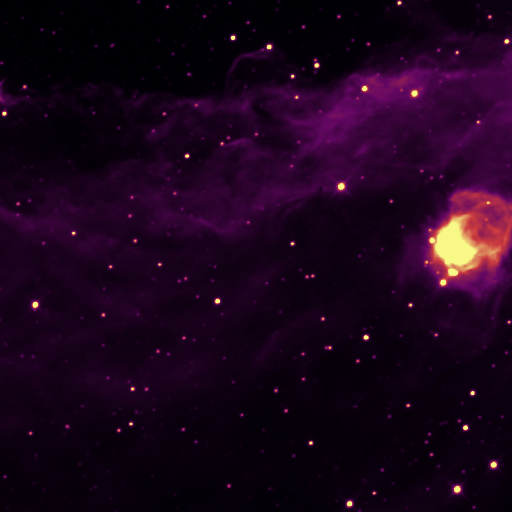
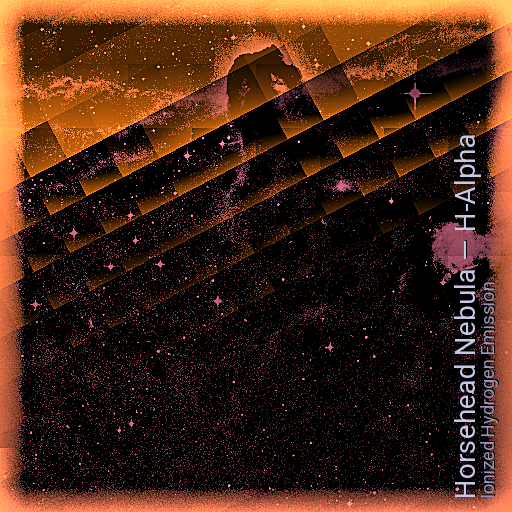
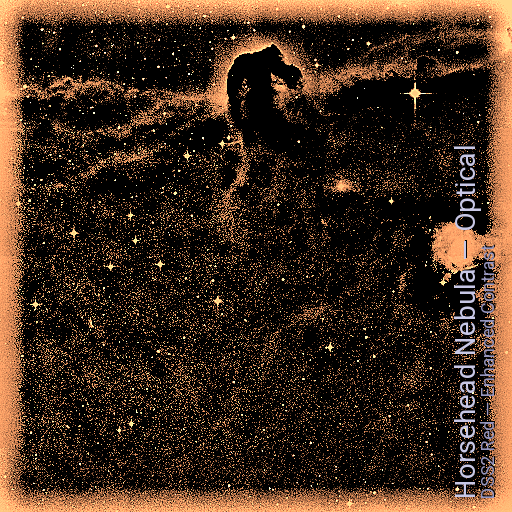
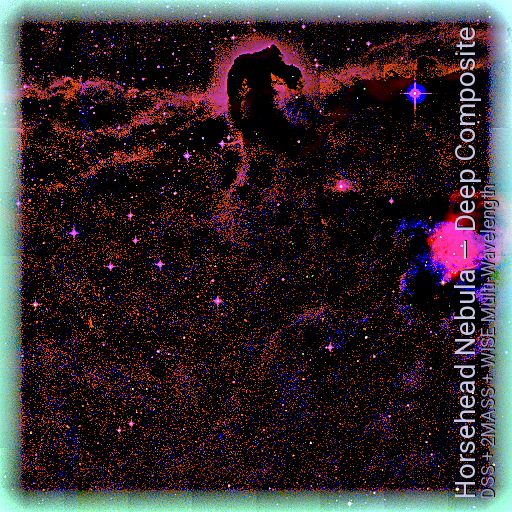
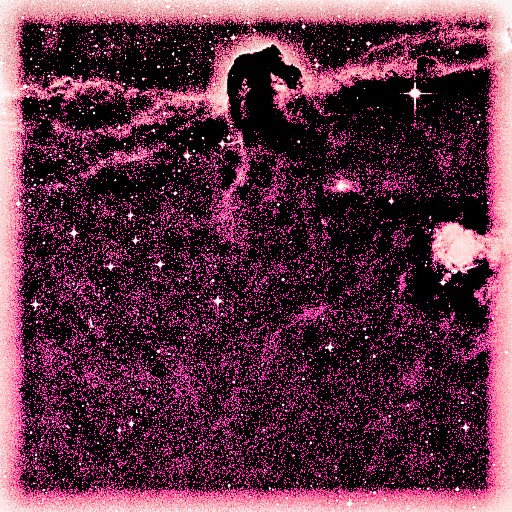
Beyond the recipe matrix above, four masters that earned the wall — the Horsehead taken from study to publication.
B33 masterThe plate the room refers back to. Sixteen frames stacked, the dust lane reading red against the IC 434 emission.
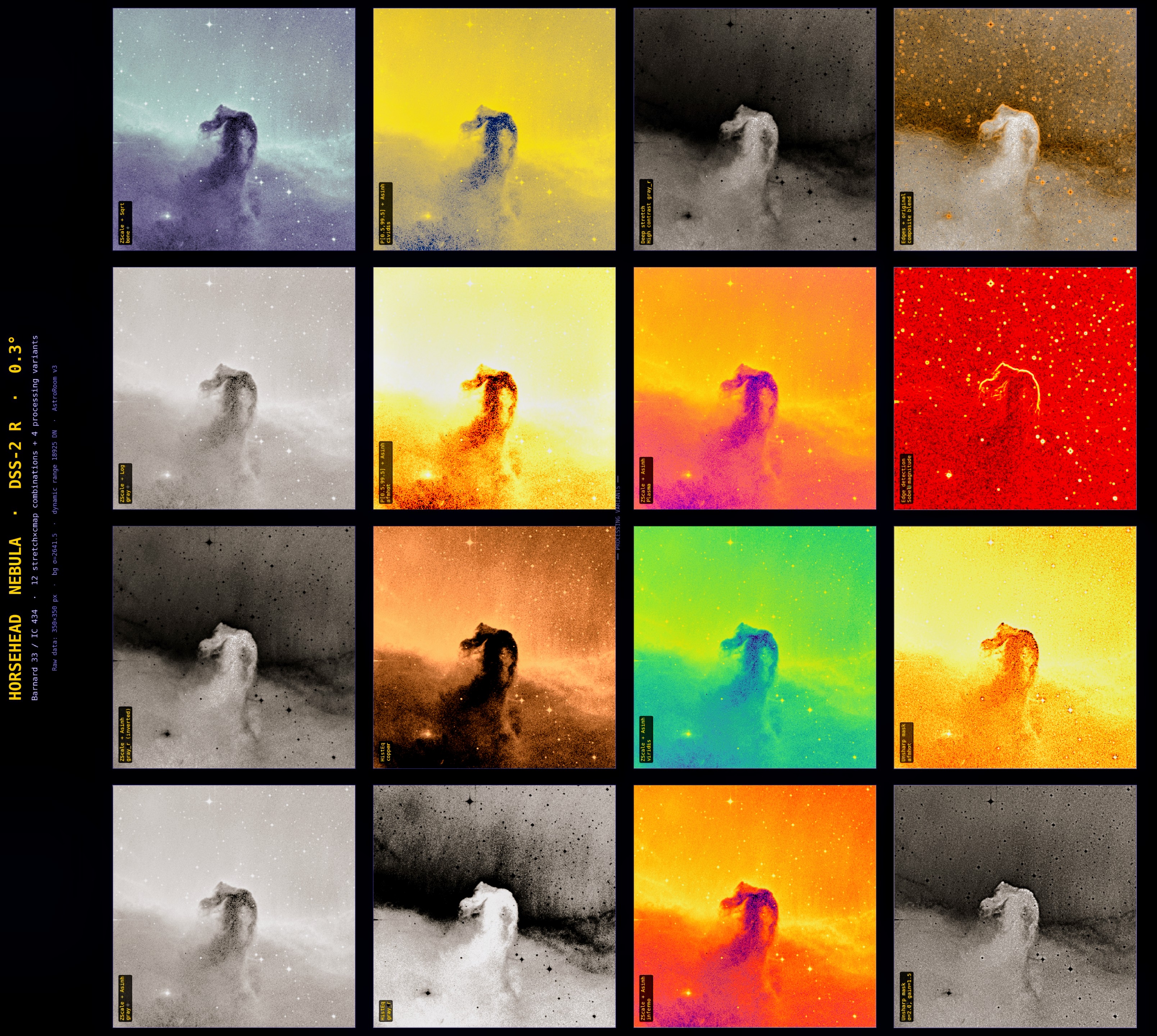 B33 deep
The same target driven harder on the stretch. The faint outer dust extends visibly past where the canonical crop ends.
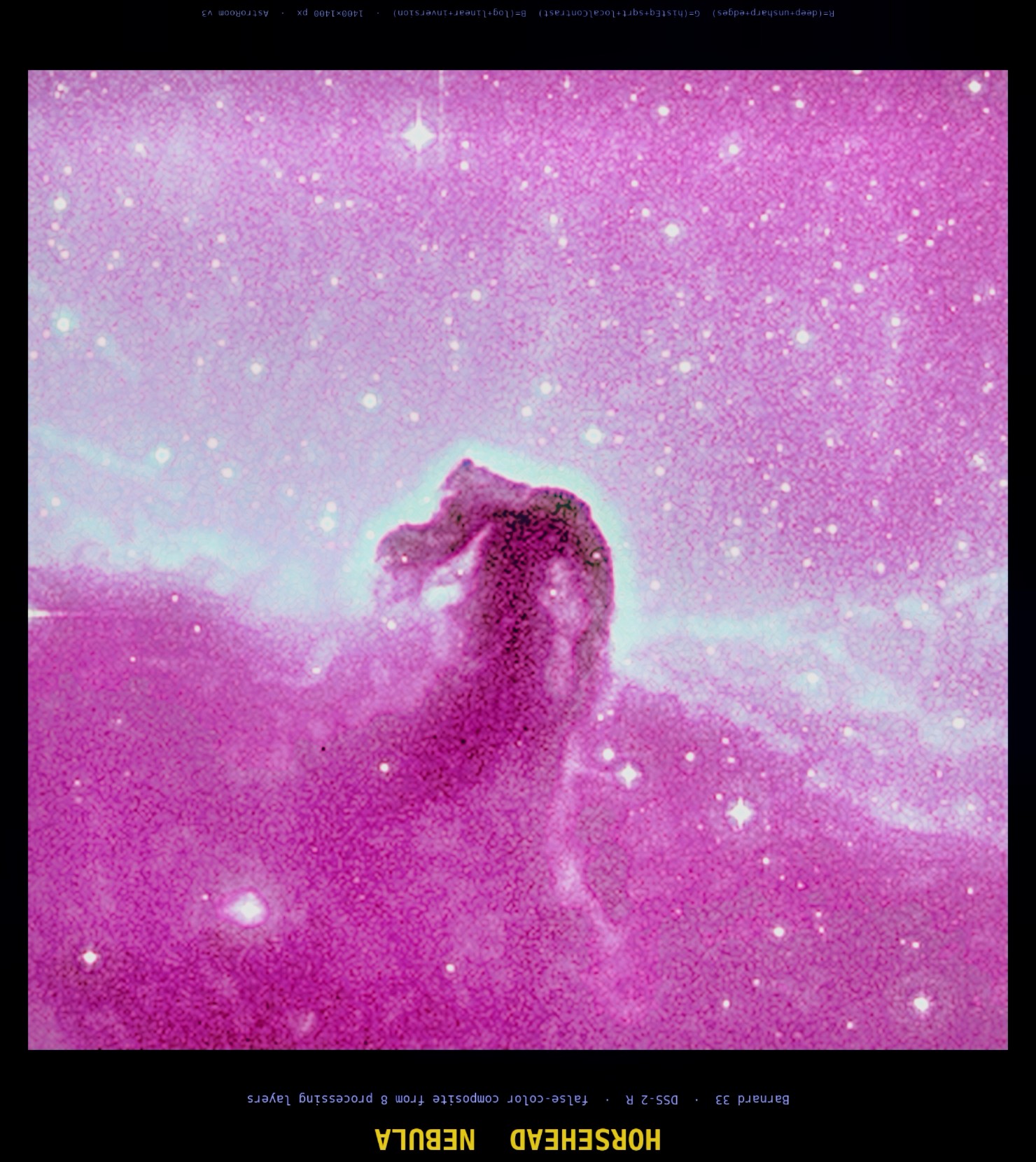 B33 false
Three bands run through one of the warm-edge palette family recipes. The silhouette is the same; the temperature reads differently.
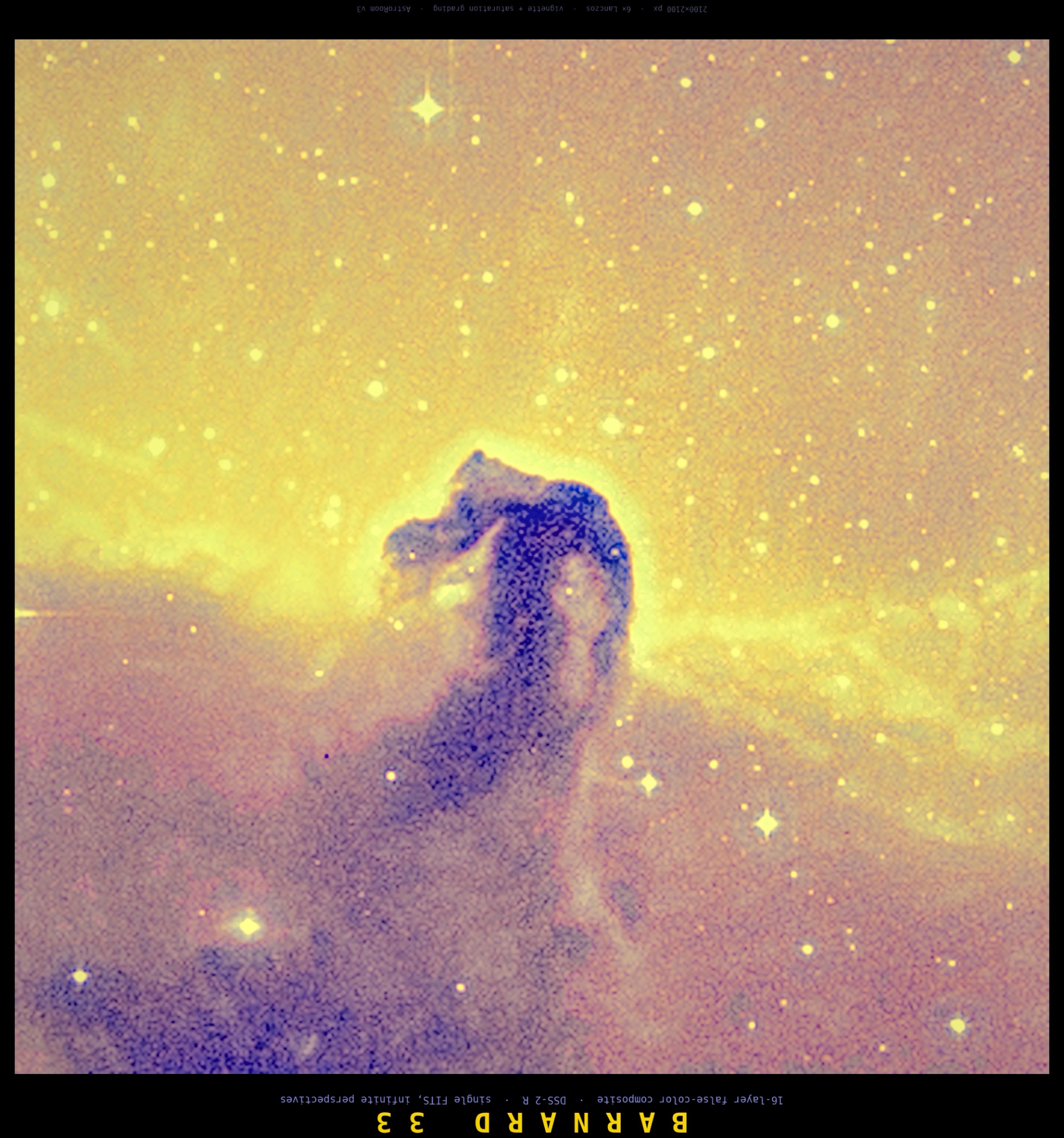 B33 ultimate
The composite the team kept after argument — narrowband H-α driving the silhouette, near-IR underneath for the dust geometry, optical broadband as the whisper.
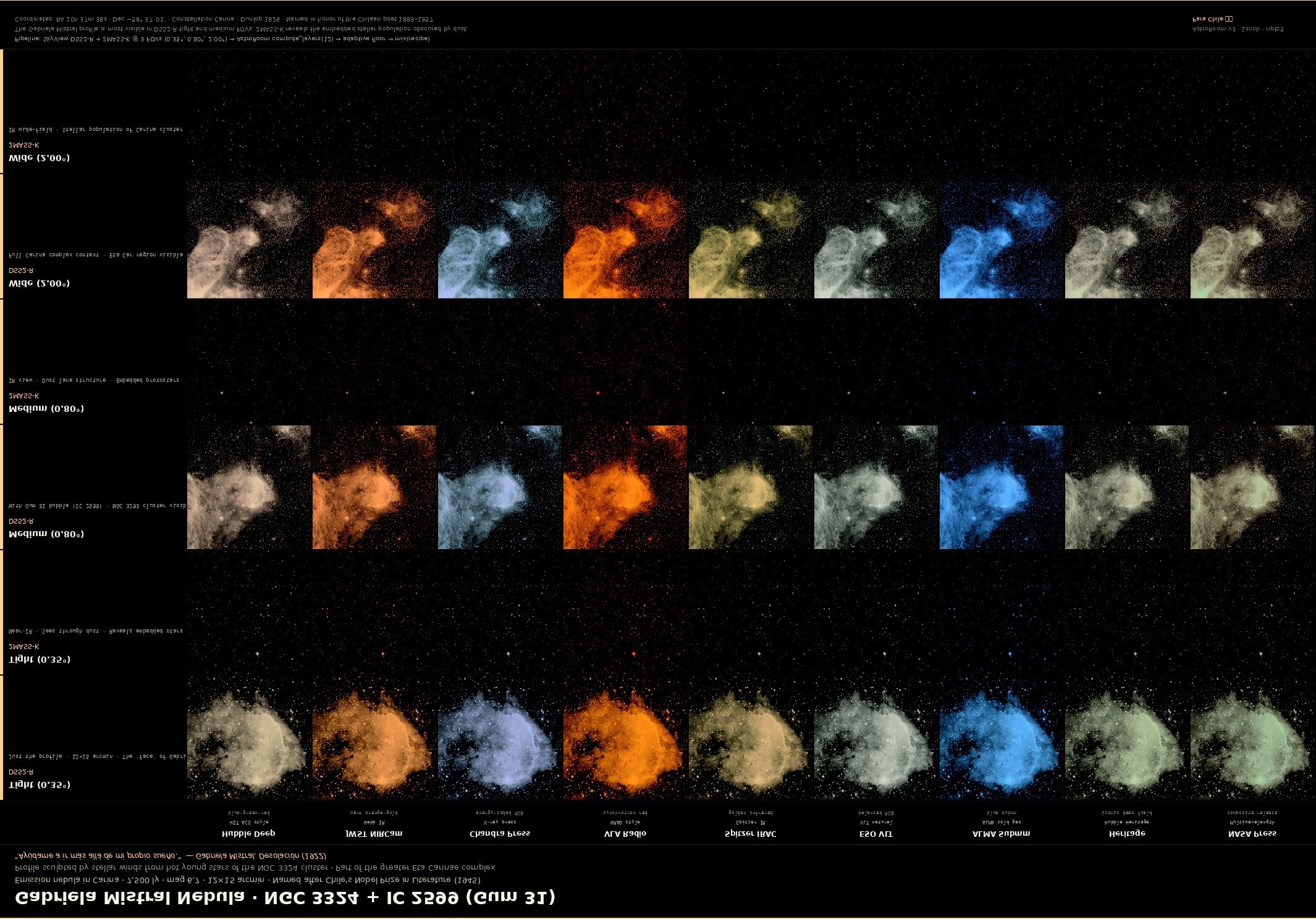 Sgr A* · Mistral
A tribute composite of the galactic centre, dedicated to the Chilean poet who wrote about the night sky as if it were a familiar room. Same FITS sources as the standard Sgr A* master; different recipe.
Thirty individual targets. Filter by band, scroll the grid, click any plate to open its provenance.
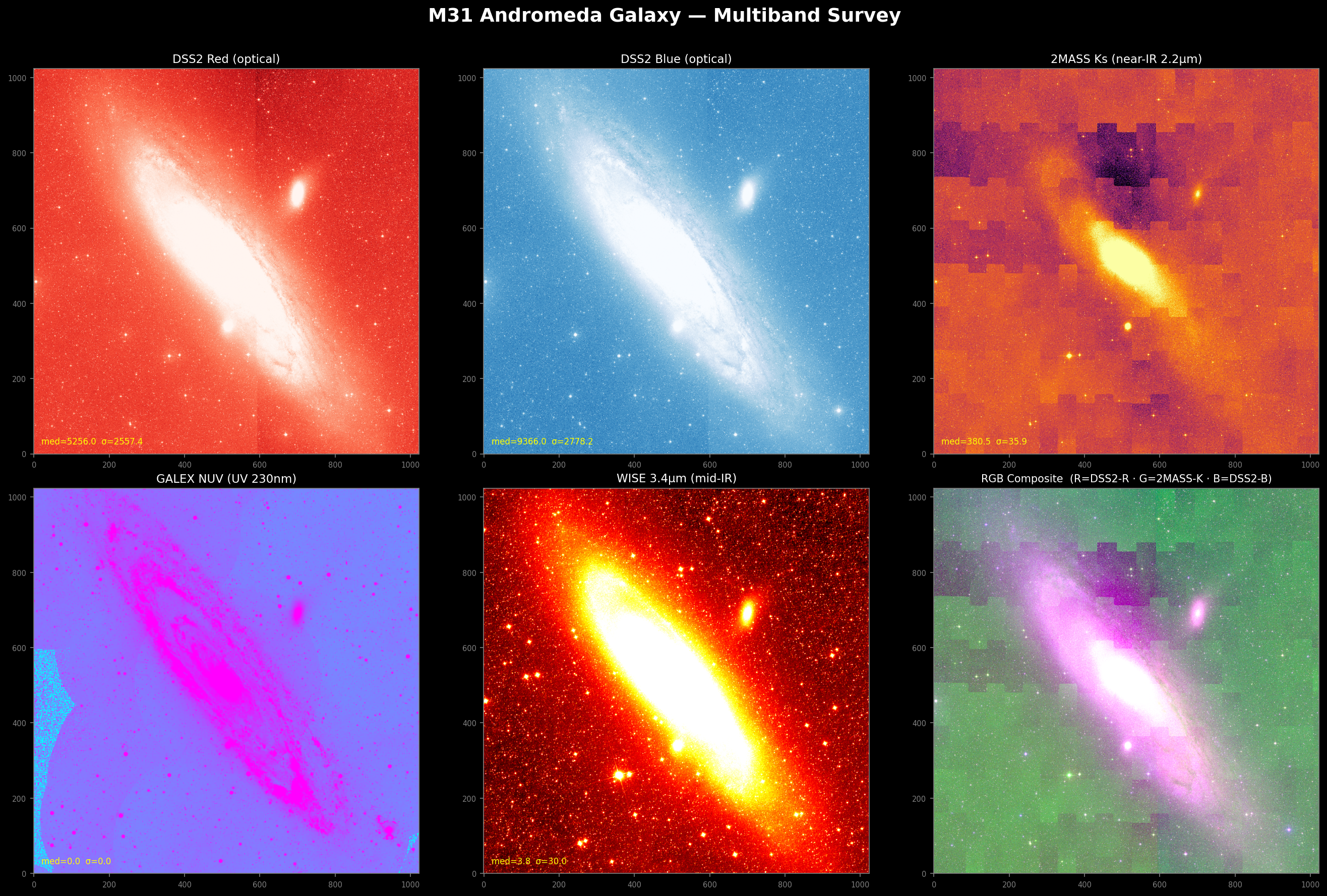 M31
M31The same galaxy in six wavelengths — optical red, optical blue, near-IR, ultraviolet, mid-IR, and a chosen RGB composite. Same dust, different witnesses.
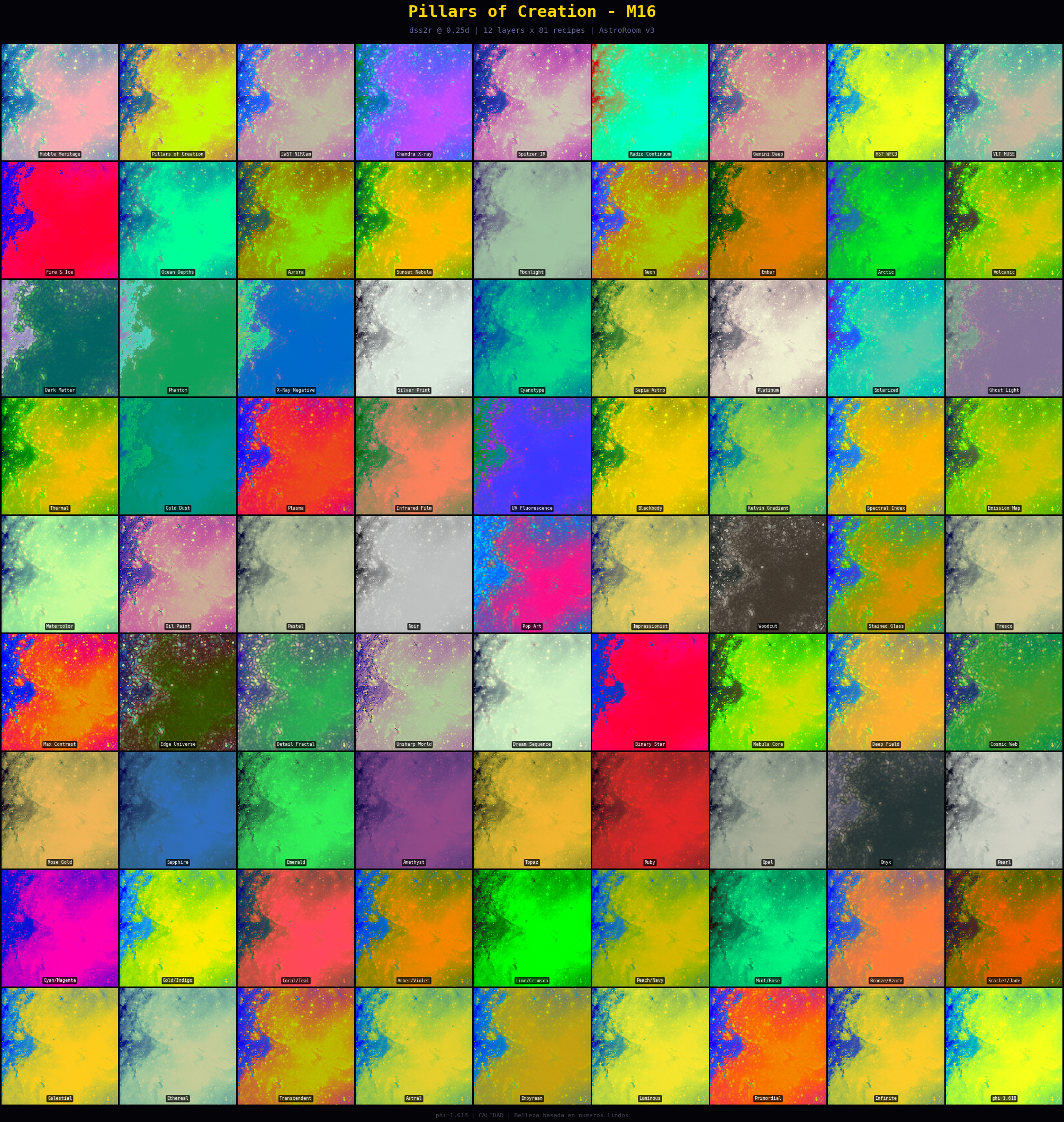 M16
M16The classic Hubble pillars, restacked from the public archive. The hottest star in the cluster is what's eating the columns from above; the youngest are still forming inside them.
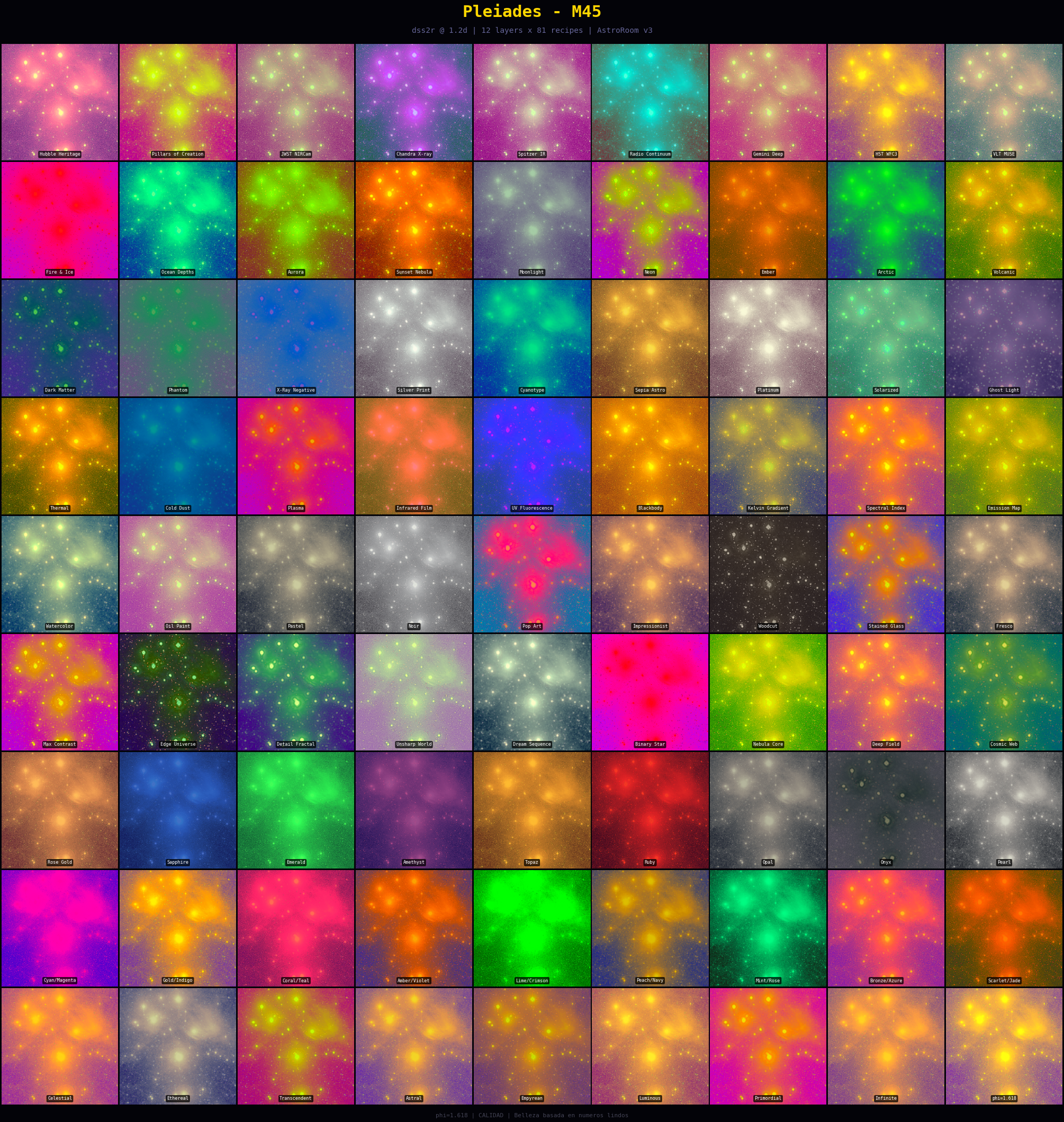 M45
M45Reflection nebulosity in the seven sisters' bow shock. The cluster is moving, fast enough that the dust looks like wake.
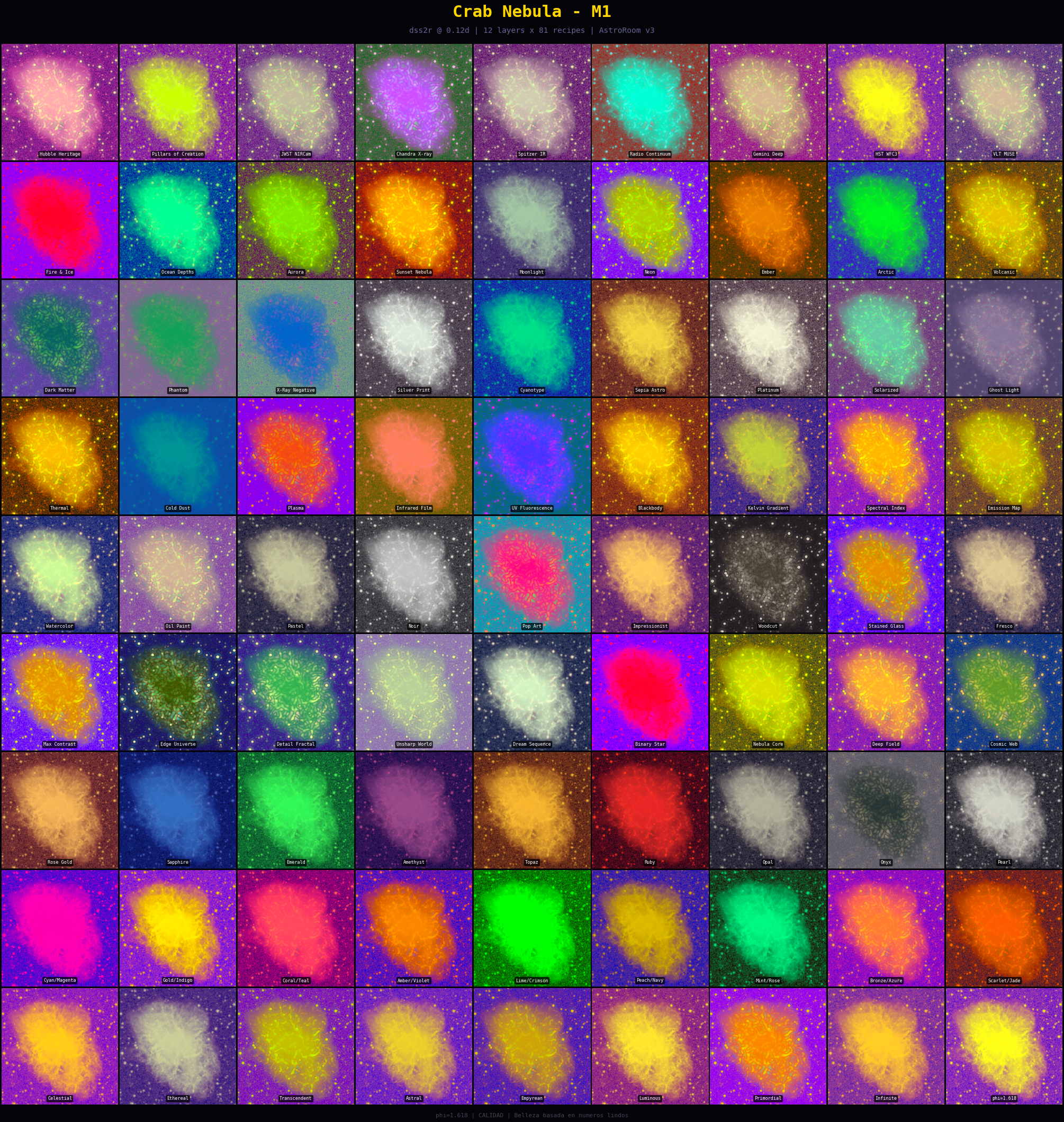 Crab
CrabSynchrotron radiation from the supernova remnant of 1054. The yellow knot at the centre is the corpse of the star; it ticks every thirty-three milliseconds.
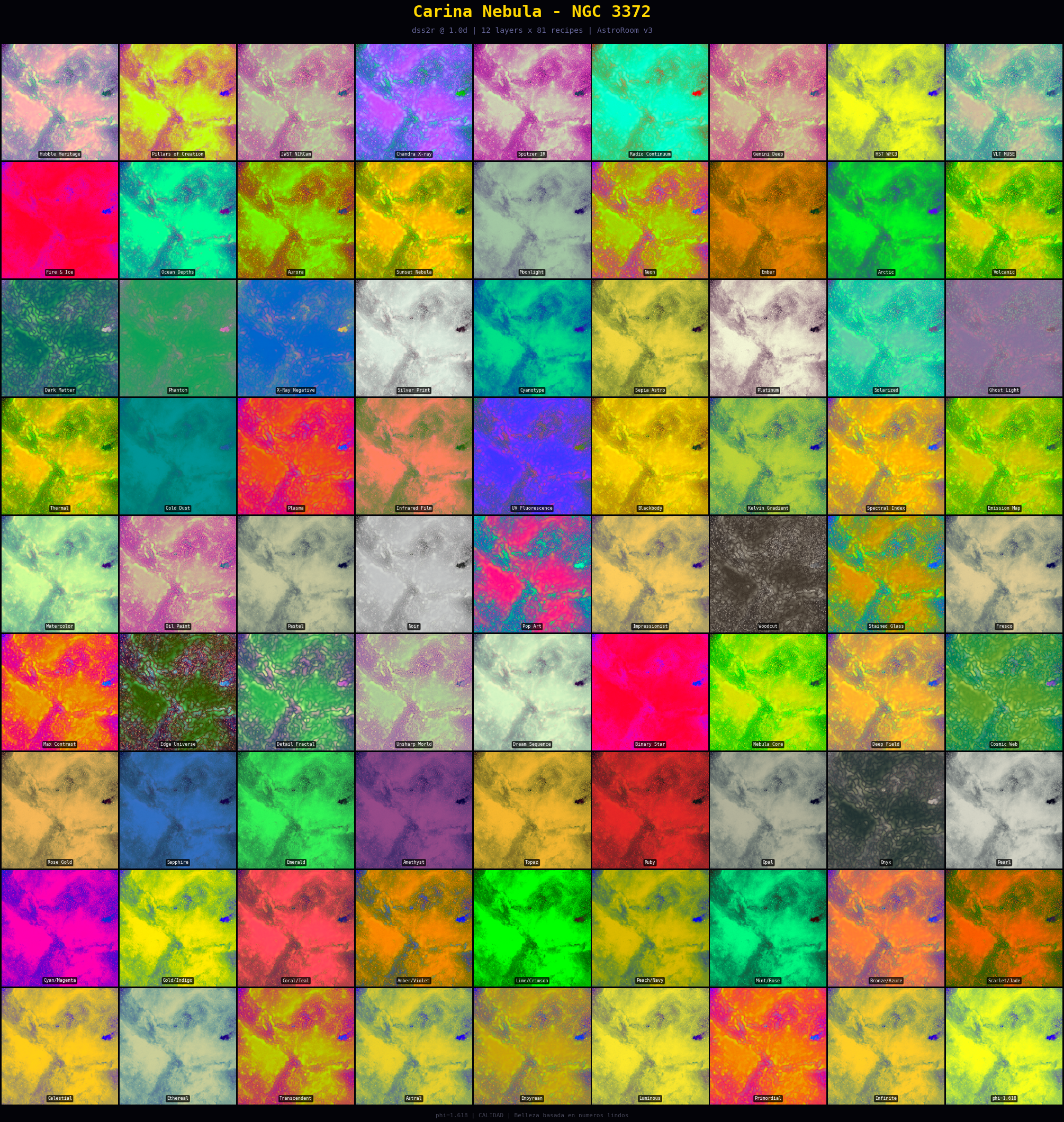 NGC 3372
The luminous blue variable Eta Carinae lives inside the bright knot. It nearly went supernova in the 1840s and is still deciding whether to finish the job.
 Cen A
Cen ANGC 5128 in X-ray. The dust lane is half a billion years old — a fossil of the merger that formed the present galaxy. The bright nucleus is the AGN feeding the central black hole.
 M87
M87Forty-seven Chandra obsids merged into one event file. The jet of M87's central engine, lit in photons that travelled fifty-five million years to reach the chip.
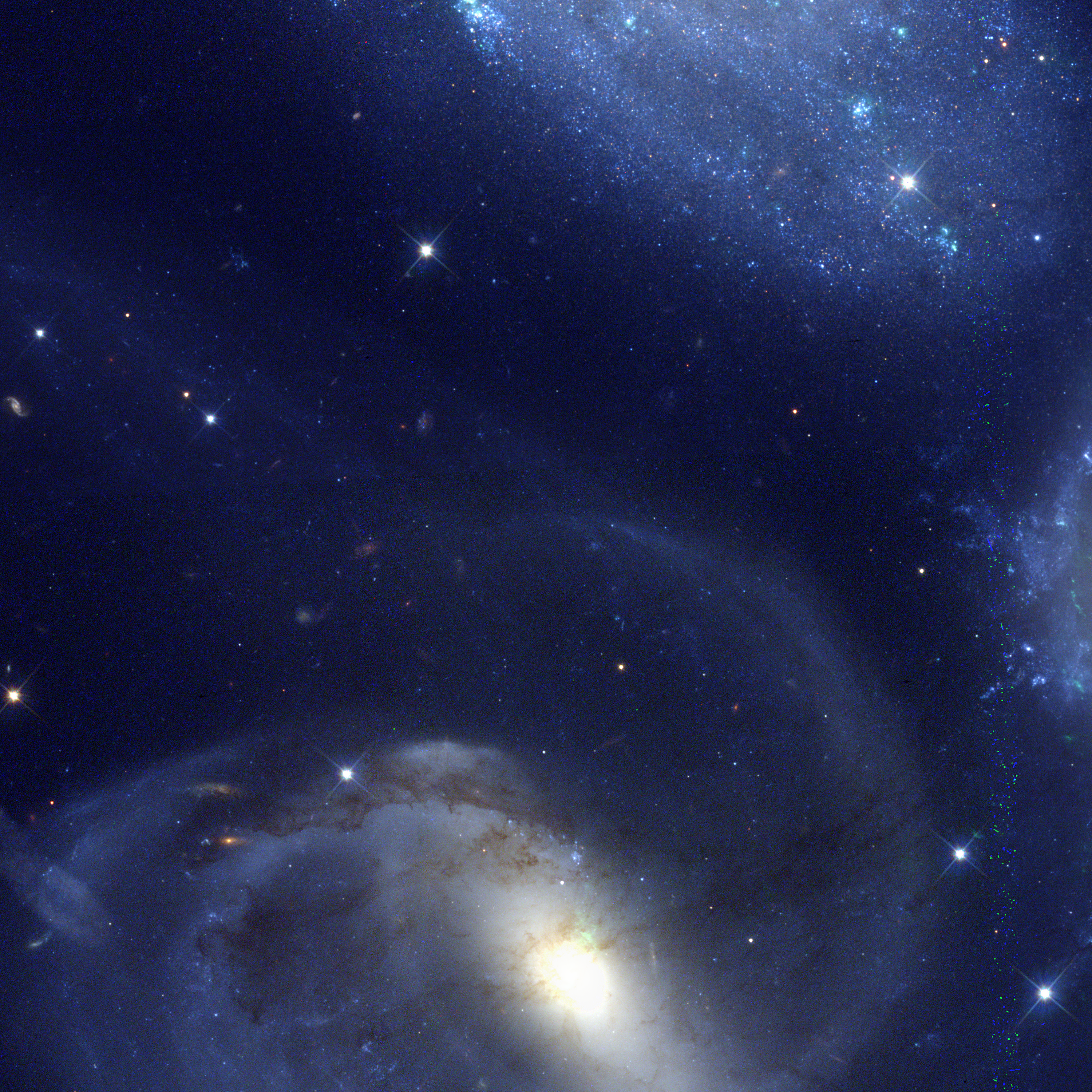 SQ
SQA megastack of public JWST exposures. Four of the five are gravitationally bound; one is a foreground impostor that just shares the line of sight.
The galactic centre over three decades of Chandra observation, annotated. The flares are real. The orbital tracks are ours.
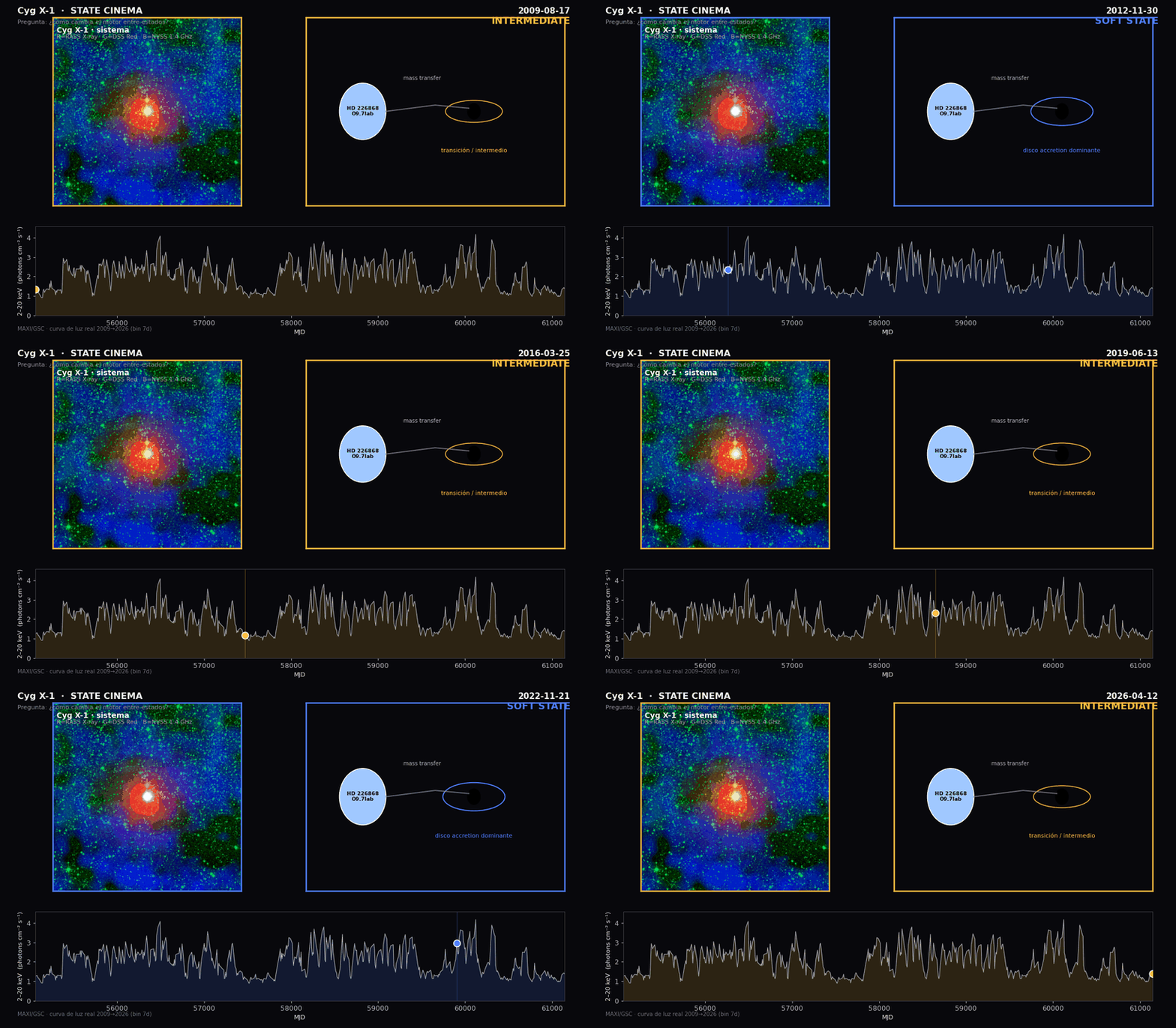 Cyg X-1
A stellar-mass black hole binary across a decade of state changes. Each frame is a different observation; the colour map is the spectral hardness ratio.
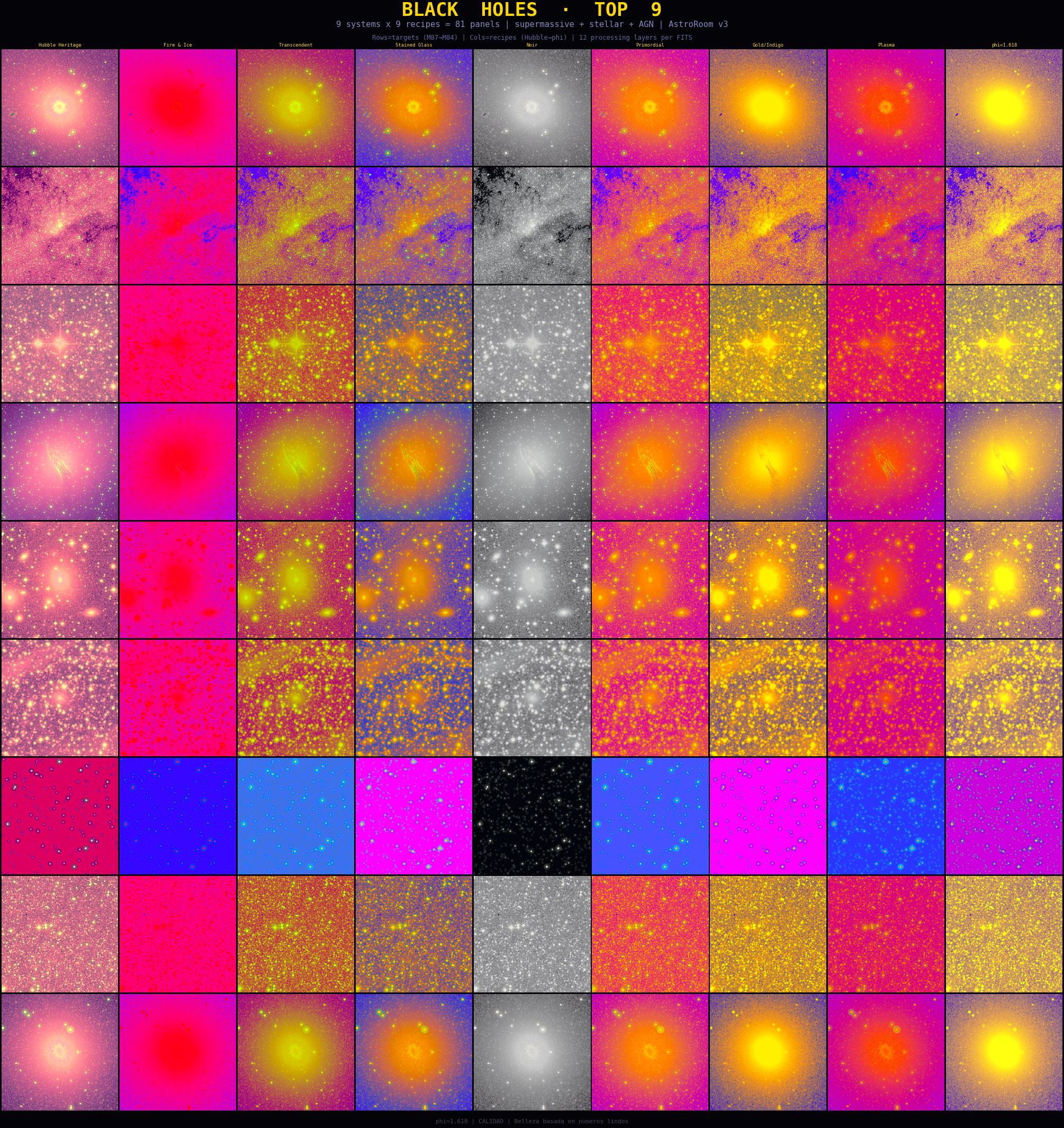 Atlas
AtlasA condensed atlas. Nine of the most observable black holes in the sky, each in nine of the recipe library's families.
B33Sixteen optical and infrared frames stacked into the iconic silhouette. The dust lane reads red against the IC 434 emission.
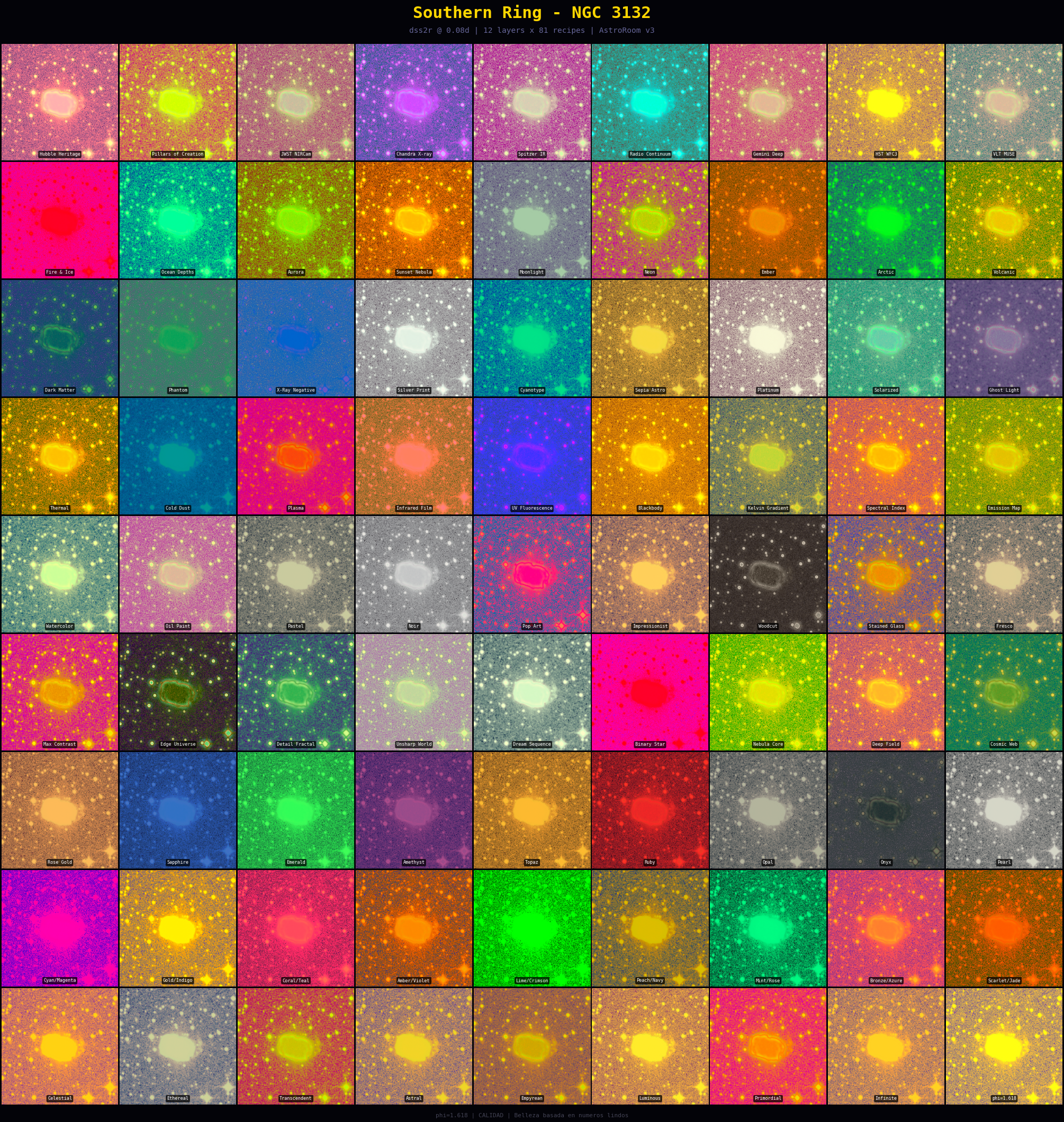 NGC 3132
NGC 3132 — a planetary nebula caught in the act of expansion. Two stars at the centre, only one of which is the source of the shell.
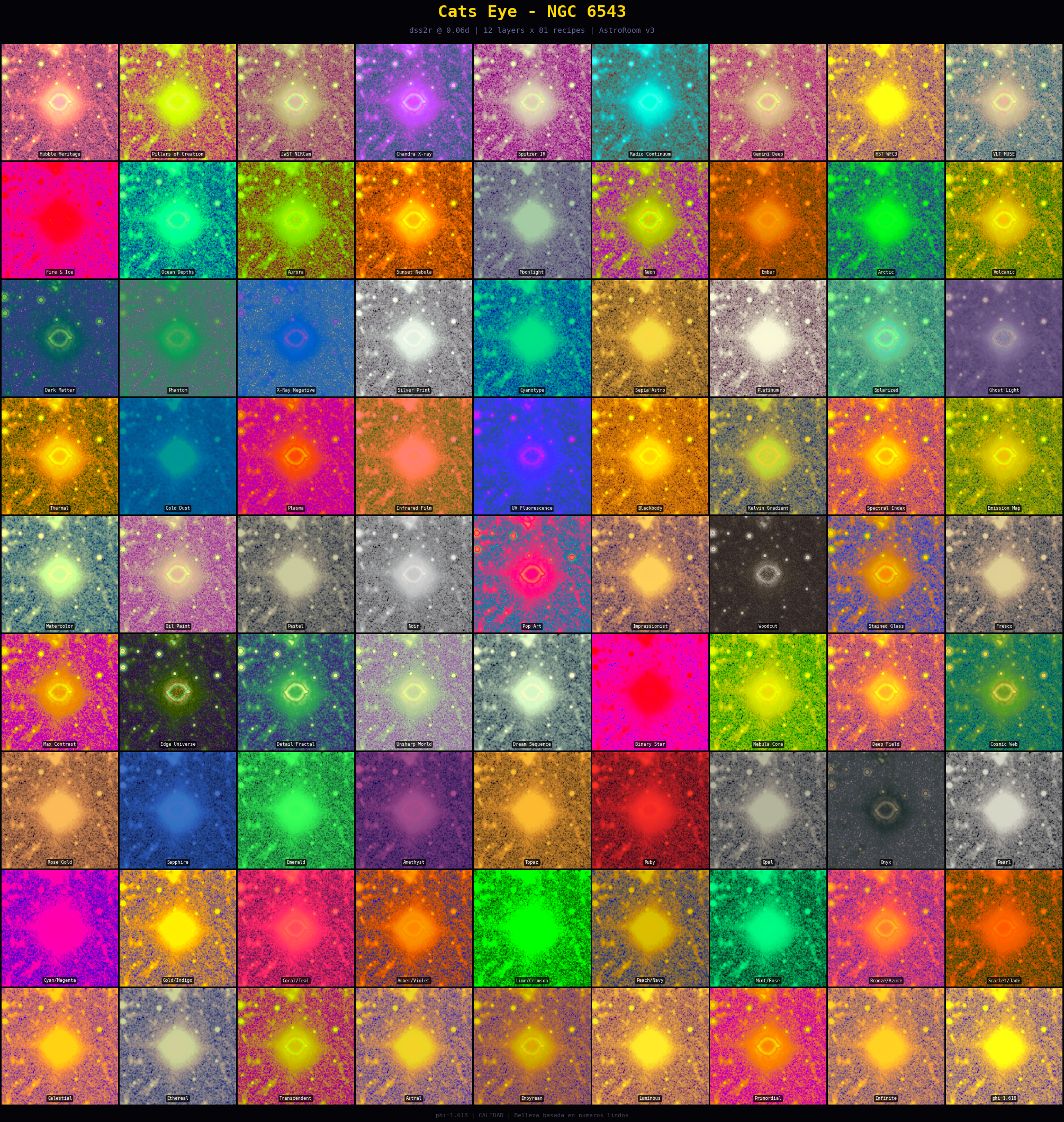 NGC 6543
One of the most structurally complex planetary nebulae known. The concentric shells are episodic mass loss from the dying central star — one shell every fifteen hundred years.
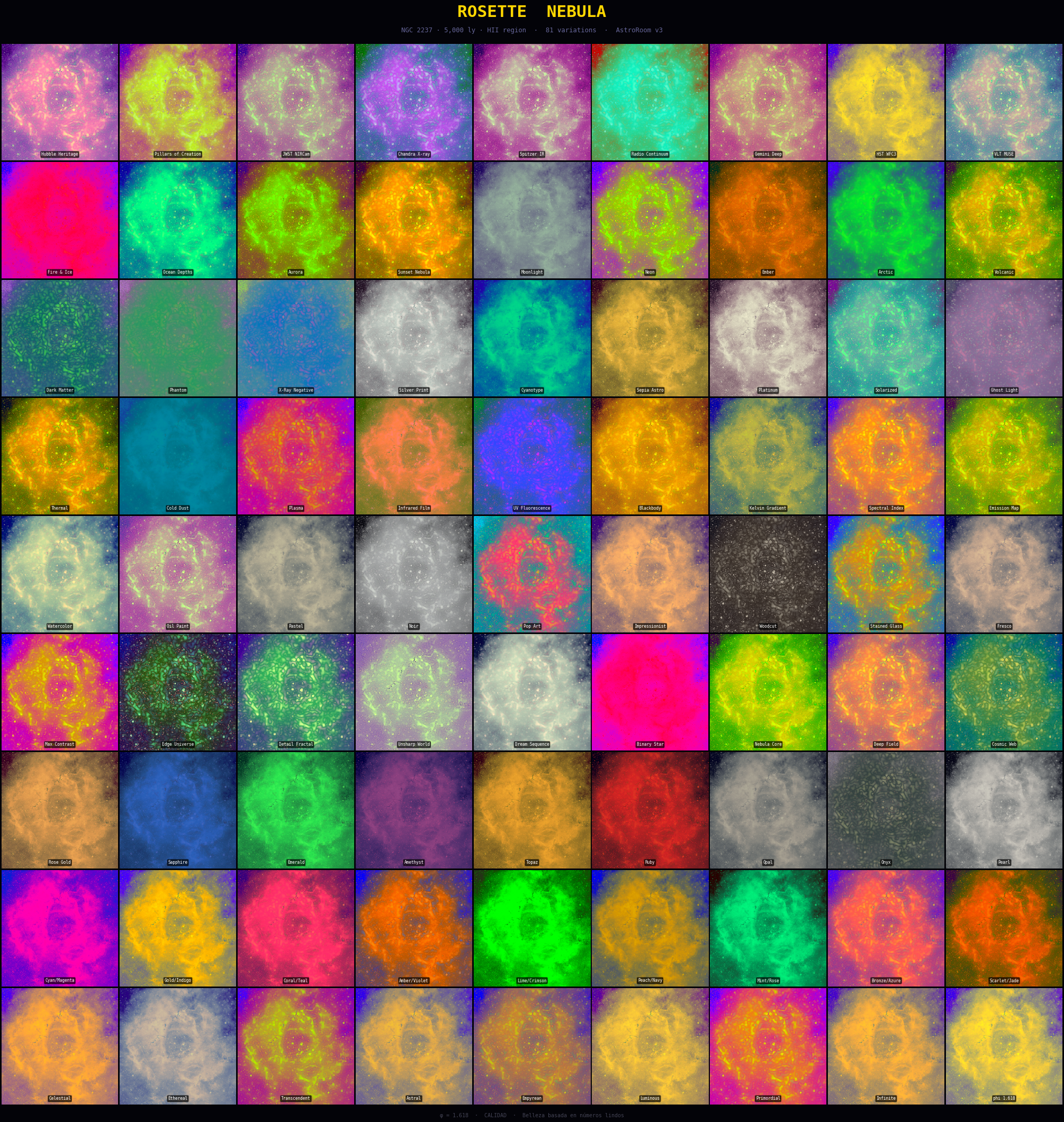 NGC 2237
An H II region around the open cluster NGC 2244. The cluster carved the cavity. The rim glows because it is being ionised by the brightest stars at the centre.
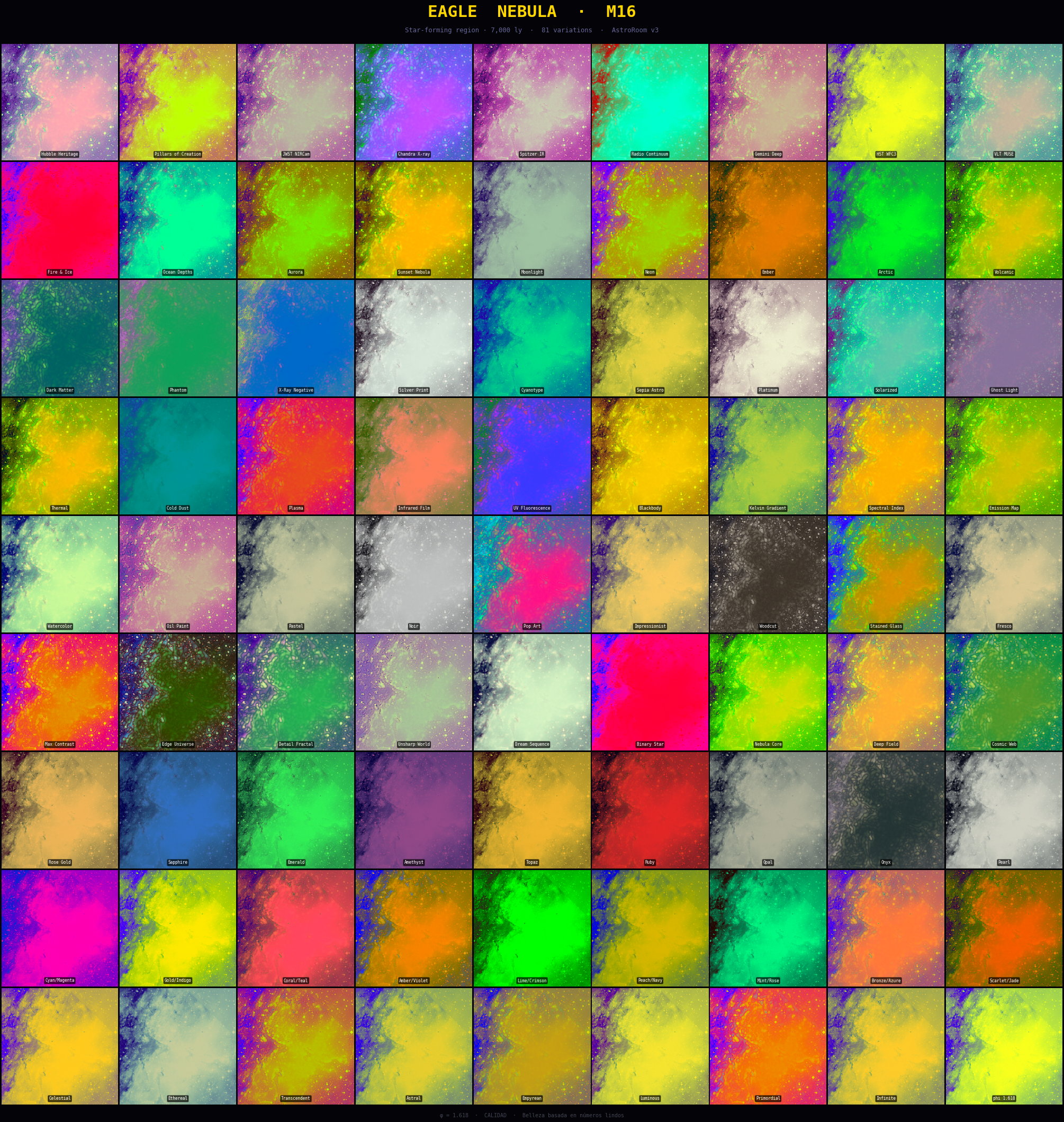 M16
M16The Pillars of Creation in their context. The full M16 H II region; the pillars themselves are a small dark feature near the centre.
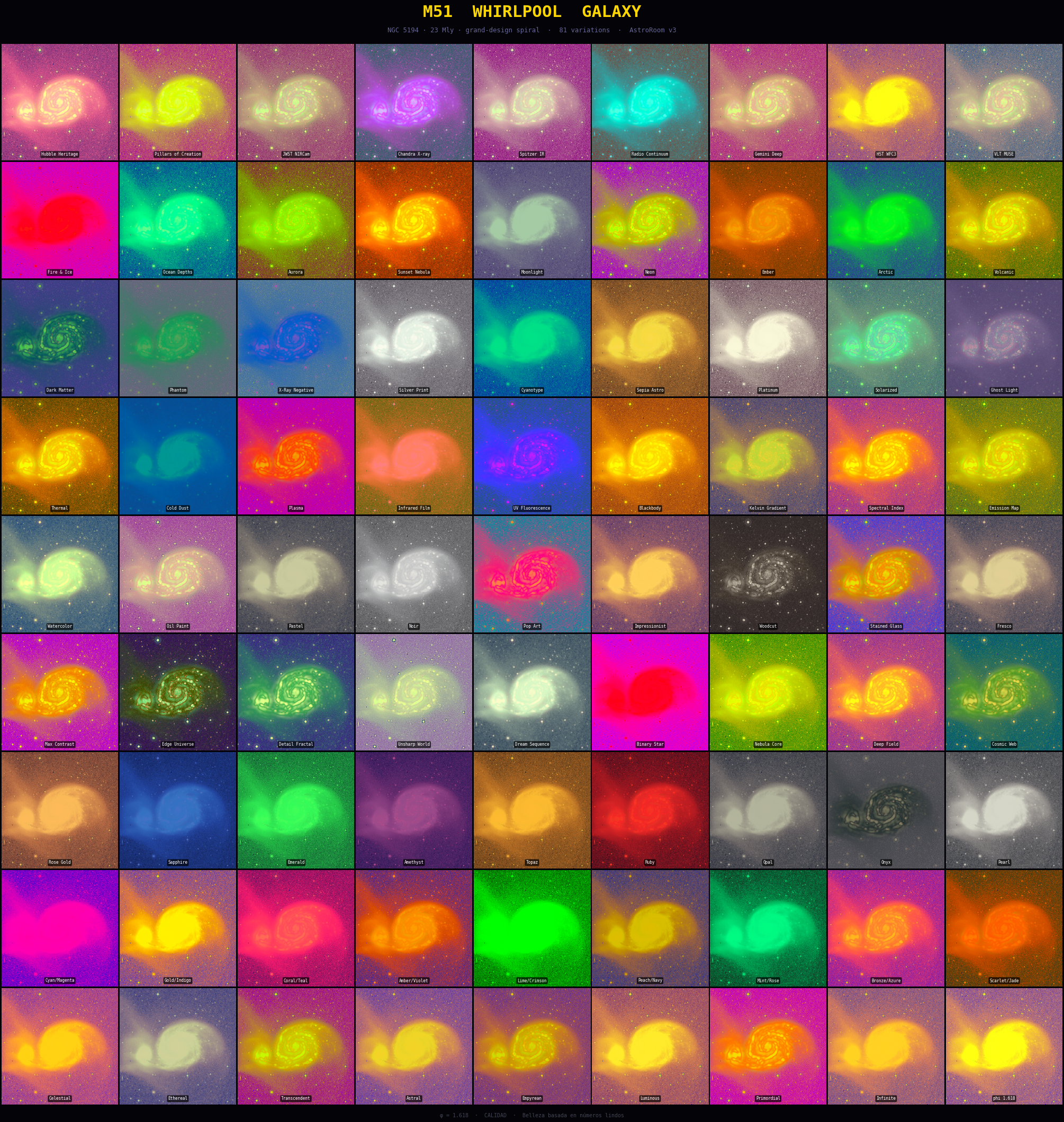 M51
M51M51 mid-merger with NGC 5195. The grand-design spiral structure is almost certainly enhanced by the gravitational disturbance from the smaller companion.
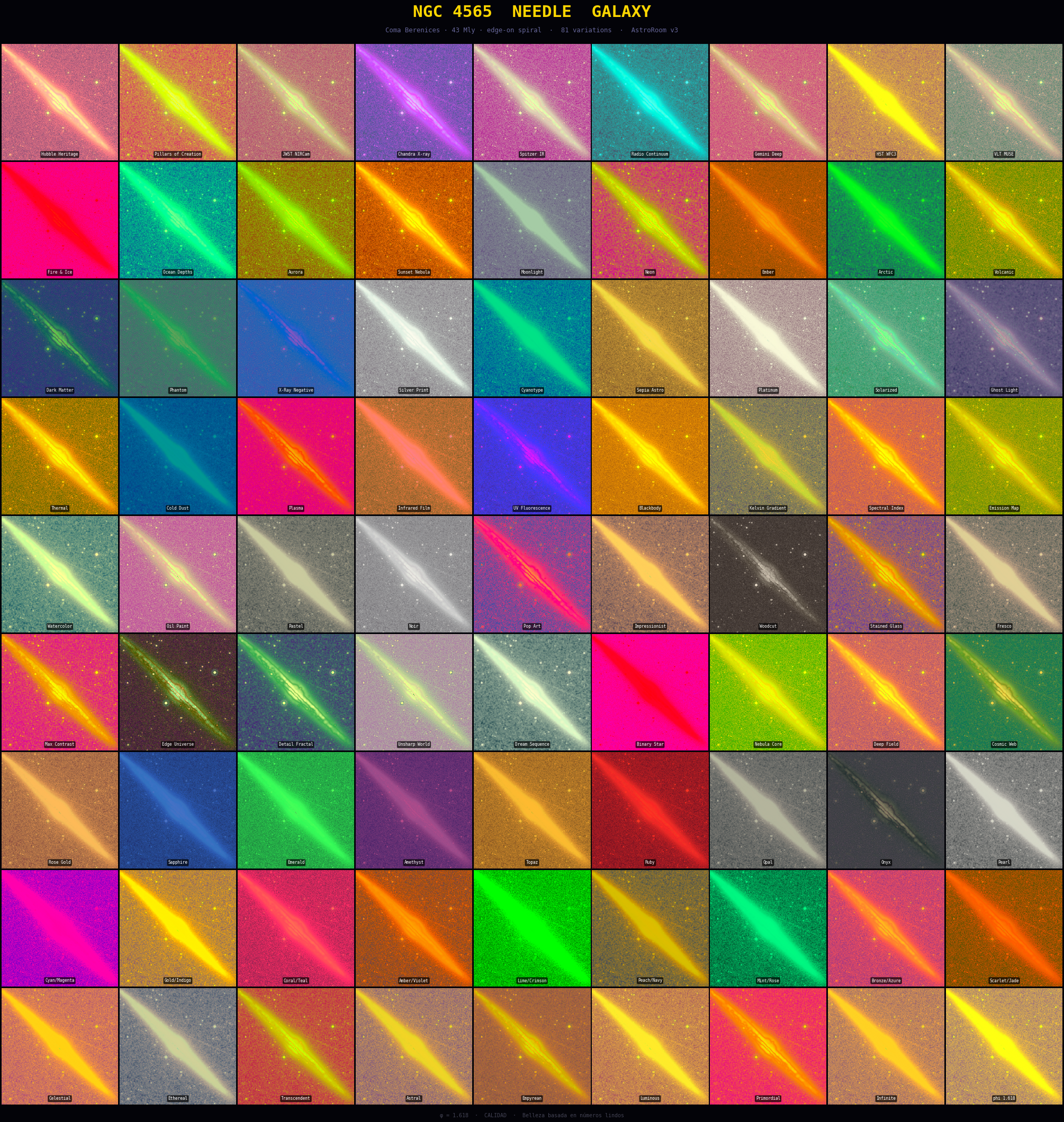 NGC 4565
An edge-on spiral with a dust lane drawn so straight it looks engraved. Forty million light-years away, in Coma Berenices.
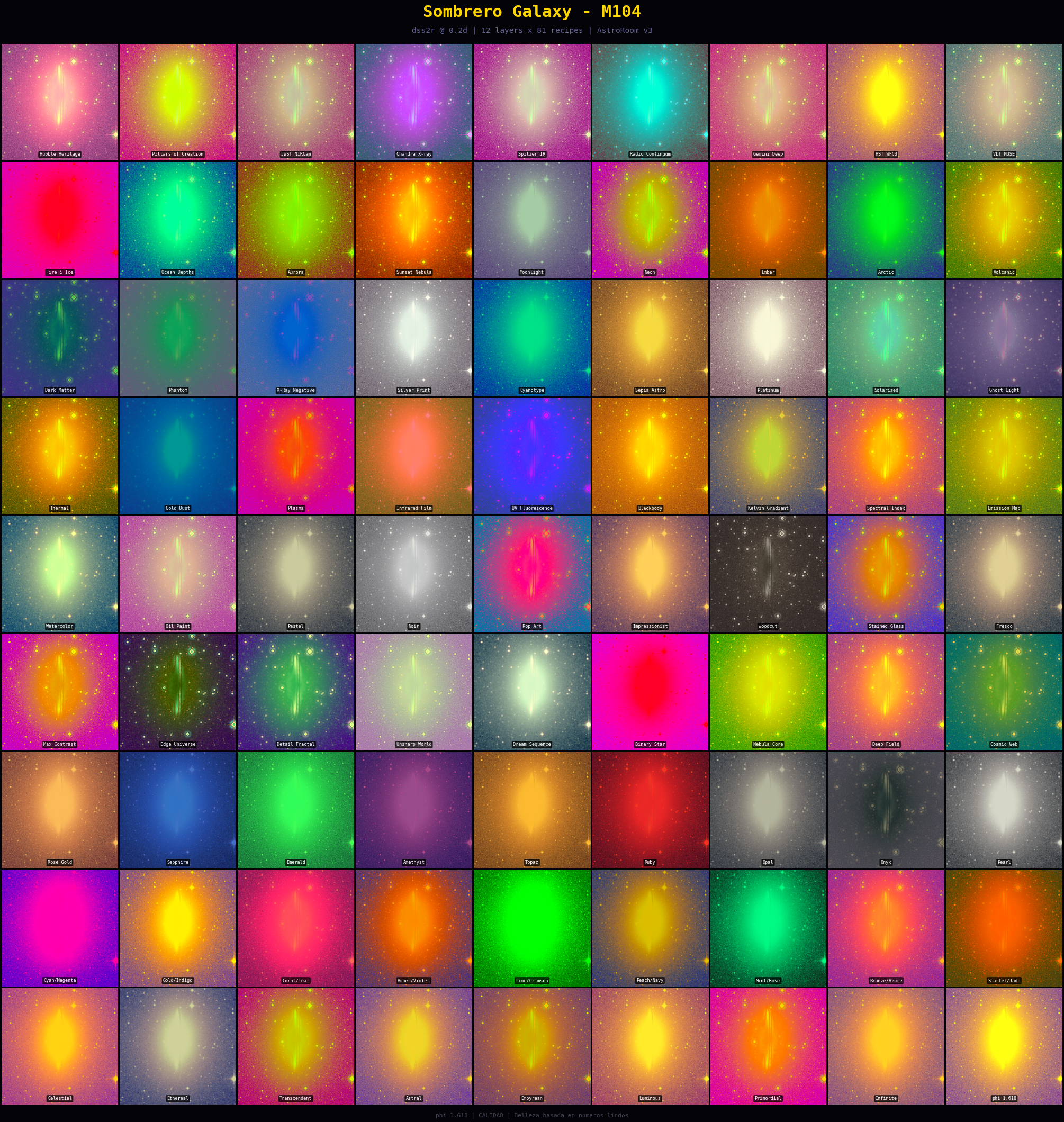 M104
M104An almost edge-on spiral with a bulge so massive it dominates the silhouette. The dust ring is the disc, seen at six degrees of inclination.
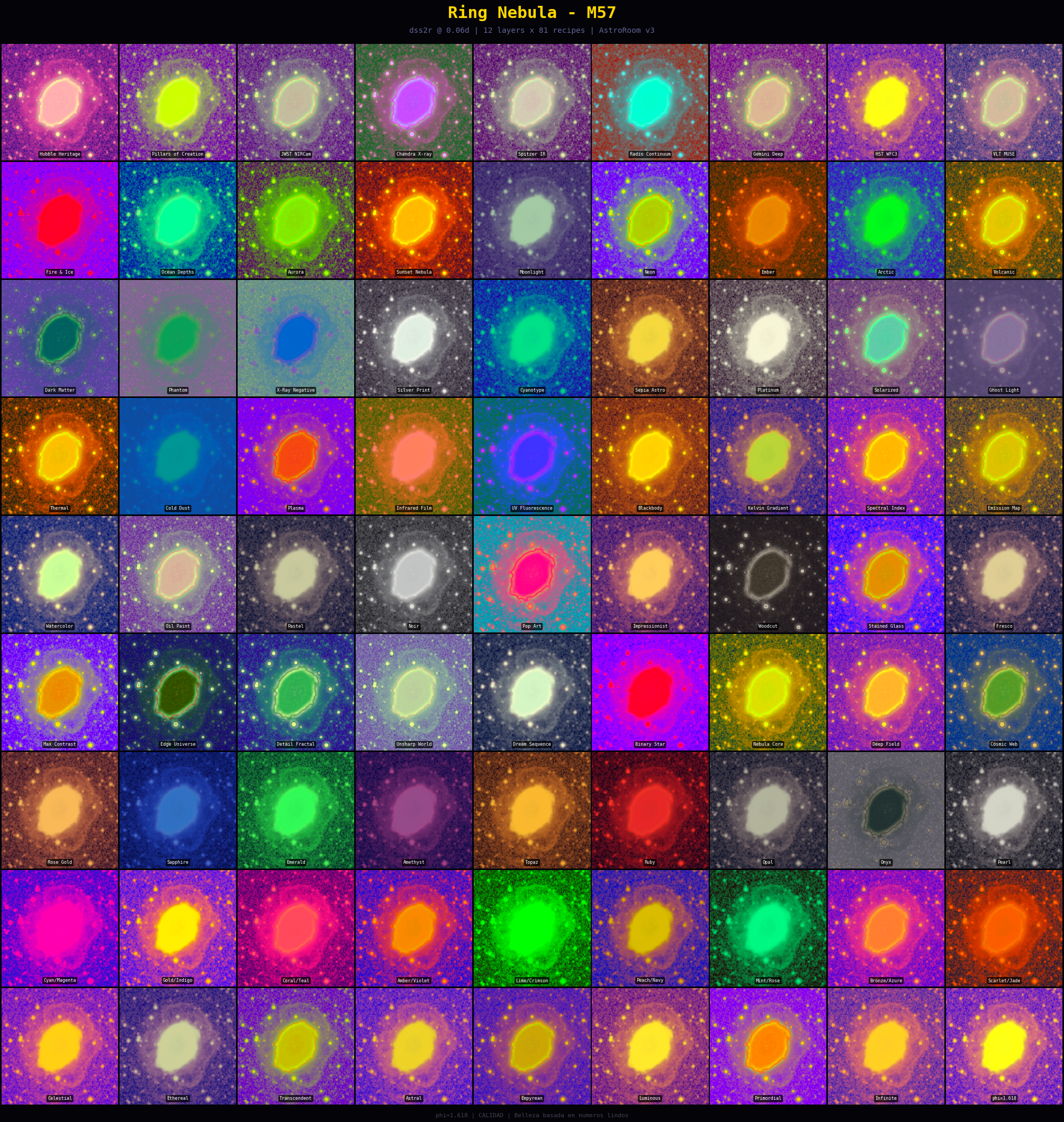 M57
M57M57 in Lyra. A barrel-shaped shell of ionised gas seen end-on, which is why it reads as a ring. The white dwarf at the centre is what's left of the star.
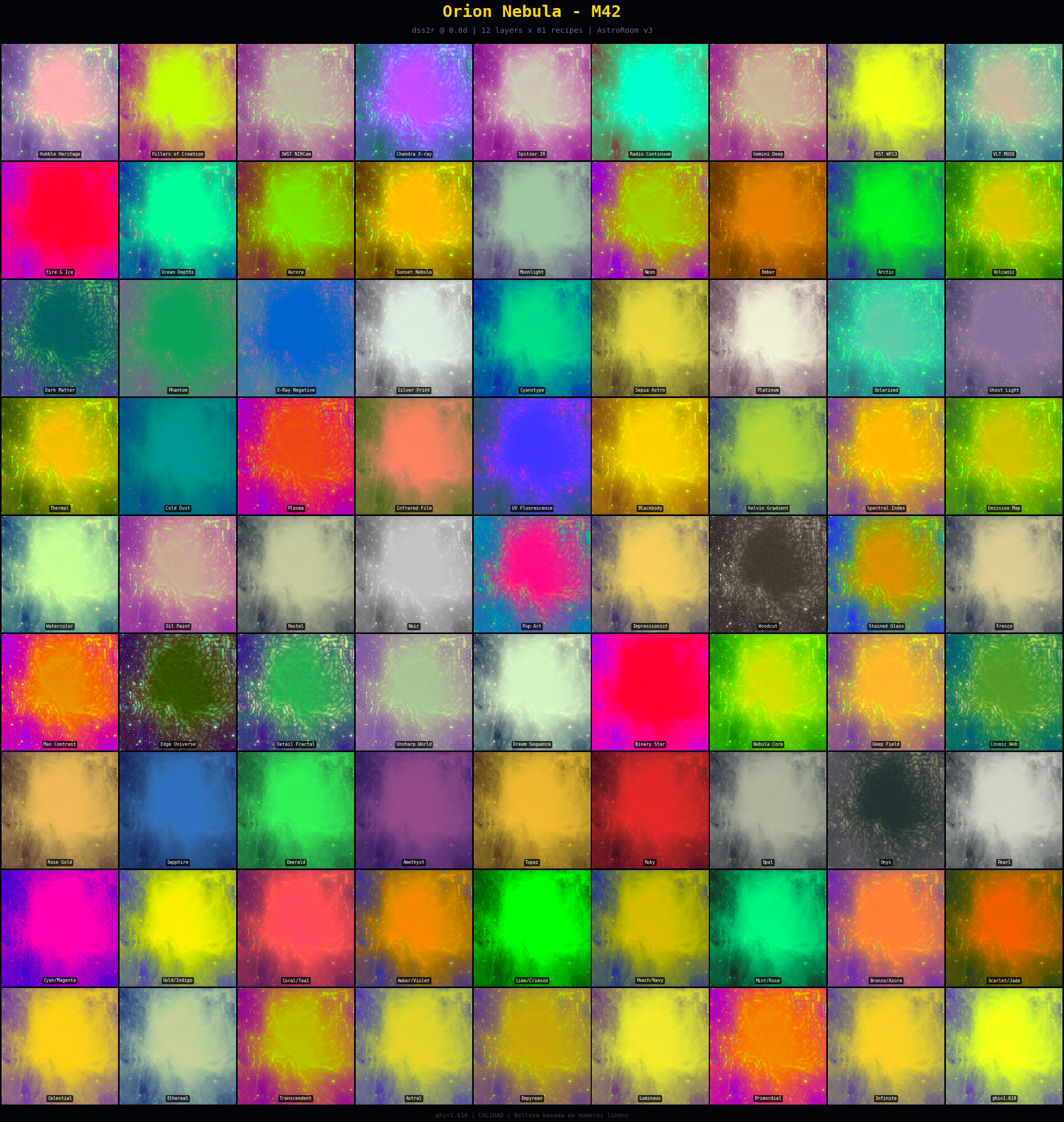 M42
M42The closest large stellar nursery, and the first object most people learn to point at without a finder. The Trapezium cluster sits inside the brightest knot.
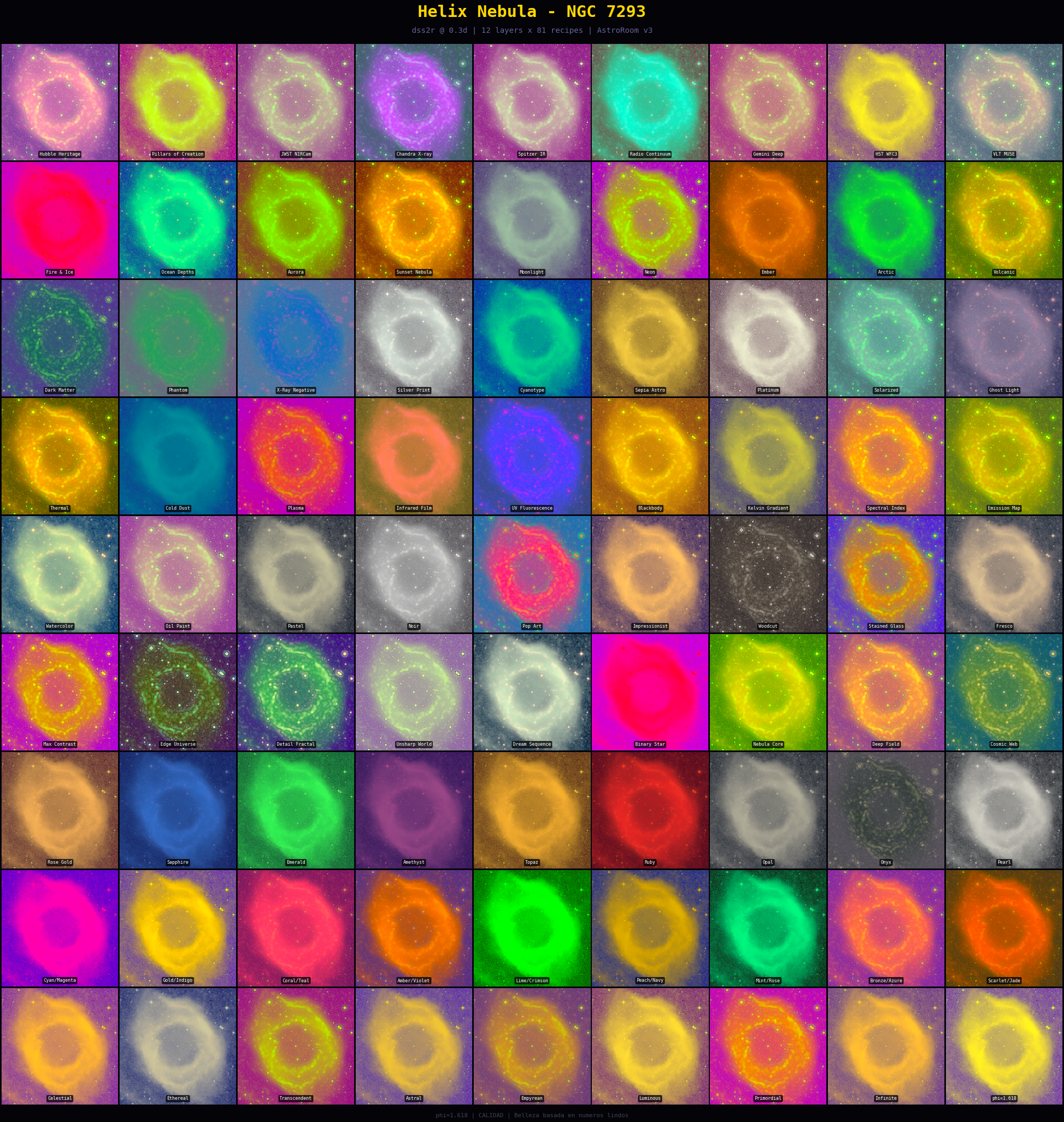 NGC 7293
The closest planetary nebula to Earth. The "cometary knots" along the inner edge are aerodynamic features — the dying star's wind sculpting denser blobs of gas.
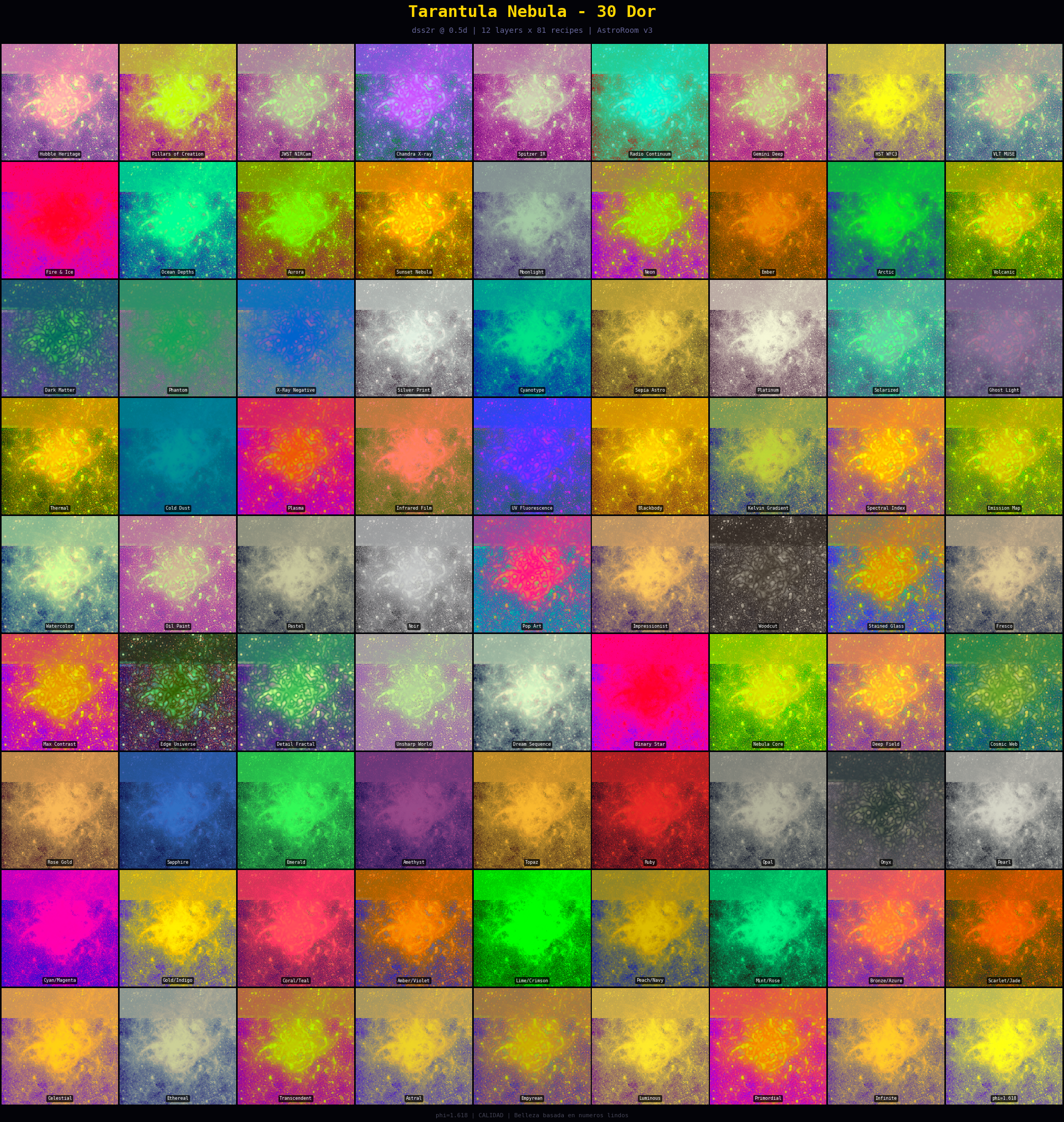 30 Dor
The largest known stellar nursery in the Local Group, in the Large Magellanic Cloud. R136a1 — the most massive known star — sits inside the central cluster.
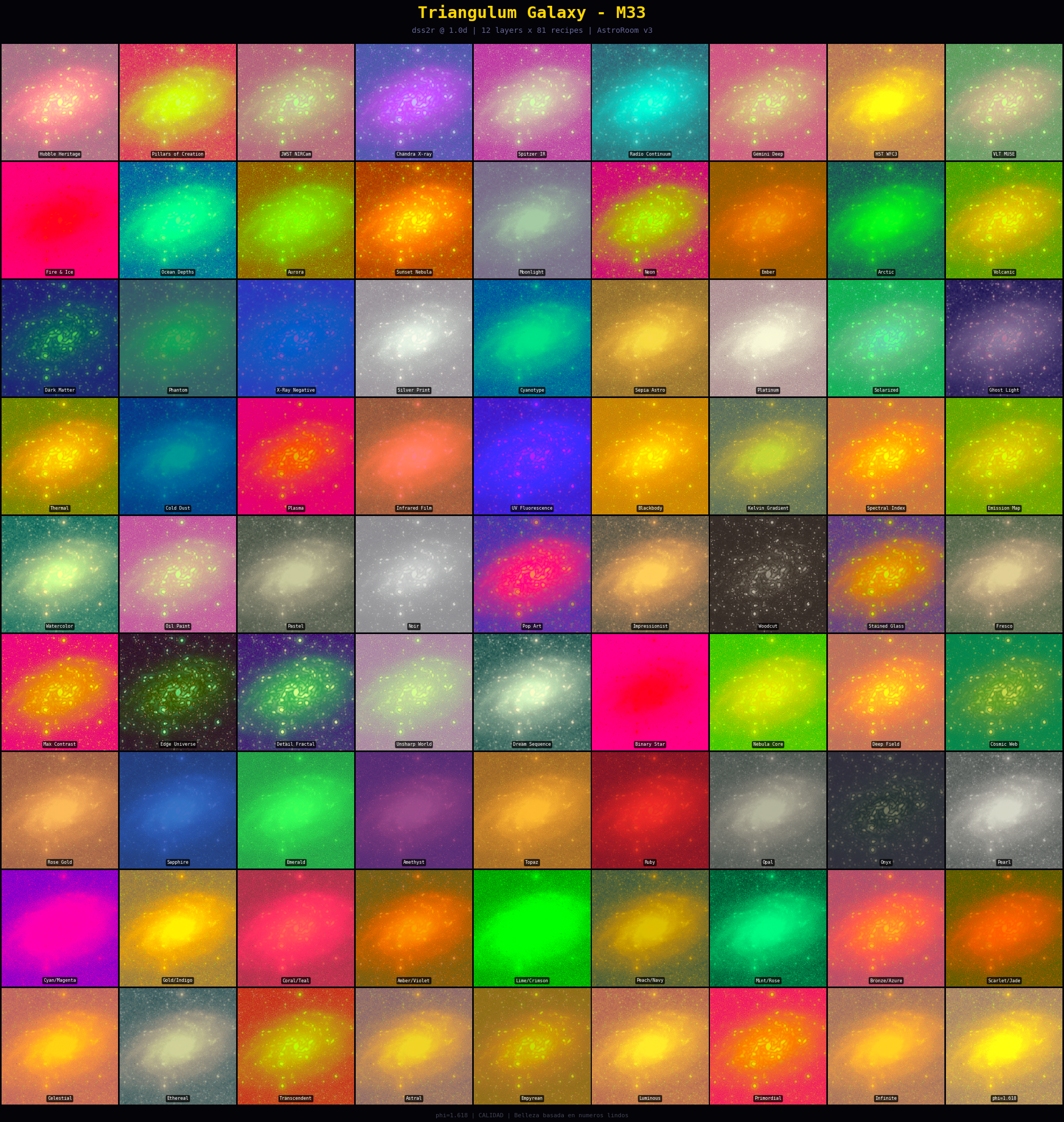 M33
M33Third-largest galaxy in the Local Group, behind Andromeda and our own. The pinwheel structure is unusually clean; the H II regions trace the spiral arms.
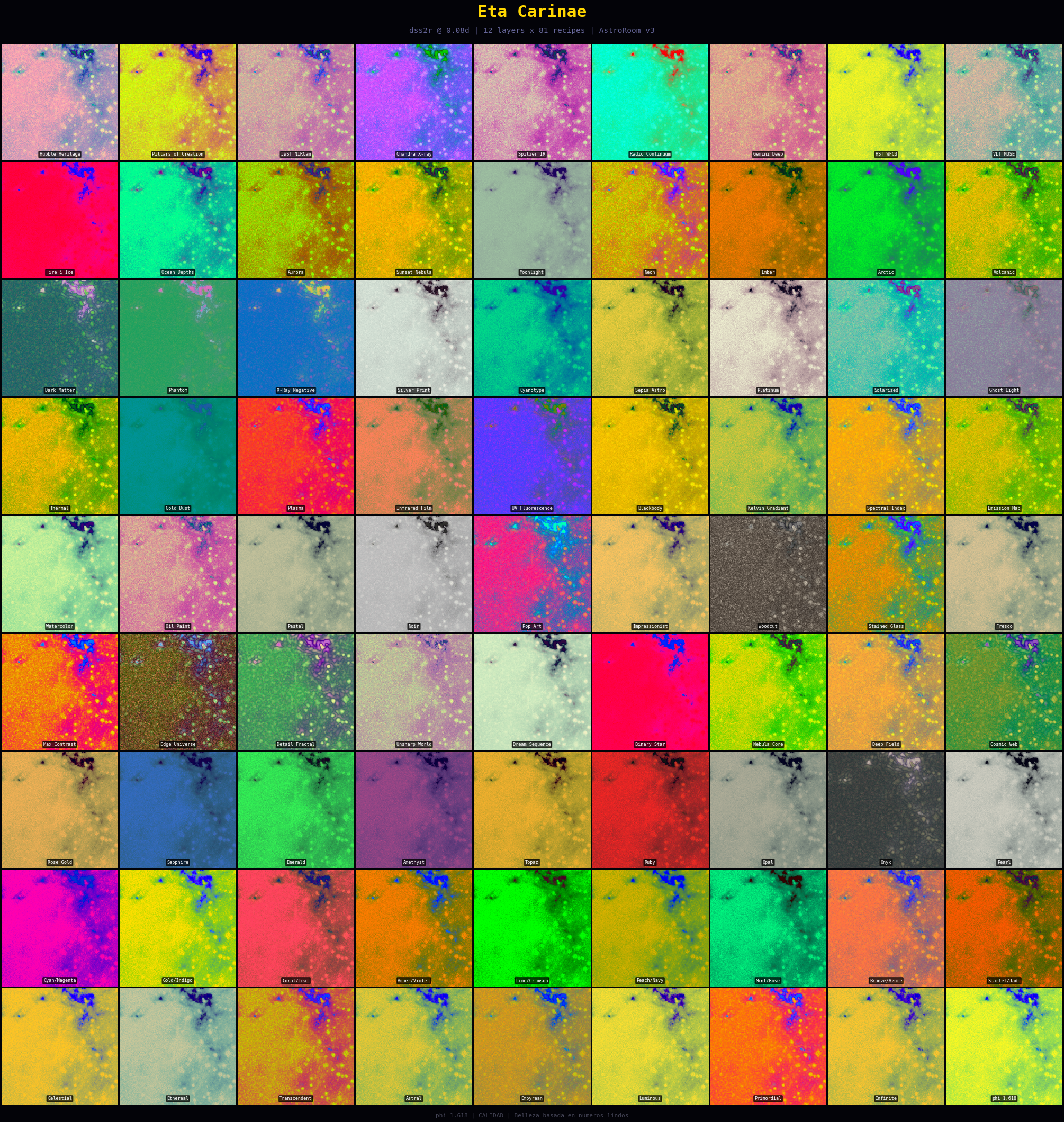 η Car
η CarThe bipolar shell ejected during the Great Eruption of the 1840s. The star at the centre is still alive, still a luminous blue variable, still on track to go supernova at some point.
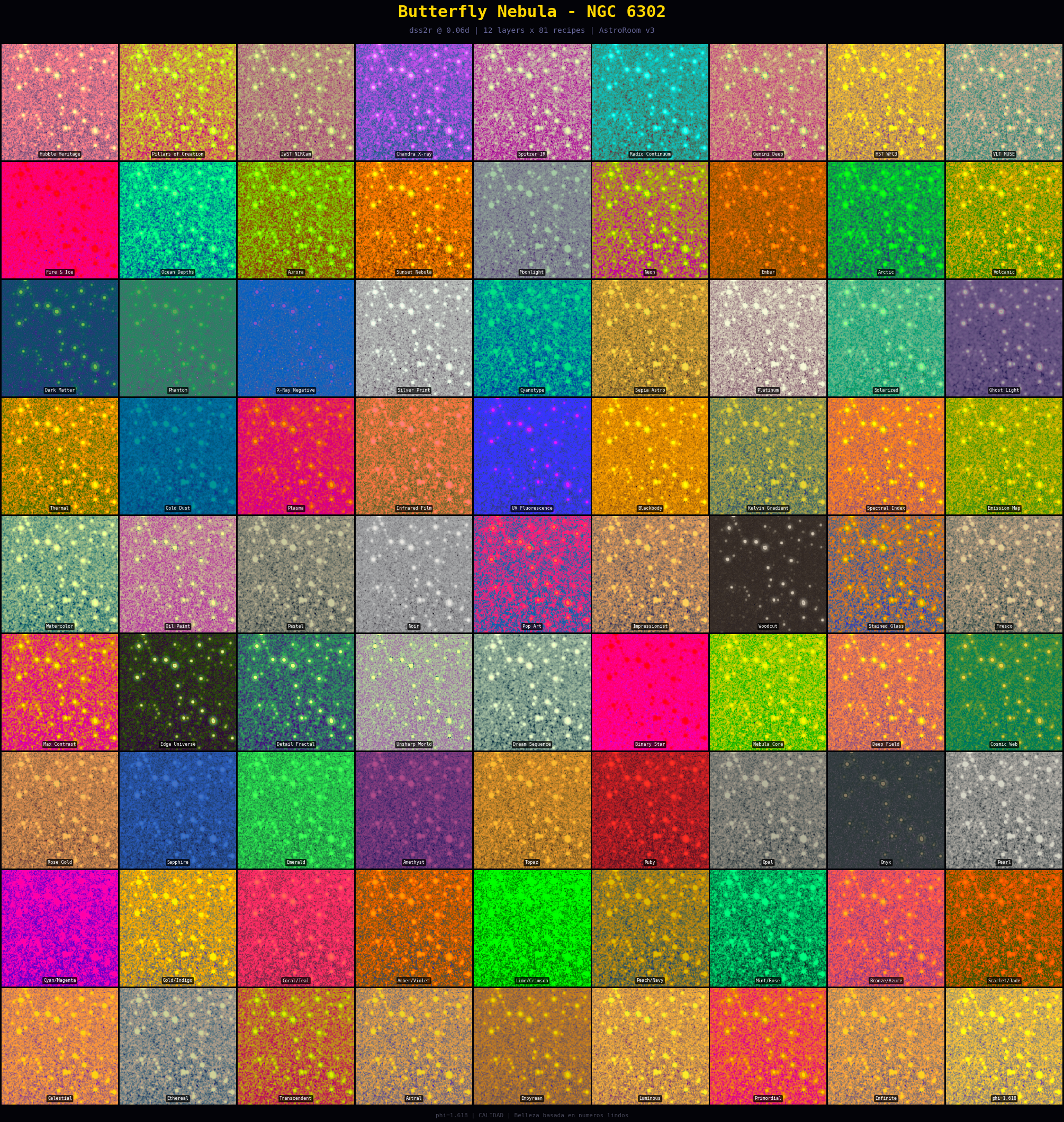 NGC 6302
A bipolar planetary nebula with a central star at over 200,000 K — among the hottest known. The wings are gas at thousands of degrees, lit by stellar-wind shocks.
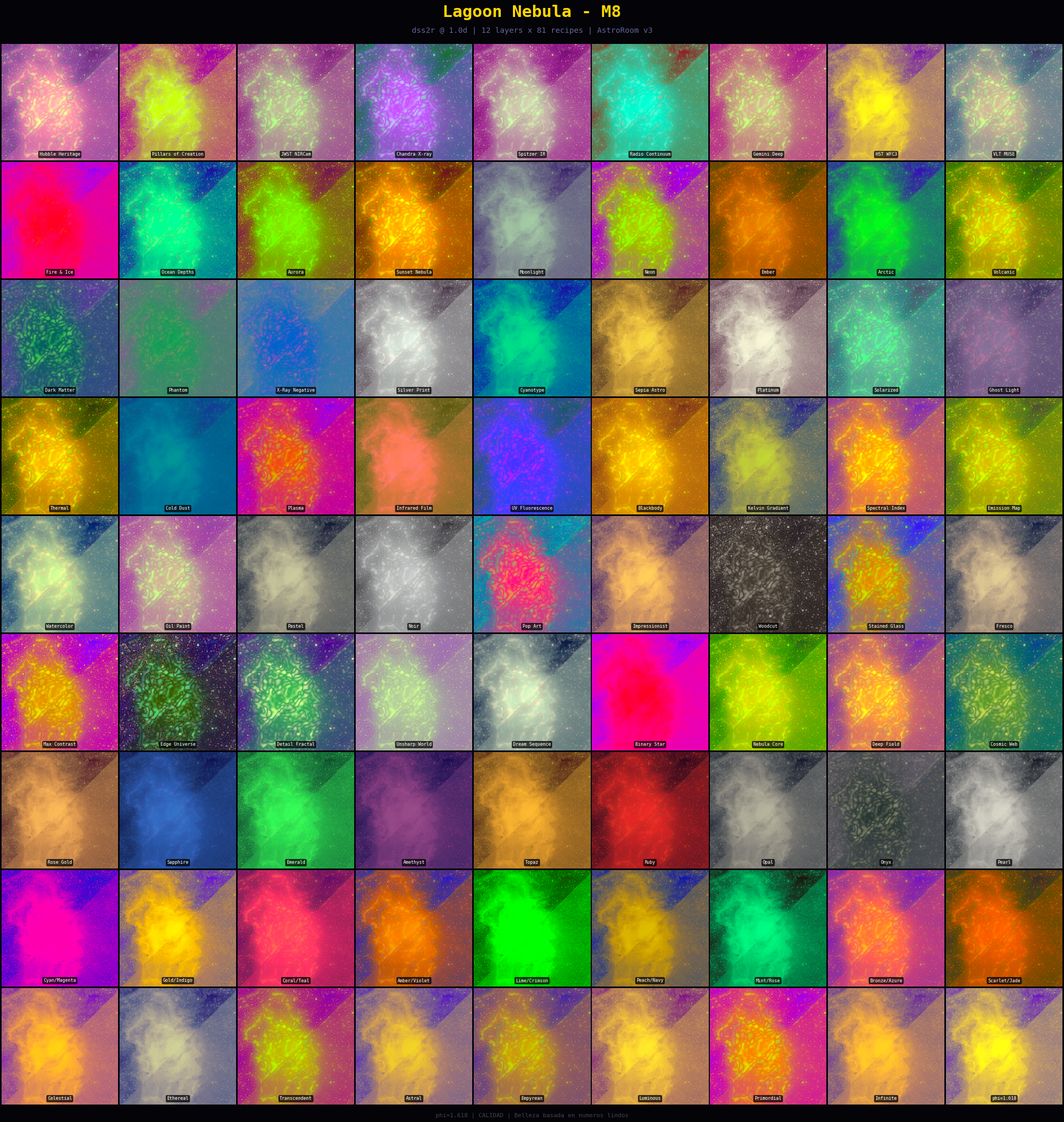 M8
M8An H II region in Sagittarius with the cluster NGC 6530 at its core. The "hourglass" tornado of gas at the centre is being shaped by a single hot O-type star.
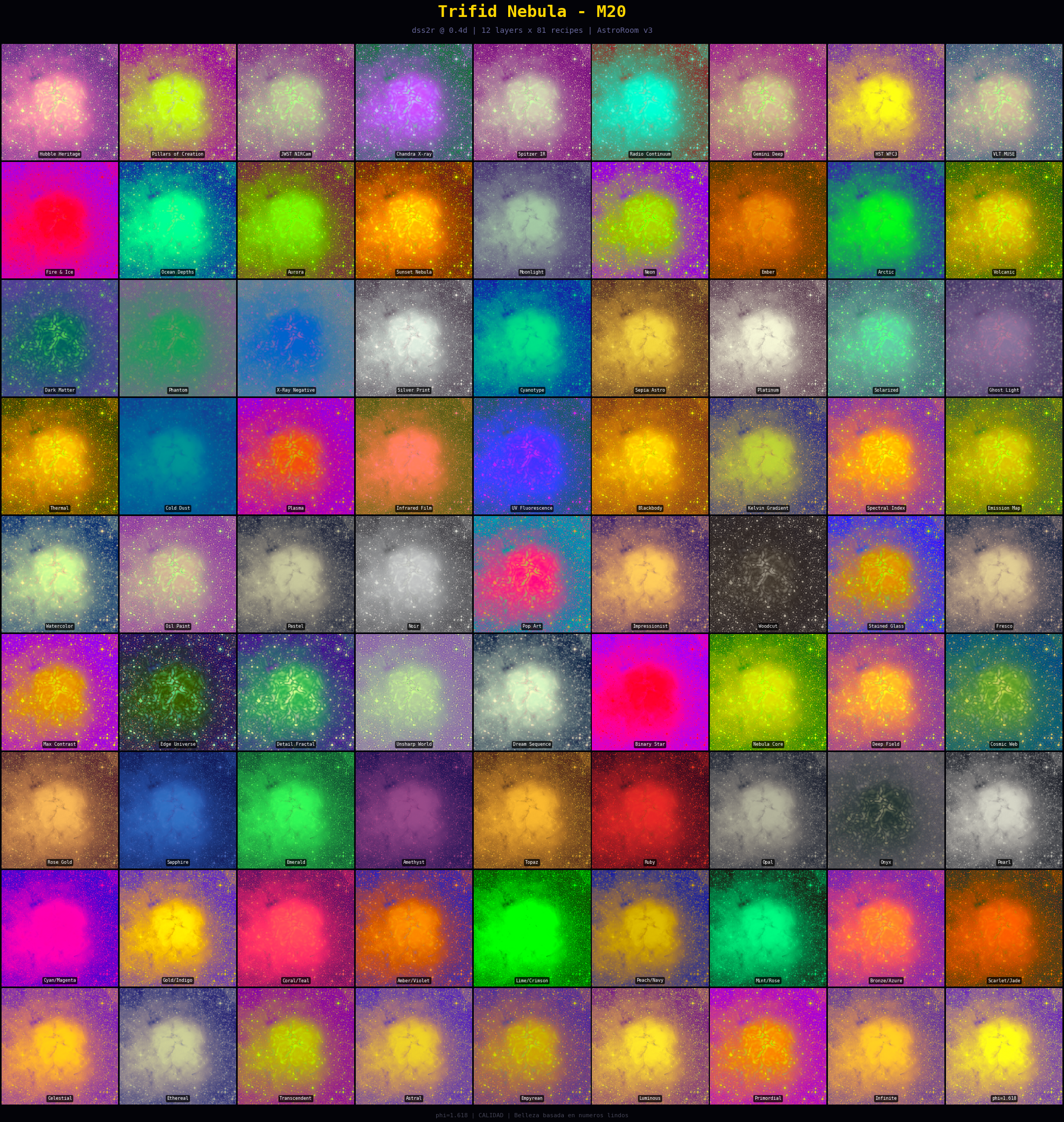 M20
M20The "three-lobed" emission nebula, divided by dust lanes that read as silhouettes against the H-α background. The reflection-nebula component above gives the colour gradient.
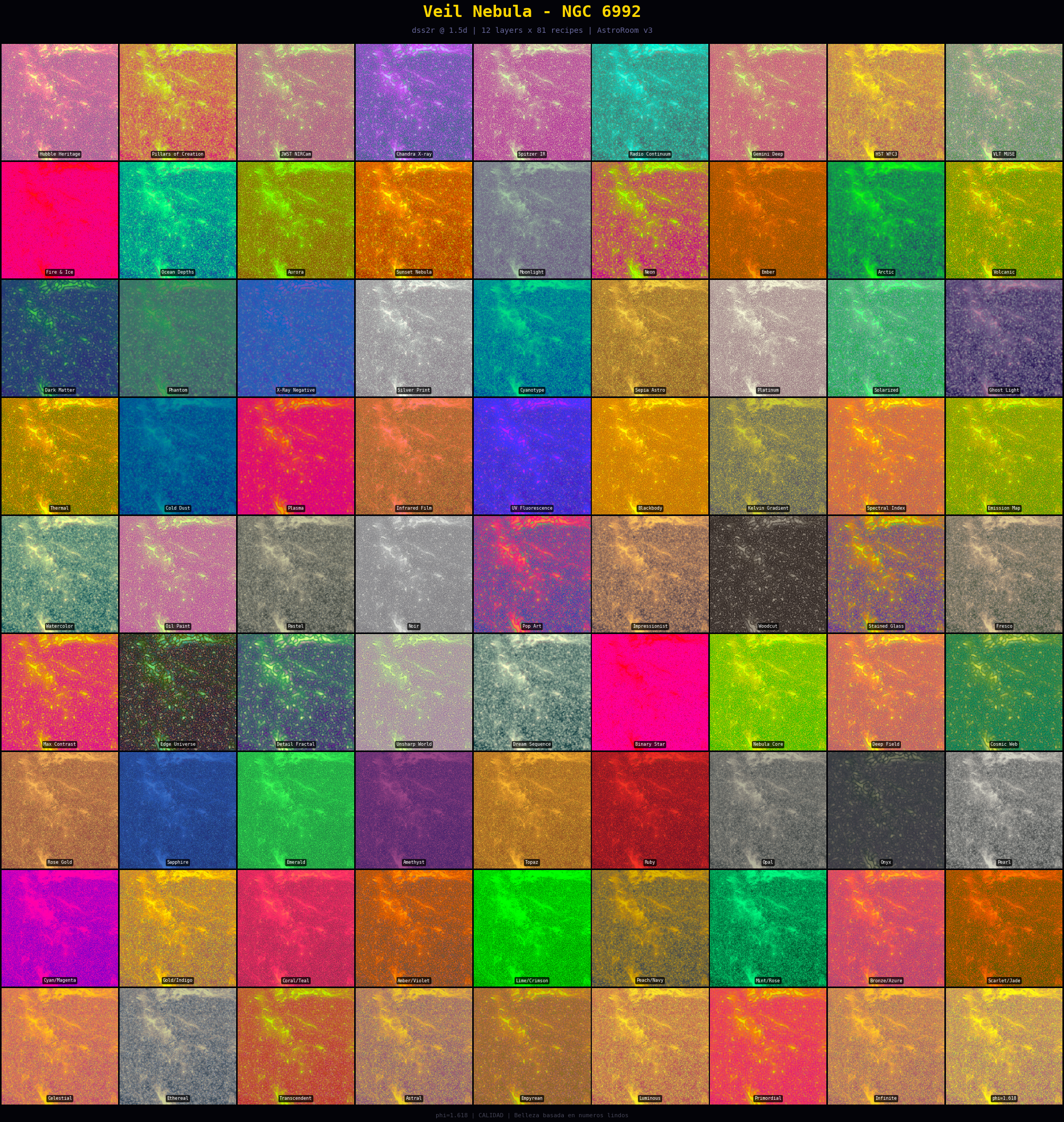 Veil
VeilA small section of the Cygnus Loop, the fading shock front of a supernova that exploded around 5,000 BC. The filaments are gas being heated as it slams into the surrounding ISM.
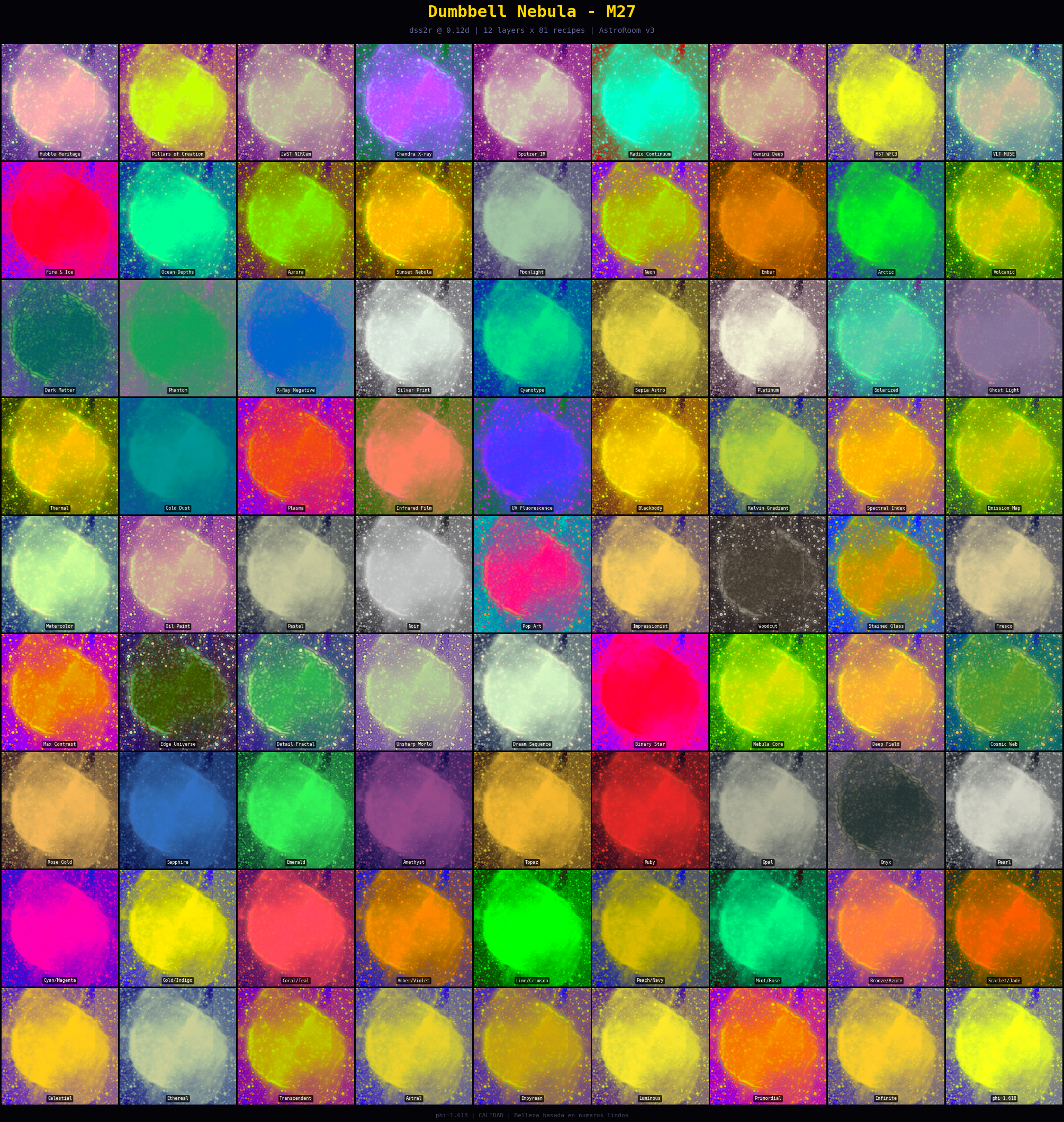 M27
M27M27 in Vulpecula. A planetary nebula about 1,360 light-years away, expanding at thirty kilometres a second. The shell is more or less spherical; the apparent dumbbell shape is projection.
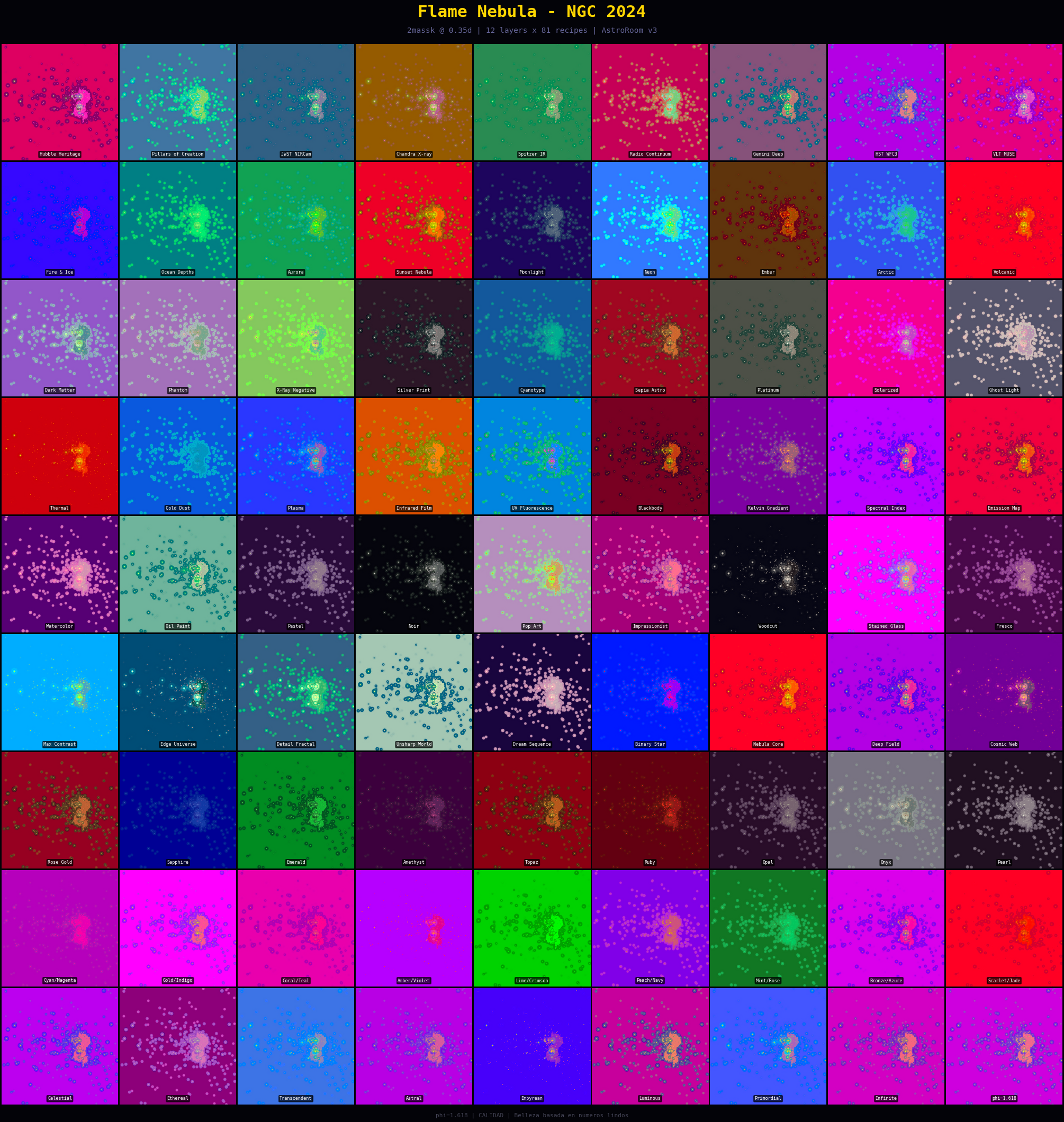 NGC 2024
A star-forming region in Orion, dust-obscured in optical but luminous in mid-IR. The young stars carving out the cavity at the centre would be hidden without the longer wavelengths.
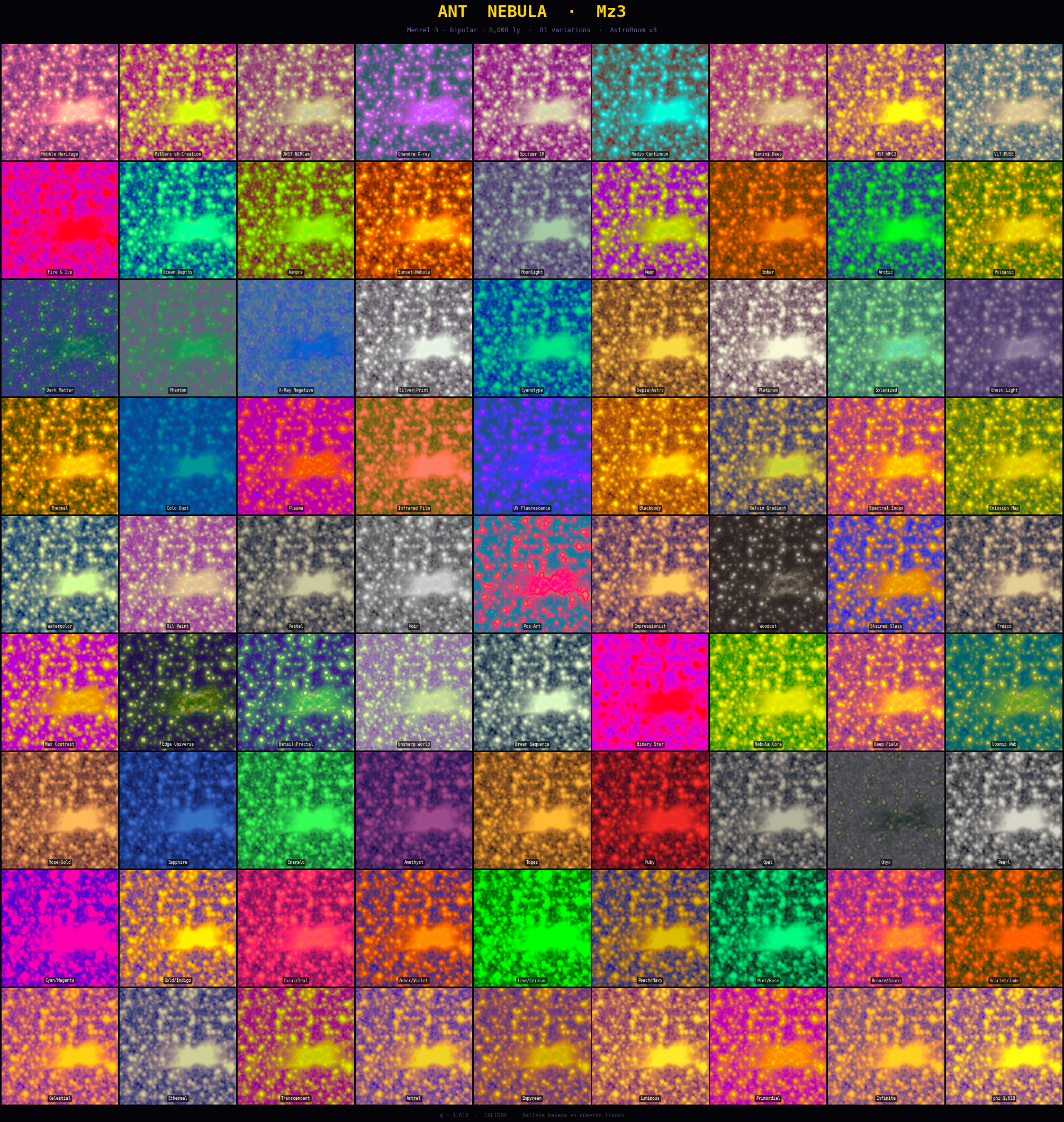 Mz 3
Mz 3A bipolar planetary nebula with a structure so complex the central system is almost certainly a binary. The lobes look symmetric only because we are seeing them edge-on.
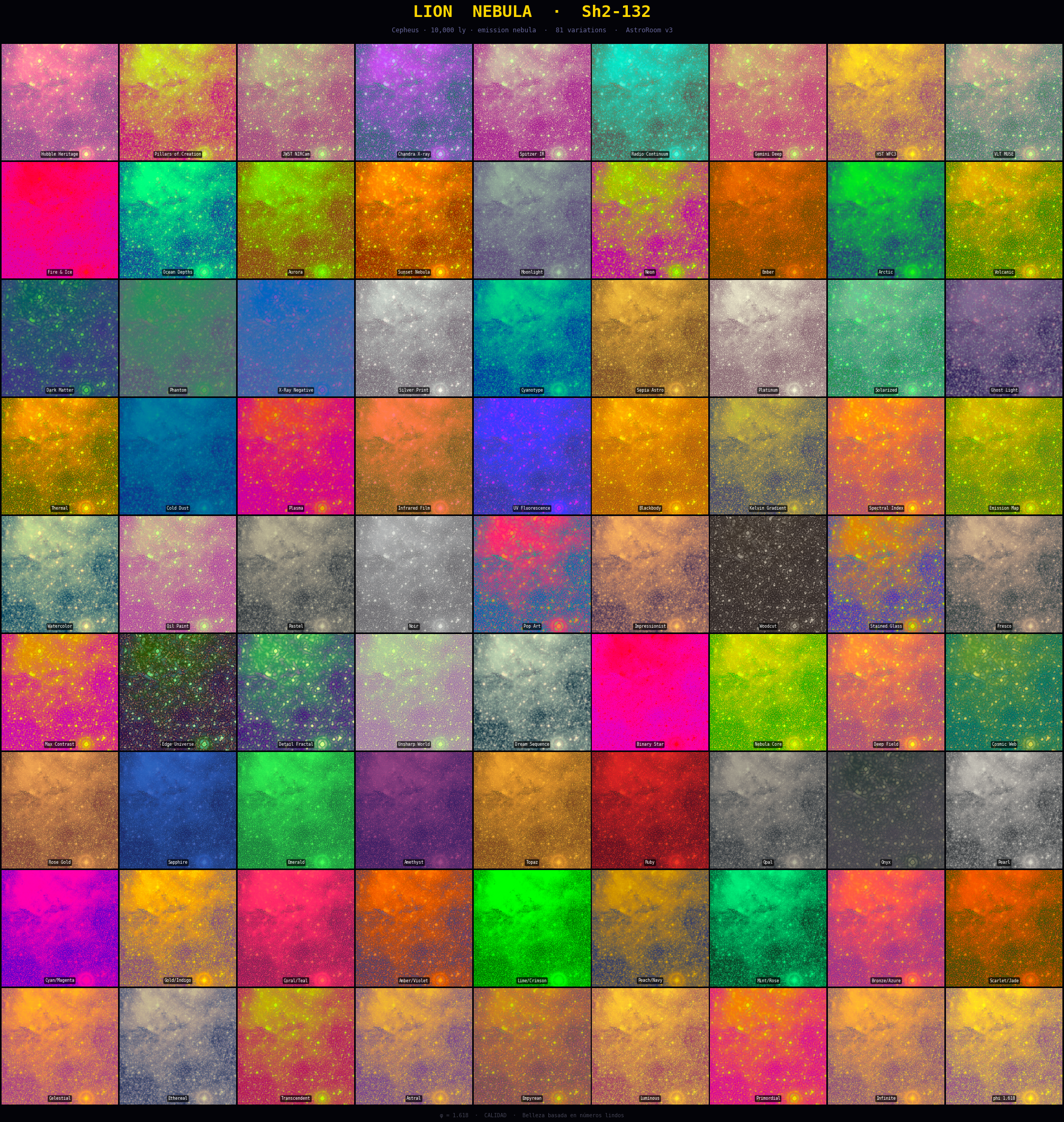 Sh2-132
An H II region in Cepheus shaped by the winds from two Wolf-Rayet stars. The narrowband filter set separates the ionisation states cleanly enough to read like a chemical map.
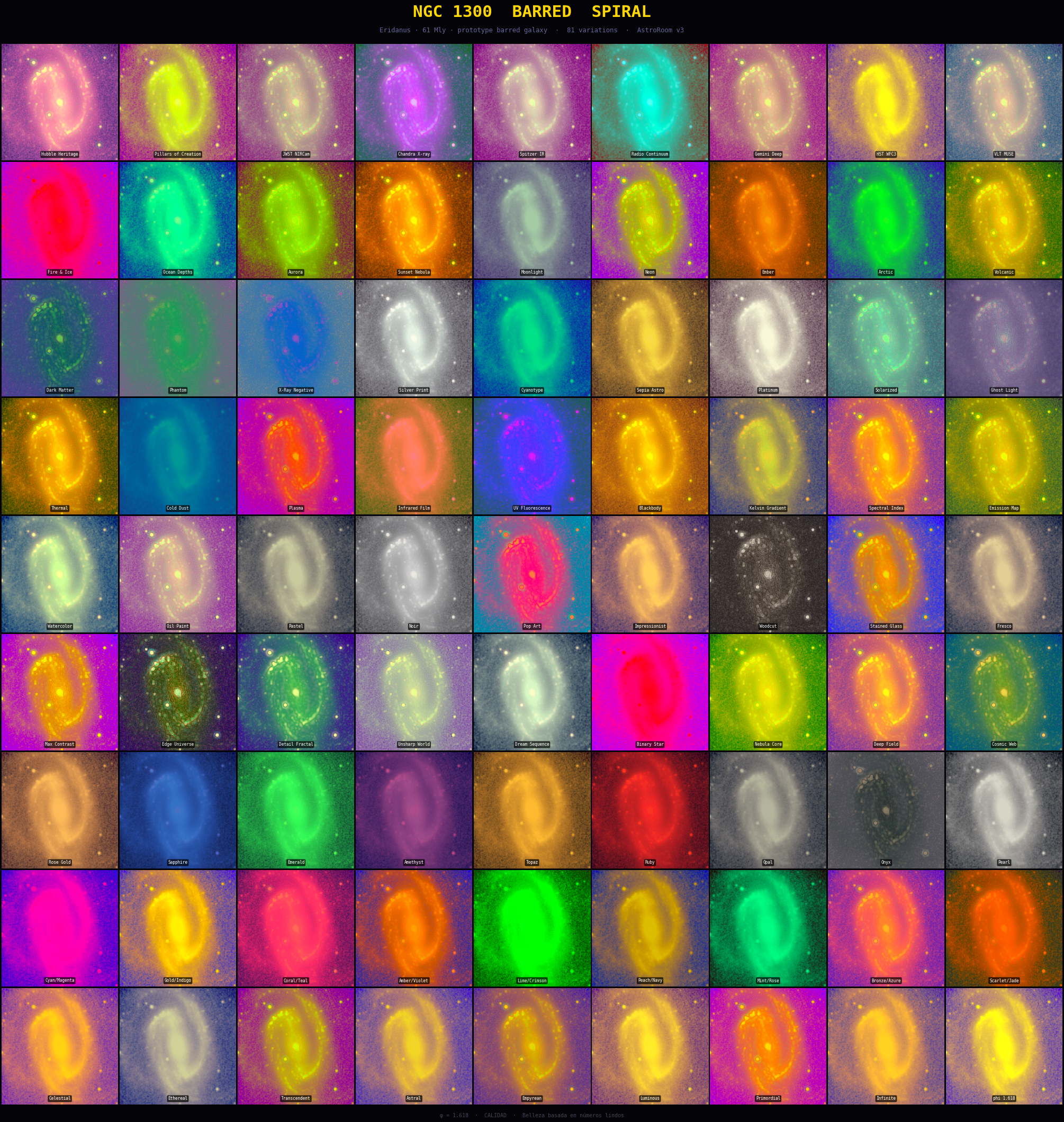 NGC 1300
A barred spiral so well organised it became the textbook example. The bar is solid; the arms wind out from its endpoints. Fifty million light-years away, in Eridanus.
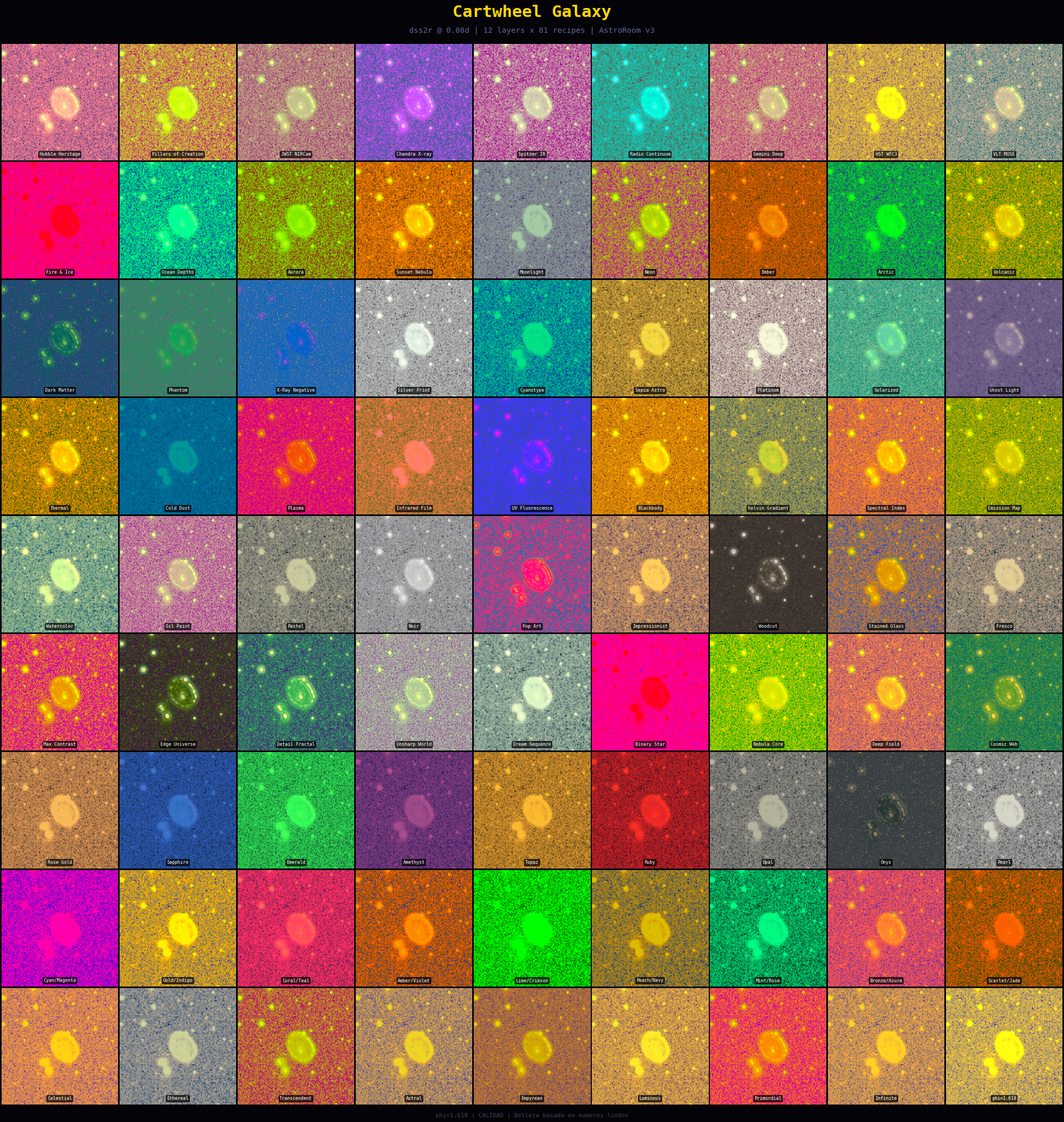 Cartwheel
A galaxy hit head-on by another, two hundred million years ago. The collision sent a ring-shaped wave outward; the wave is still expanding at over two hundred kilometres a second, igniting star formation as it goes.
Thirty-four objects plus a Horsehead portrait set is not the limit. The gallery grows with each edition. If you have a target you want to see in the next edition, the room takes requests in the monthly letter.