 M1 → M110
The Messier sheet.
M1 to M110. Charles Messier's eighteenth-century catalogue of "things that aren't comets." A single sheet, all hundred and ten, run through the 1snob AstroRoom darkroom under the same recipe family.
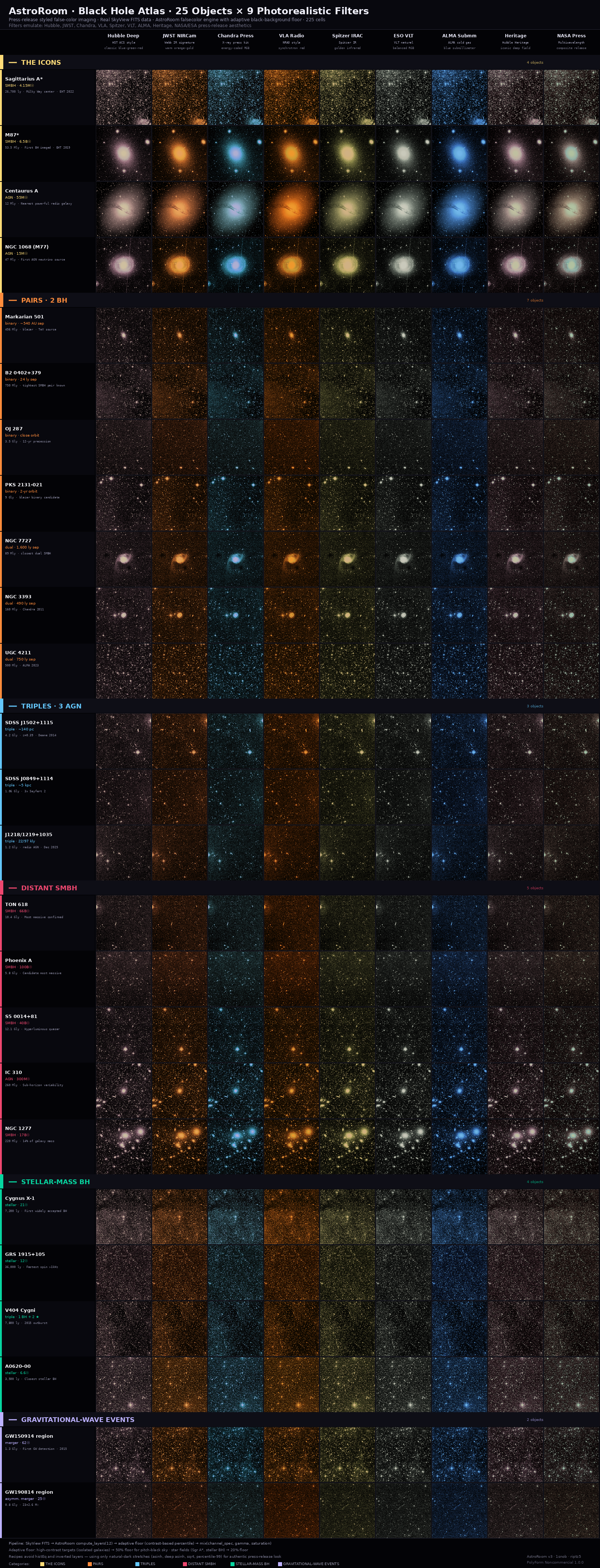
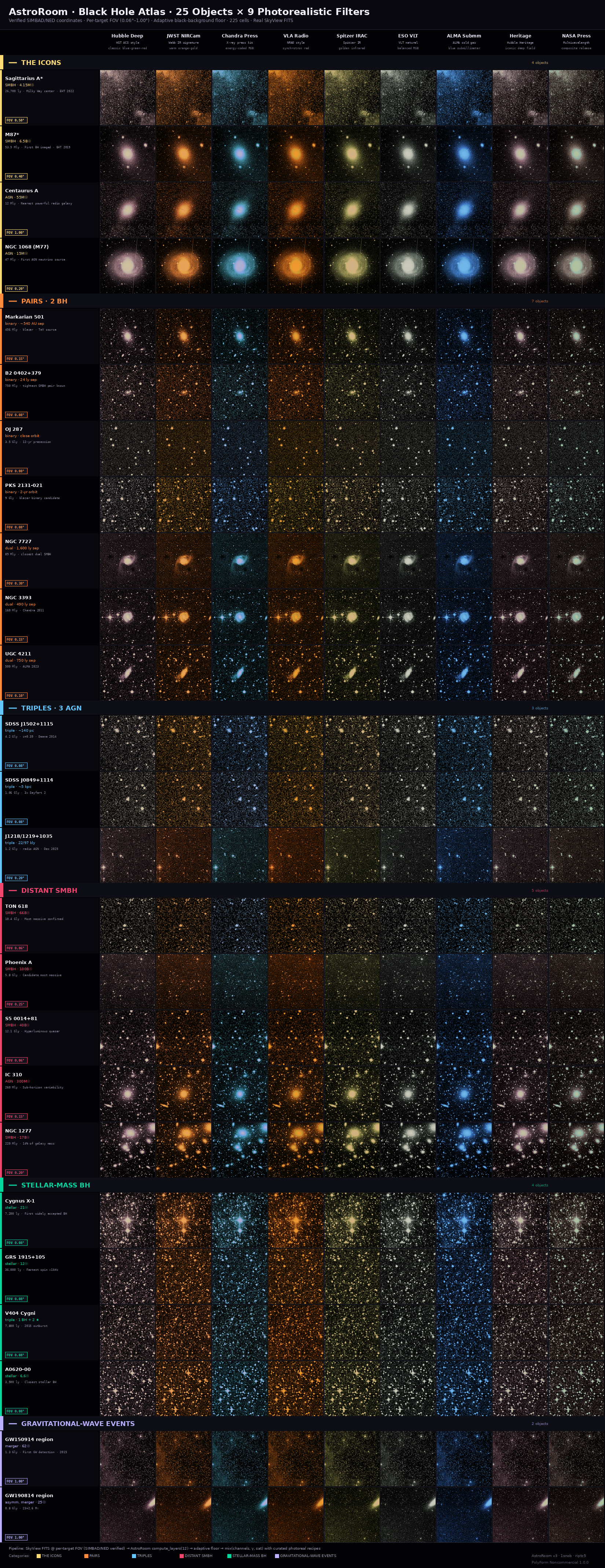
An atlas sheet is a single page where one published catalogue has been run through the same recipes, end to end, with the parameters attached. The Messier 110, the Caldwell 109, the canonical Black Hole top-25, the Phenomena 15, the Famous Deep-Sky 30 — each one rendered as one photograph of the whole catalogue.
 M1 → M110
M1 to M110. Charles Messier's eighteenth-century catalogue of "things that aren't comets." A single sheet, all hundred and ten, run through the 1snob AstroRoom darkroom under the same recipe family.
 C1 → C109
Patrick Moore's complement to Messier. Bright deep-sky targets Messier missed because they were too far south. The sheet pairs naturally with the Messier sheet above.
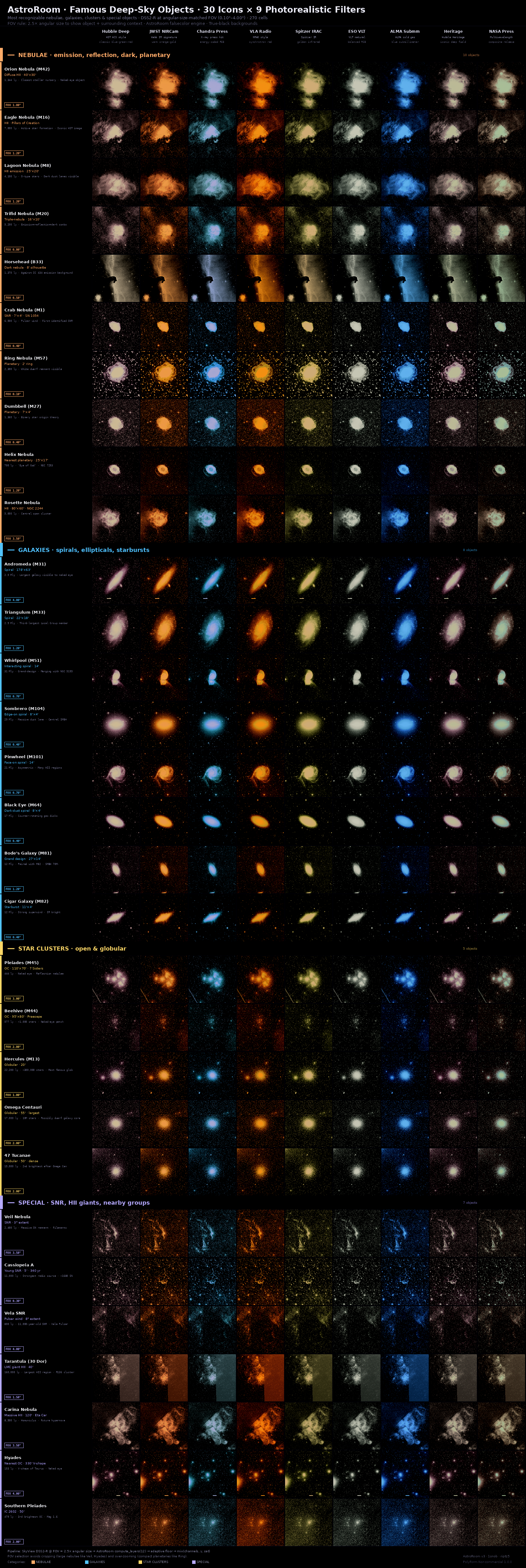 Famous · 30
The thirty deep-sky objects most people have heard of, by name. Less a catalogue than a vocabulary check.
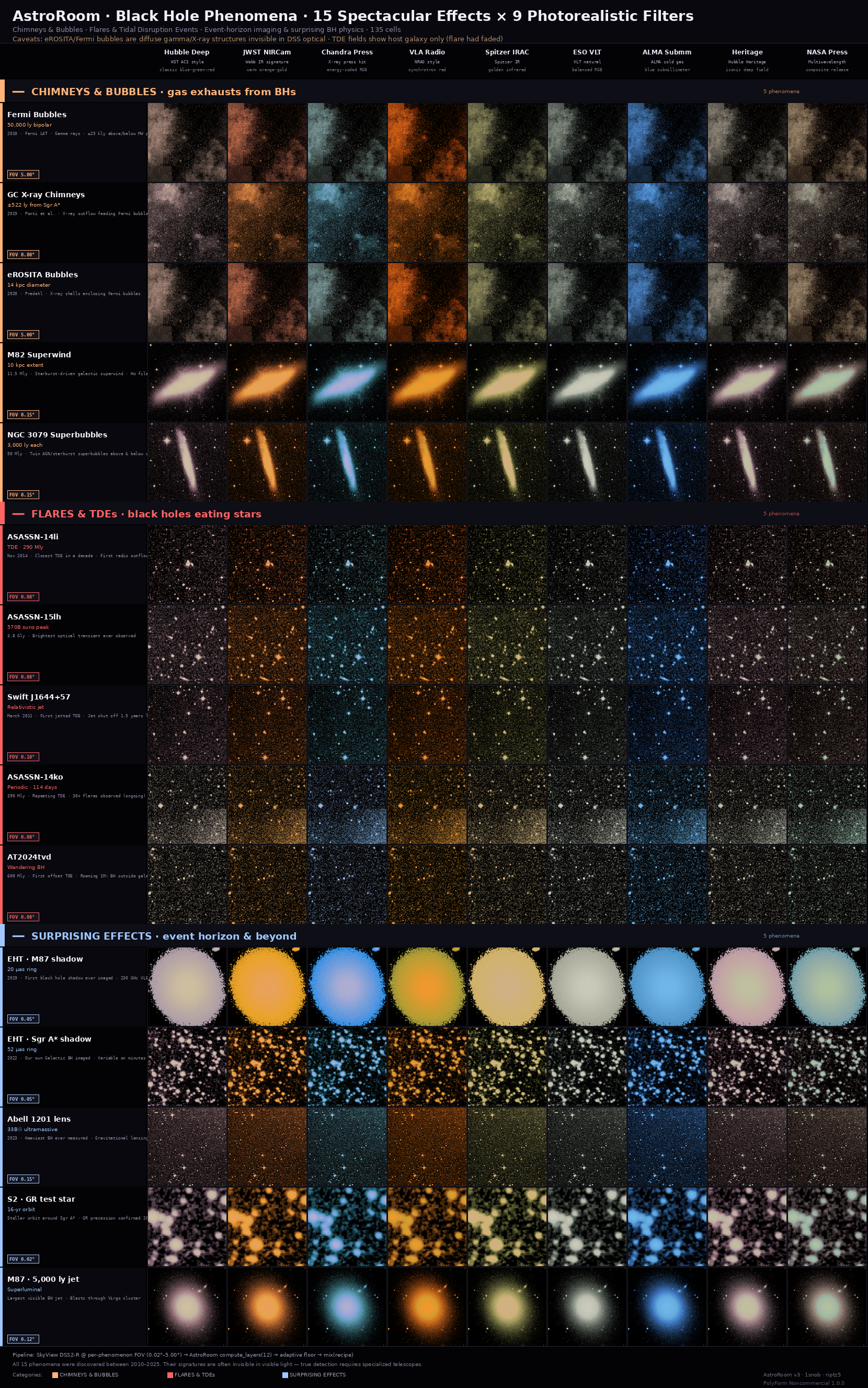 Phenomena · 15
Fifteen astrophysical phenomena where a single object is less interesting than the kind of thing it is. Pulsar wind nebulae, accreting binaries, planetary nebulae caught in expansion.
 Clean
CleanA pure-greyscale render of every target the room currently holds in its base tier, no recipe applied. The atlas of the photometry, before anyone made a colour decision.
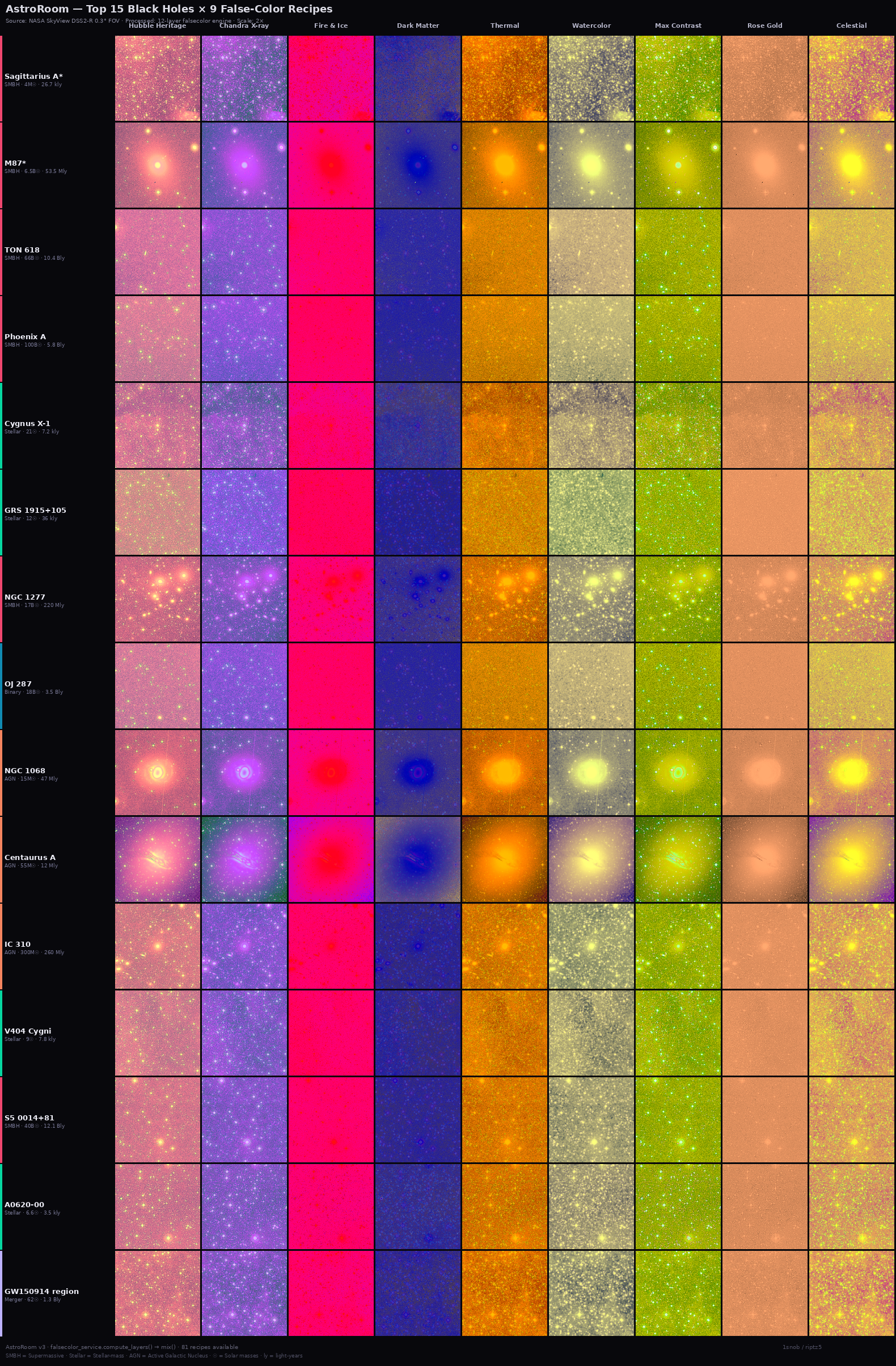 15 × 9
The companion to the lead Black Hole Atlas: fifteen extra hosts run through the nine palette families — same recipes, different targets. One hundred and thirty-five plates that read in conversation with the lead sheet.
A recipe is the instruction sheet that turns raw FITS data into a coloured photograph: which band goes into which channel, which stretch, which clip percentile, which palette. 1snob AstroRoom ships eighty-one named recipes grouped under nine families. Below, the families that drive every Atlas sheet.
The familiar warm-edge palette used in canonical Hubble releases. Gives accreting matter a fire-edge halo. Best for Sgr A* and accreting AGN.
Mid-infrared first. Dust separates from the underlying galaxy structure. Best for hosts of obscured nuclei.
Soft / medium / hard X-ray as B / G / R. Photon energy reads as colour. Best for compact accretion features.
Synchrotron jet emission against an inverted background. Best for AGN with extended radio lobes.
A near + mid + far IR composite. The host galaxy gets the spotlight; the engine is the hot spot.
Fermi LAT contours over an optical underlay. Energy regimes that the human eye cannot reach, drawn on top of one it can.
Pure photometry. No false colour. Restores the picture to a measurement.
Magnetic-field geometry as colour wheel. Best for radio-bright AGN and pulsar wind nebulae where polarisation is the science.
The same object across multiple epochs, montaged. Time becomes the third dimension of the recipe.
Each family contains nine specific named recipes — variations on the same compositing logic with different stretches, clip percentiles, and band weights. Eighty-one in total. The full list lives in backend/app/services/falsecolor_service.py; pass recipes=all to the API to enumerate them.
The dot prefix marks objects that ship with a hand-curated FITS URL manifest in the base tier. Everything else resolves at runtime through SIMBAD TAP and SkyView. The list is extensible — Edition Nº 02 expands the lead sheet past fifty.
The Atlas is a working document. Recipes change as the public archives grow. The plate you download today carries the Merkle root of the Atlas-version it was generated under. A printed plate from Edition Nº 01 is a valid reproducible artefact even after Edition Nº 02 ships.