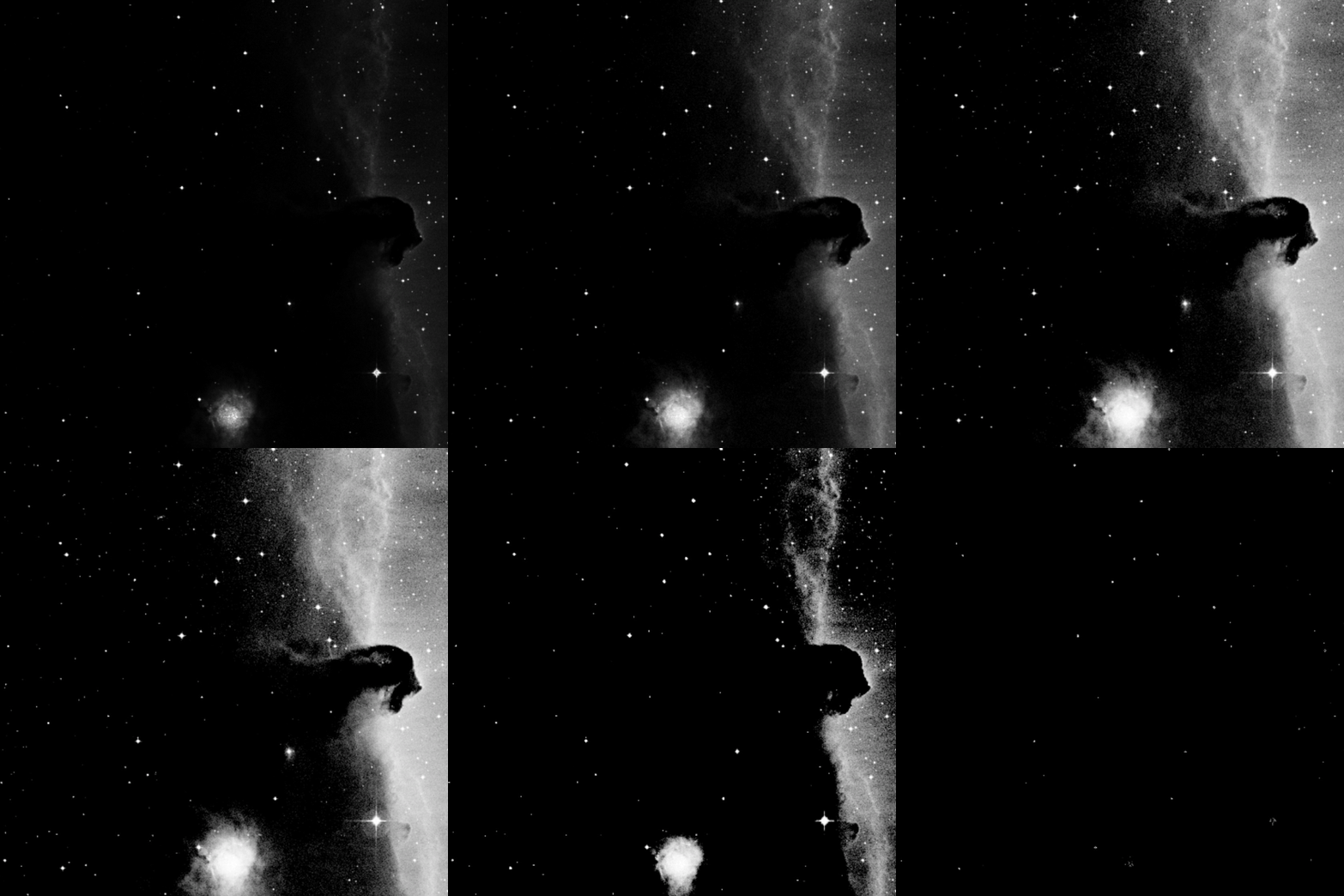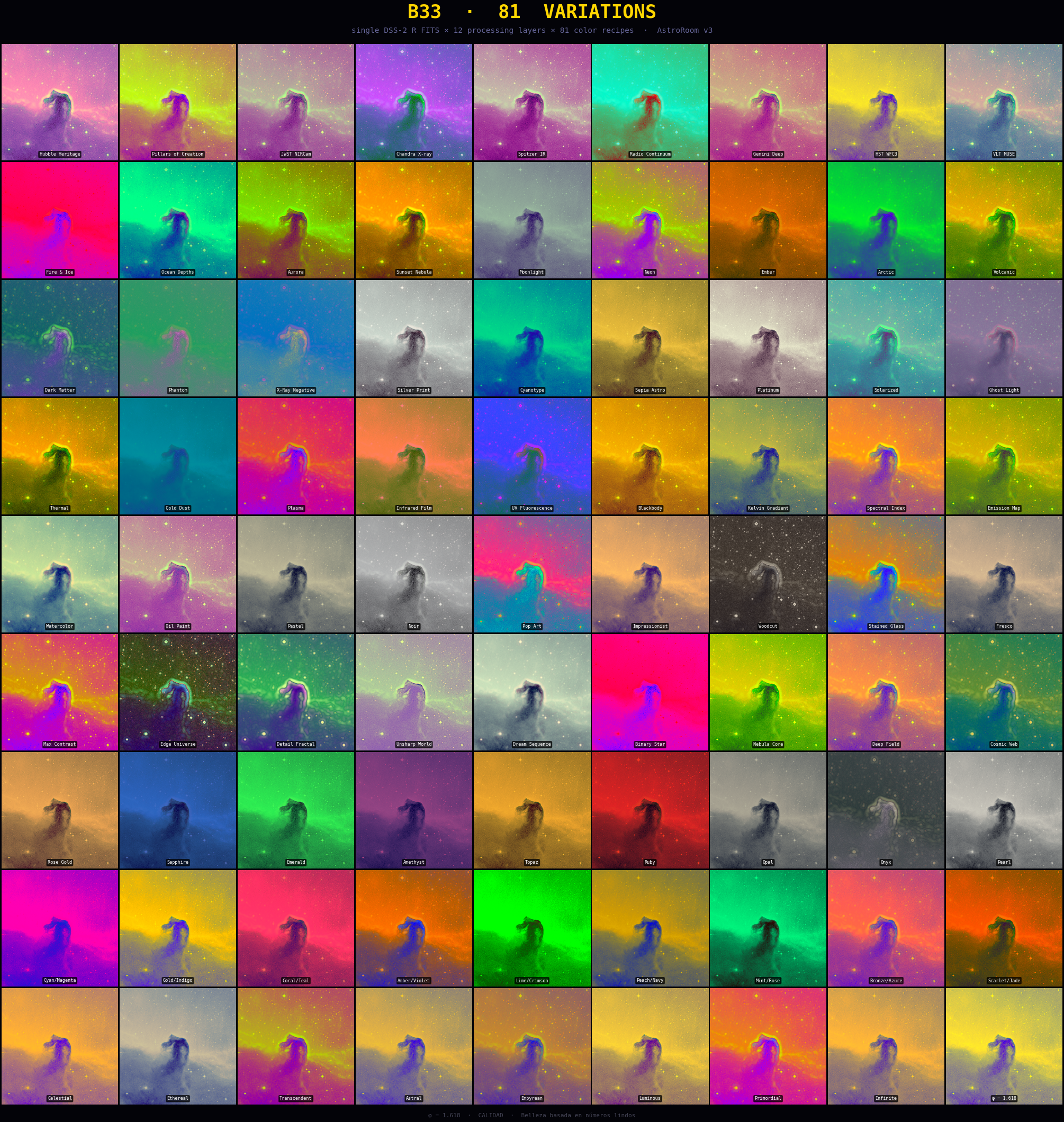
One target, eighty-one recipes, one sheet.
Barnard 33 — the Horsehead — run through every named recipe in the false-colour engine. Same FITS sources, same crop, same exposure. The only thing that changes from plate to plate is the recipe id. The differences on the sheet are the recipes themselves, made visible.
When the family of recipes ships an update, this is the sheet that changes most.
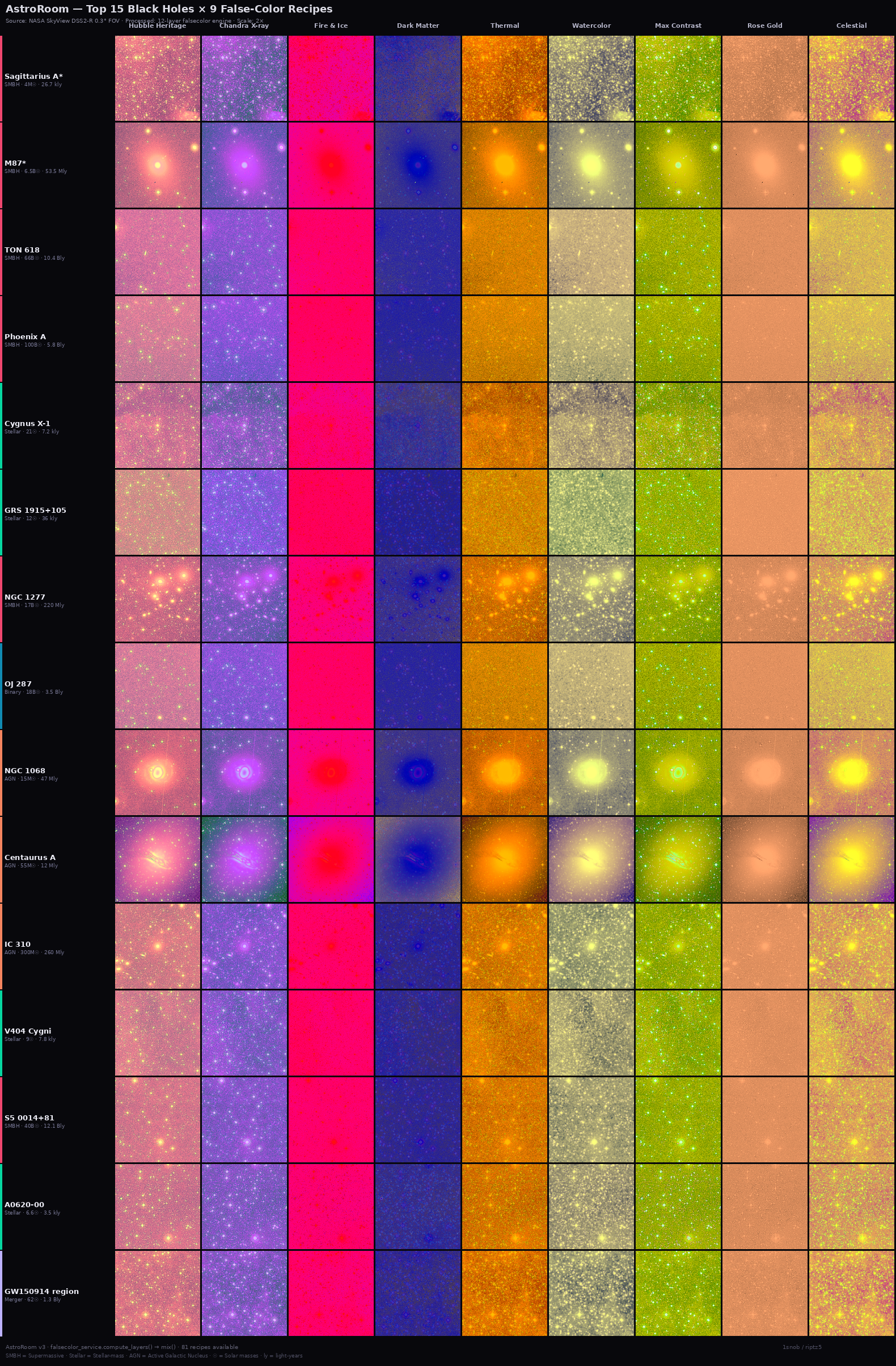
Fifteen black holes, nine ways each.
The companion to the Atlas's lead sheet. Fifteen black-hole hosts run through the nine palette families, side by side. The recipe-driven differences in the appearance of the same X-ray emission are what this sheet is for.
Between this sheet and the lead Atlas sheet, the question "what is the X-ray photograph" answers itself in 135 plates.
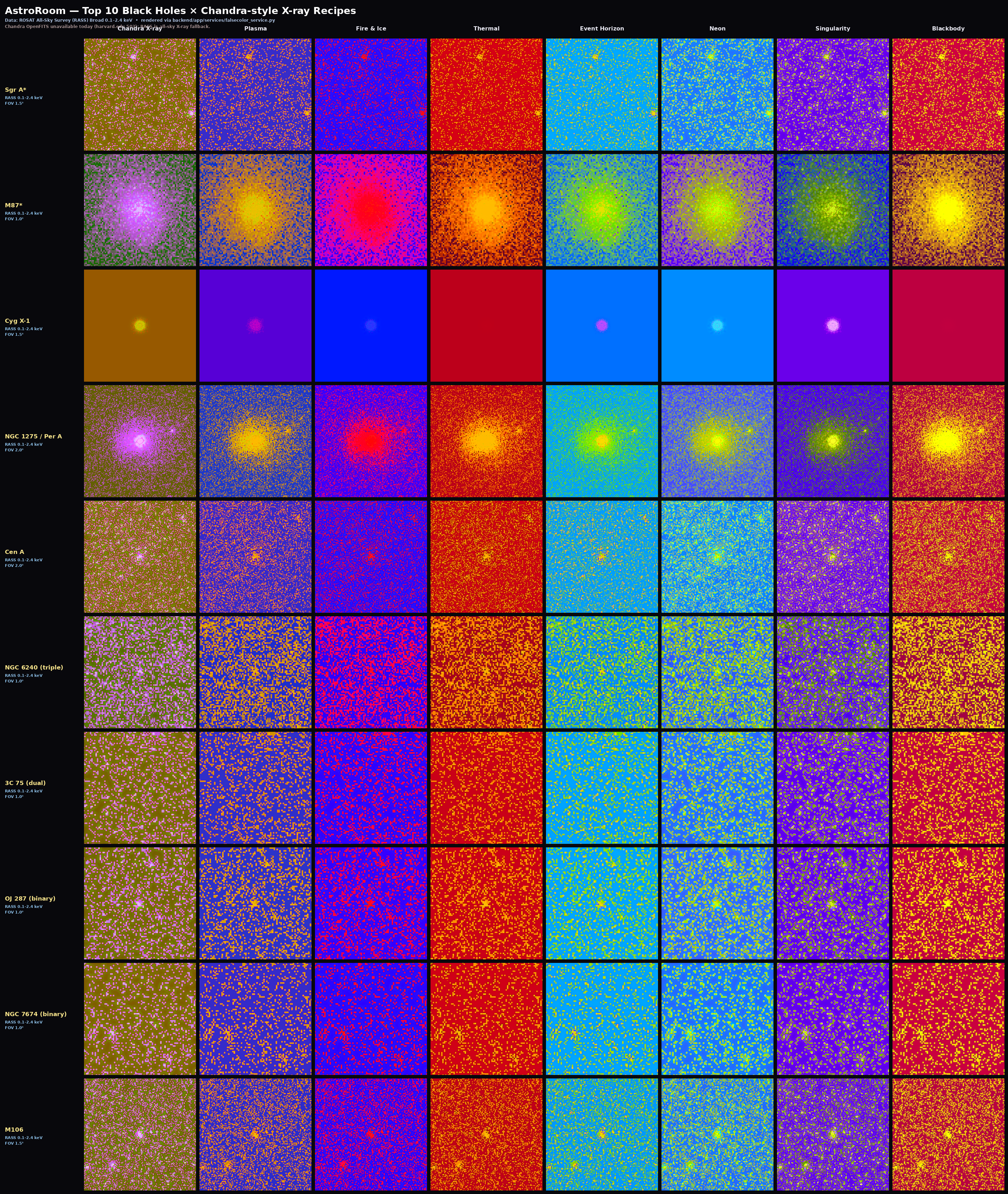
The ten most-photographed X-ray targets.
The ten objects with the most public Chandra integration time — a working astronomer's working set — run through the photoreal palette family at full resolution. Sgr A*, M87, the Crab, the Bullet Cluster, M82, NGC 1275, the others. Each plate is the deepest image we can build from the public data.
Saved at print resolution. Hand the sheet to the printer with the recipe attached and the print is reproducible.
Sgr A* in four dimensions.
An ISPR cube of Sagittarius A*, animated on the time axis. The first three dimensions are the standard pseudo-volume — bright core, mid-density envelope, diffuse halo. The fourth is the date.
The flares appear as bright transients in the core. The halo shifts subtly as different epochs of Chandra observation contribute different photons. This is one cube, not many; the time axis is real.
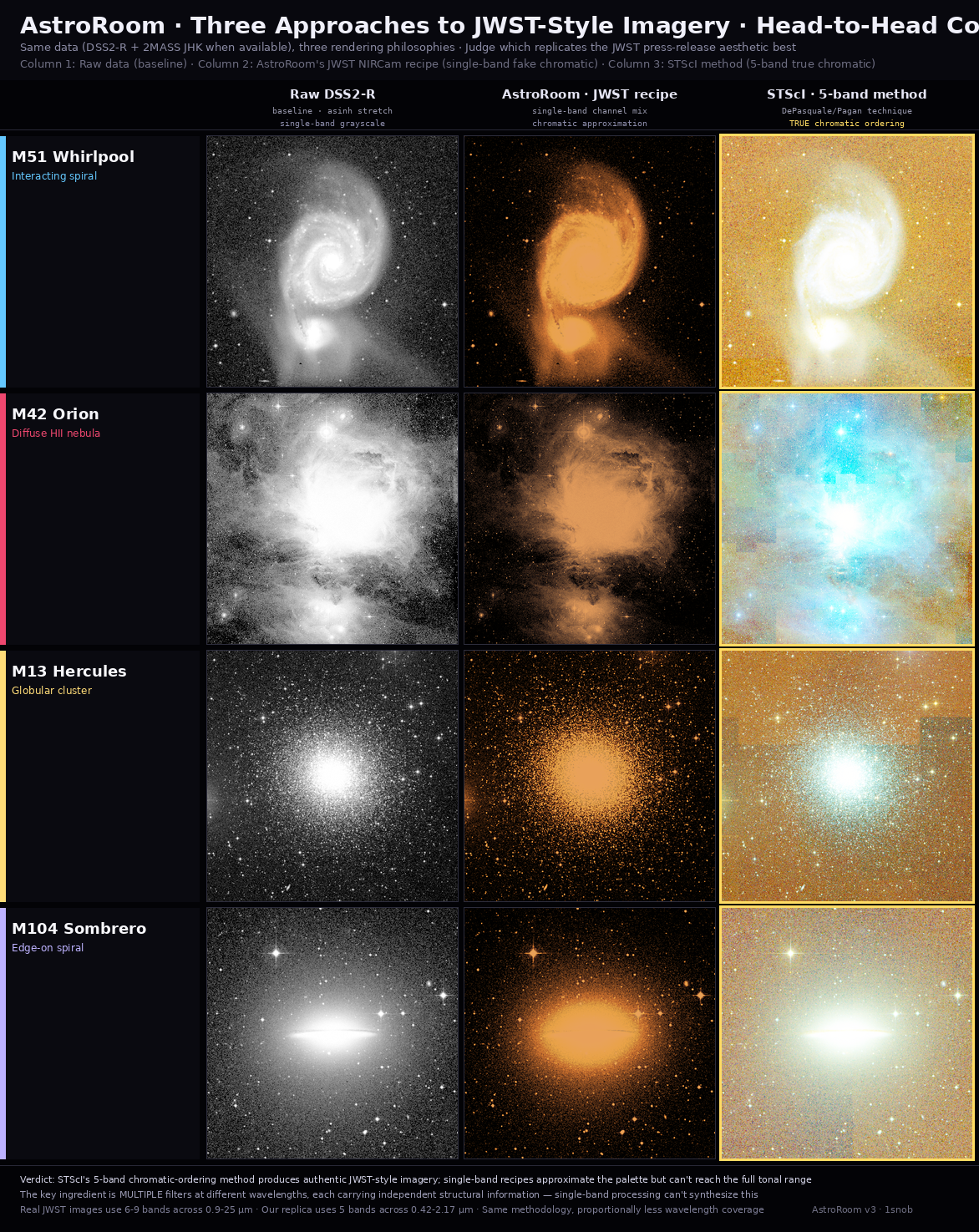
The same data, two different photographs.
A side-by-side: the canonical STScI release of a JWST target on the left, the same target restacked from the raw frames in 1snob AstroRoom on the right. Same FITS inputs. Different recipes, different stretches, different decisions about what to show. Both are honest.
Use this study every time someone asks why two published images of the same object don't look alike. The answer is on the sheet.
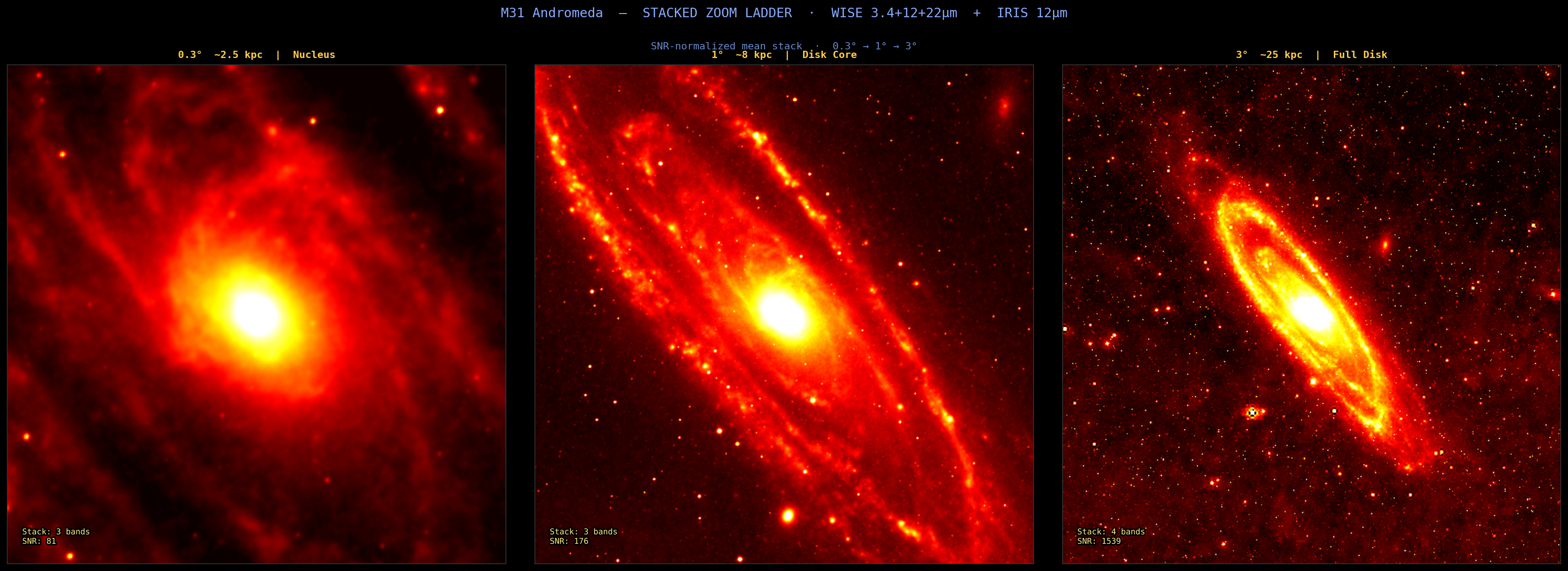
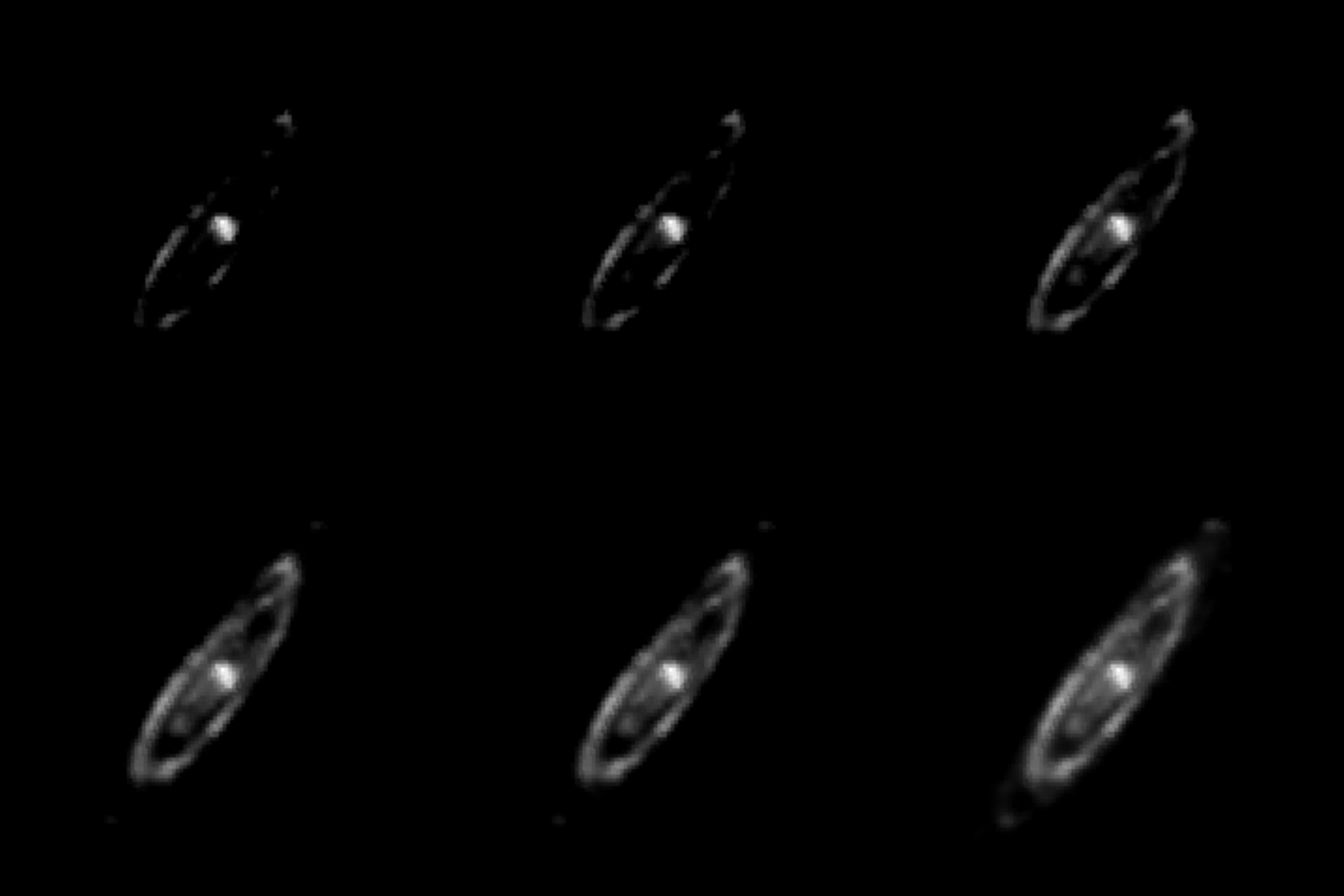
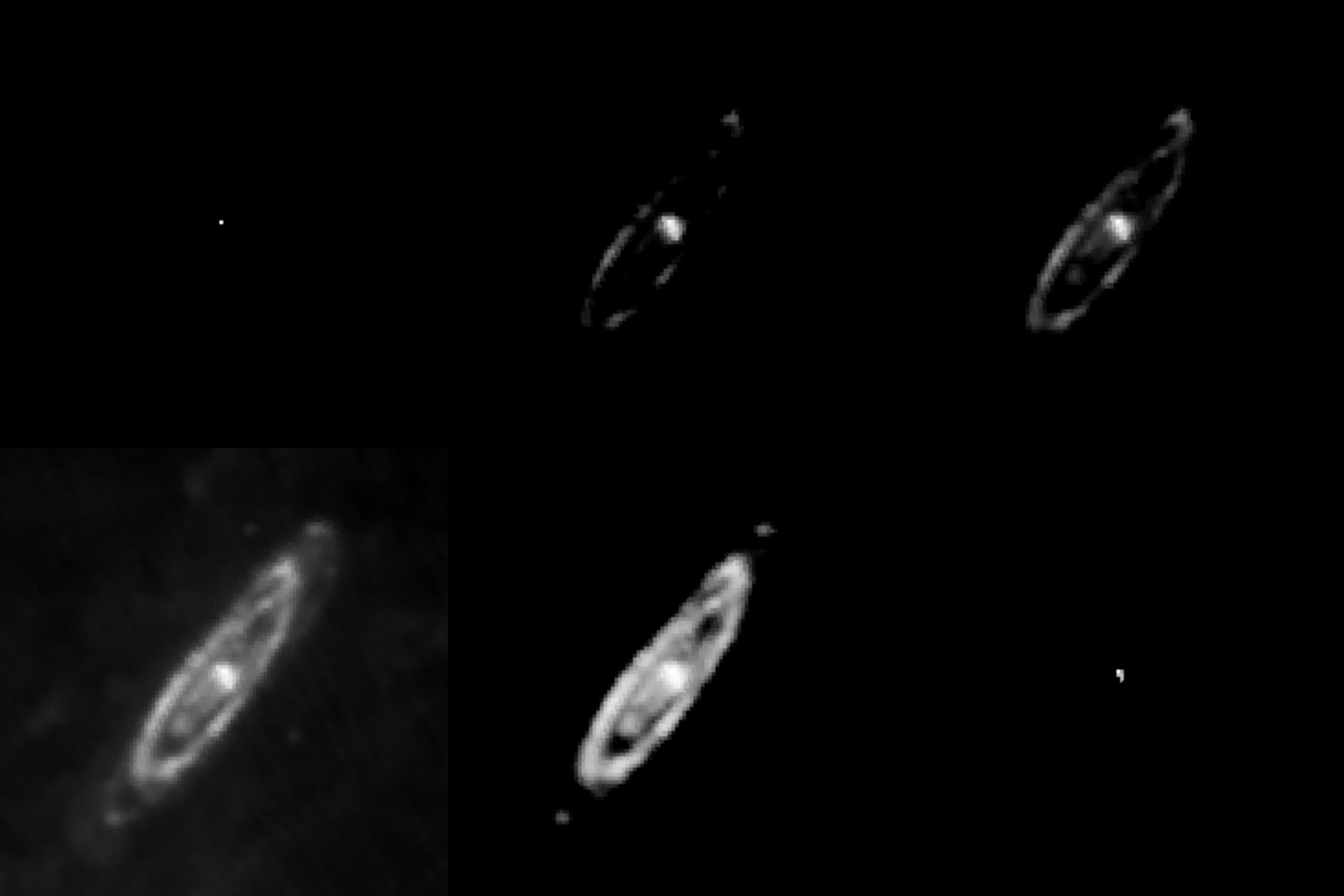
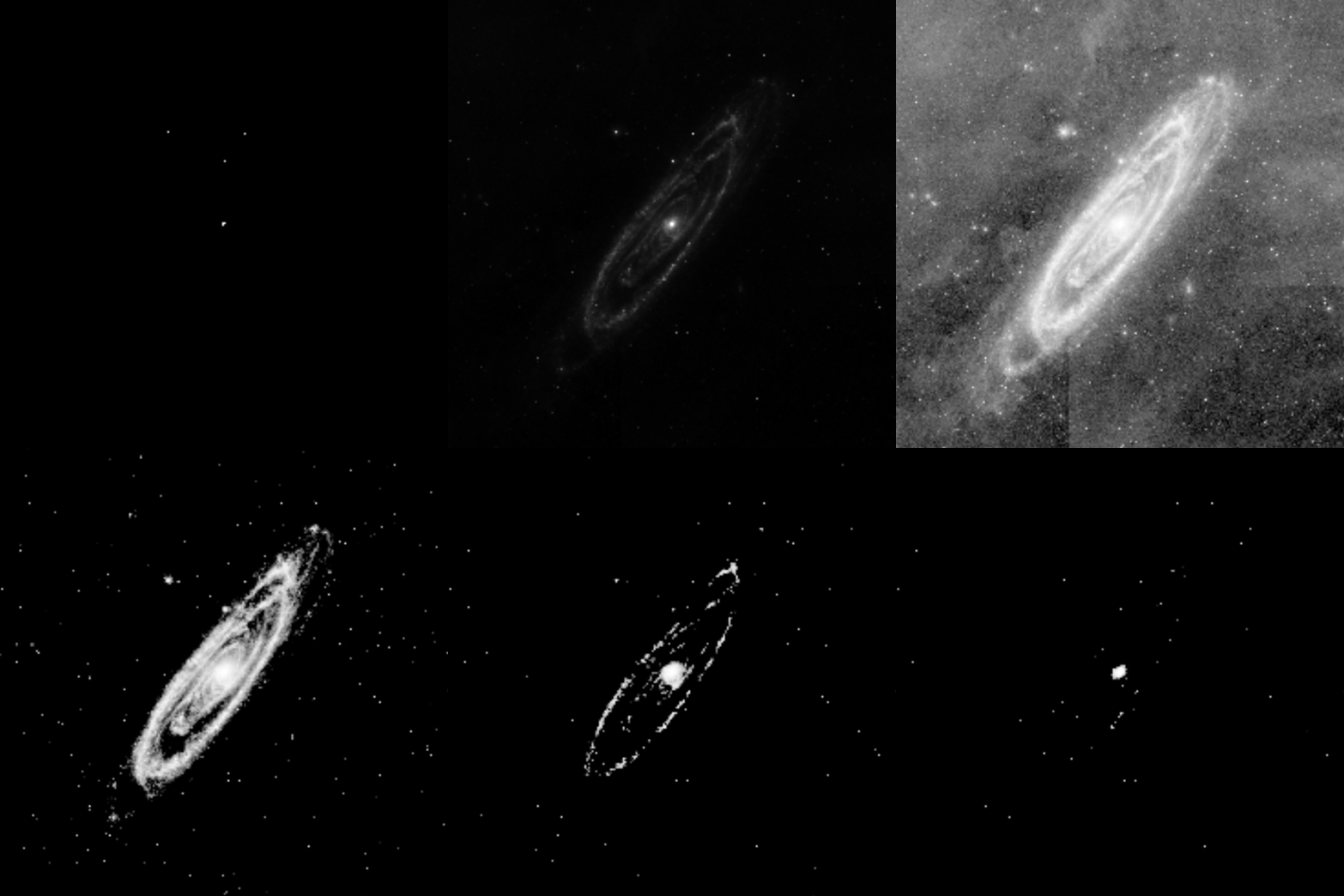
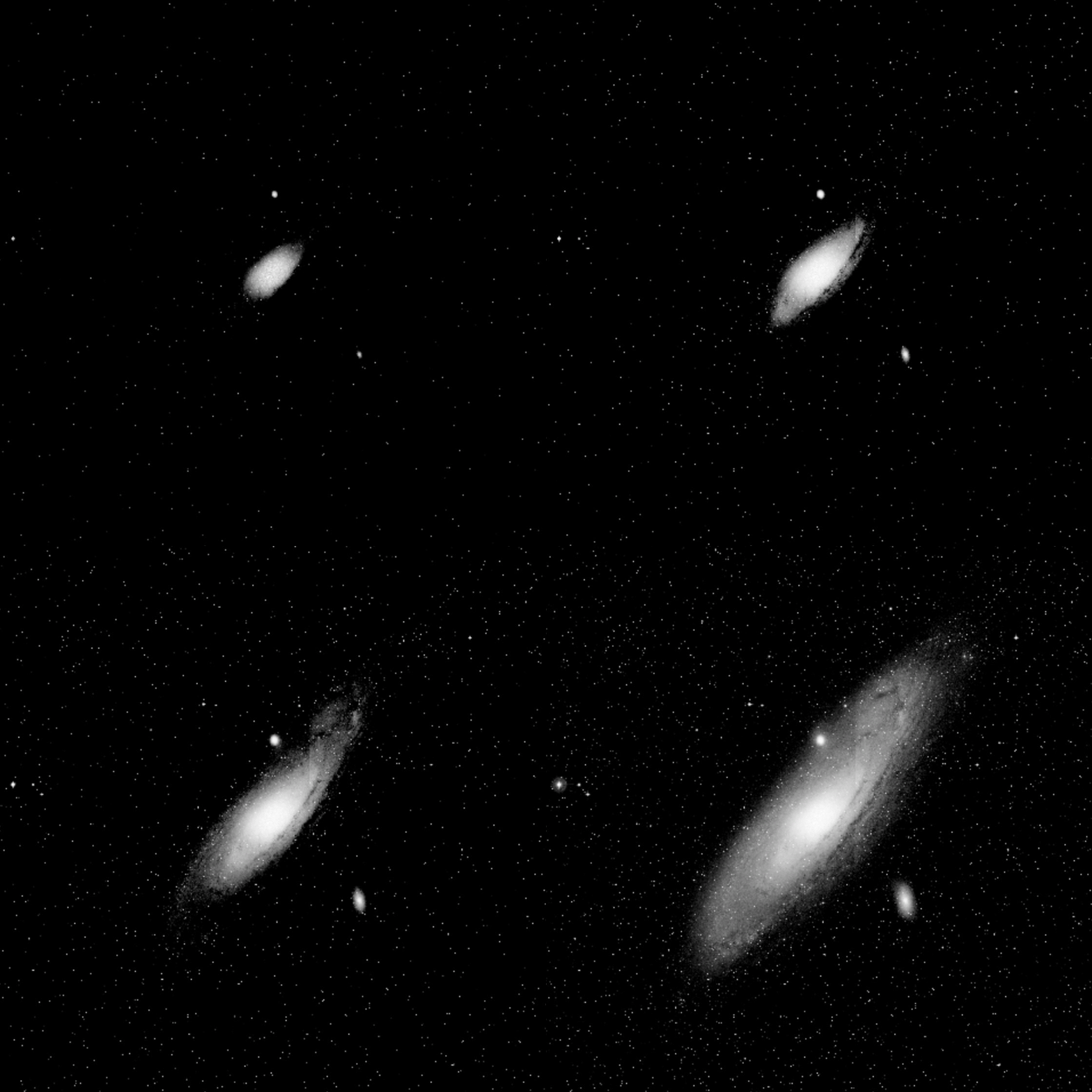
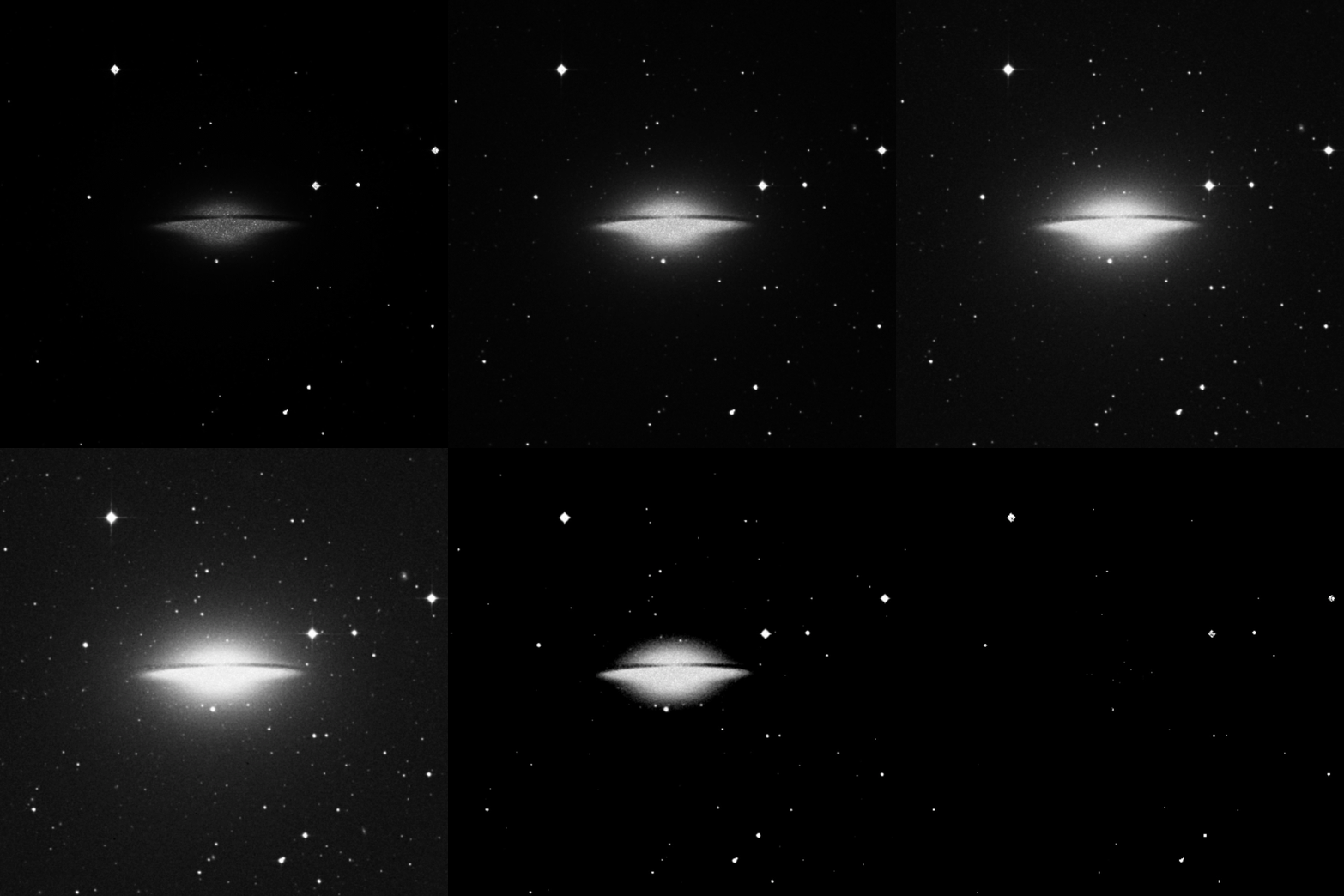
Andromeda, step by stack.
A stacking ladder of M31. Top: a single optical frame. Each step down: another frame added to the stack. The faint outer arms appear progressively. The dust lanes resolve. The point sources stop being noise.
A teaching artefact. The stack is not abstract; you can see it earn its detail.
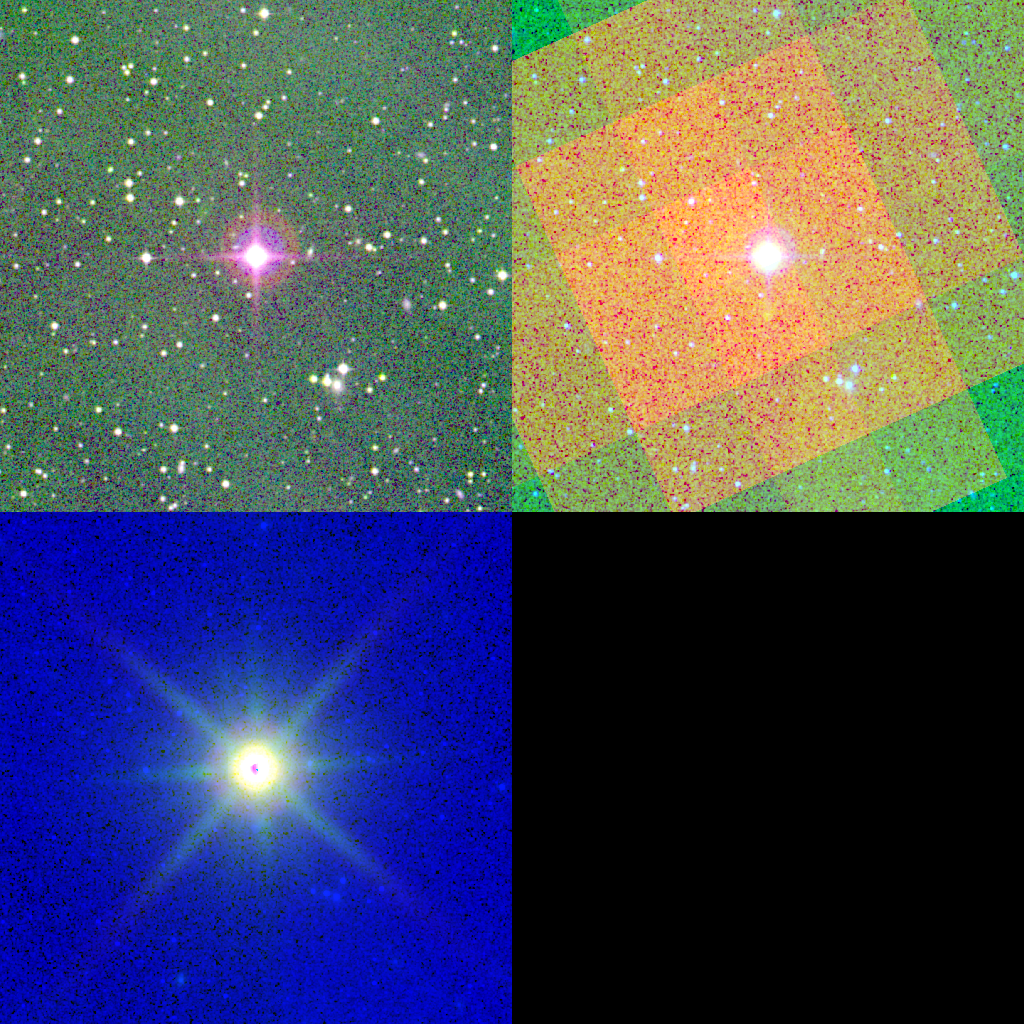
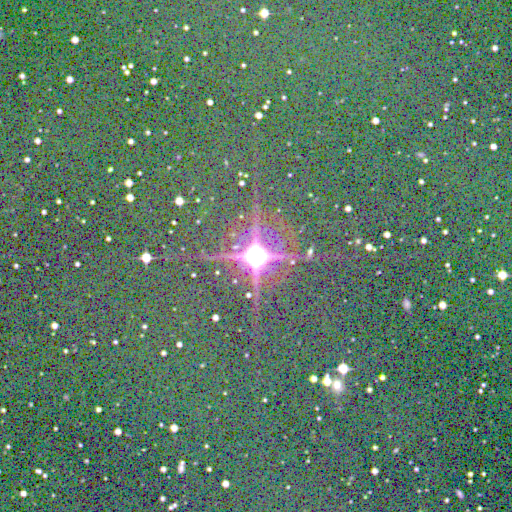
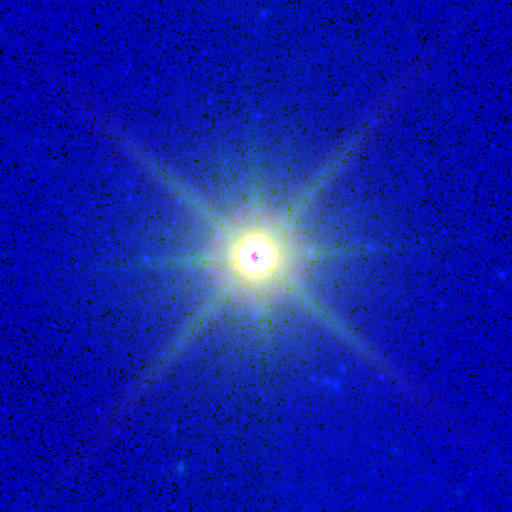
IC 418 across every band we have.
The Spirograph planetary nebula imaged in optical, near-IR, mid-IR, far-IR, and radio bands — each panel a different survey, each one showing a different layer of the same expanding shell. The hot central star is brightest in UV; the cold dust shell is brightest in far-IR.
This is what fourteen bands buys you. The same object reads as five different physical objects depending on what you look at.
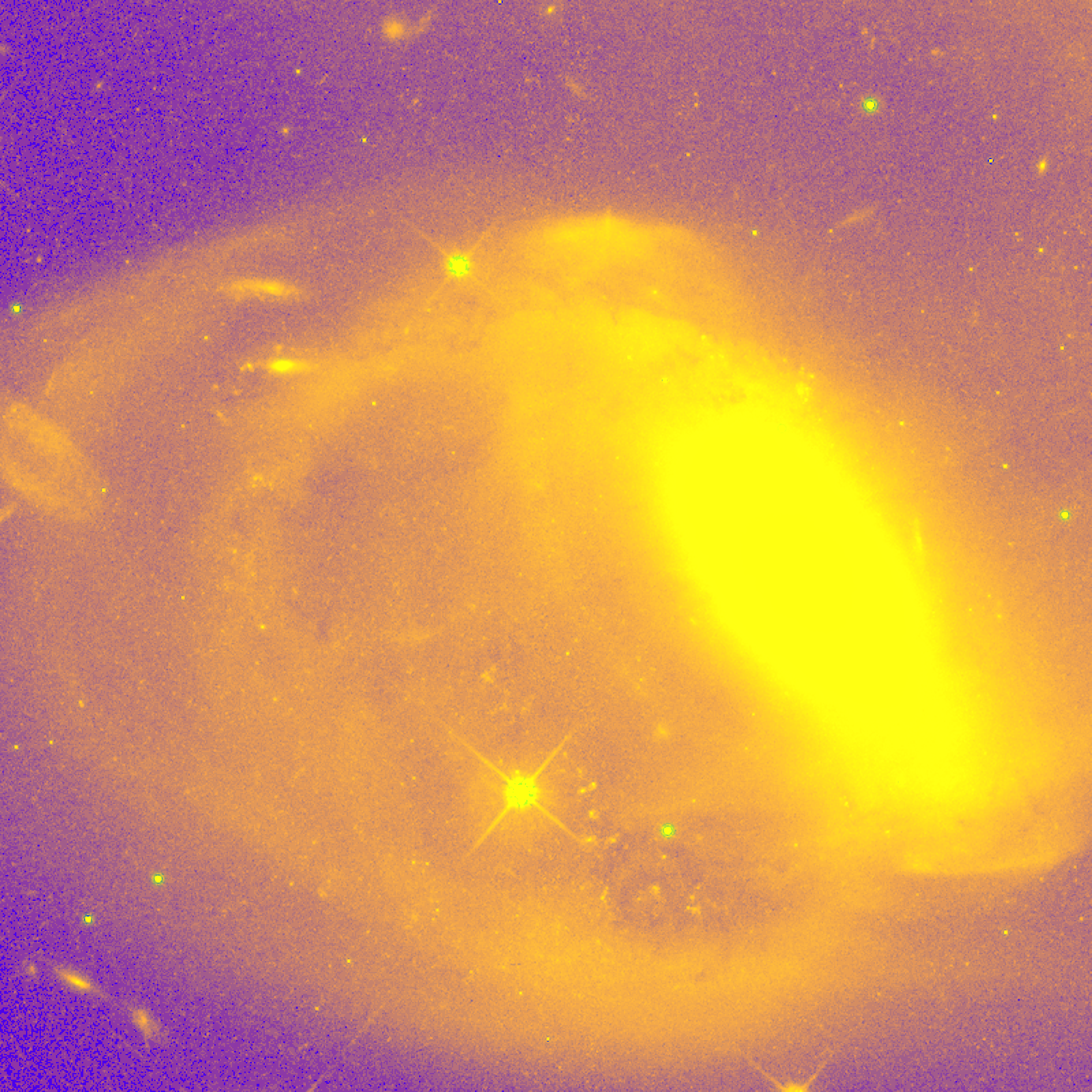
Stephan's Quintet, phi.
A composition study. The same megastack used in the gallery, recomposed with the band weights driven by the golden ratio (φ ≈ 1.618). The mid-IR contributes the dominant share, then near-IR, then optical, in φ-decreasing fractions.
Whether this is a more honest reading of the data than equal-weight is a matter of taste. The recipe is on the file.
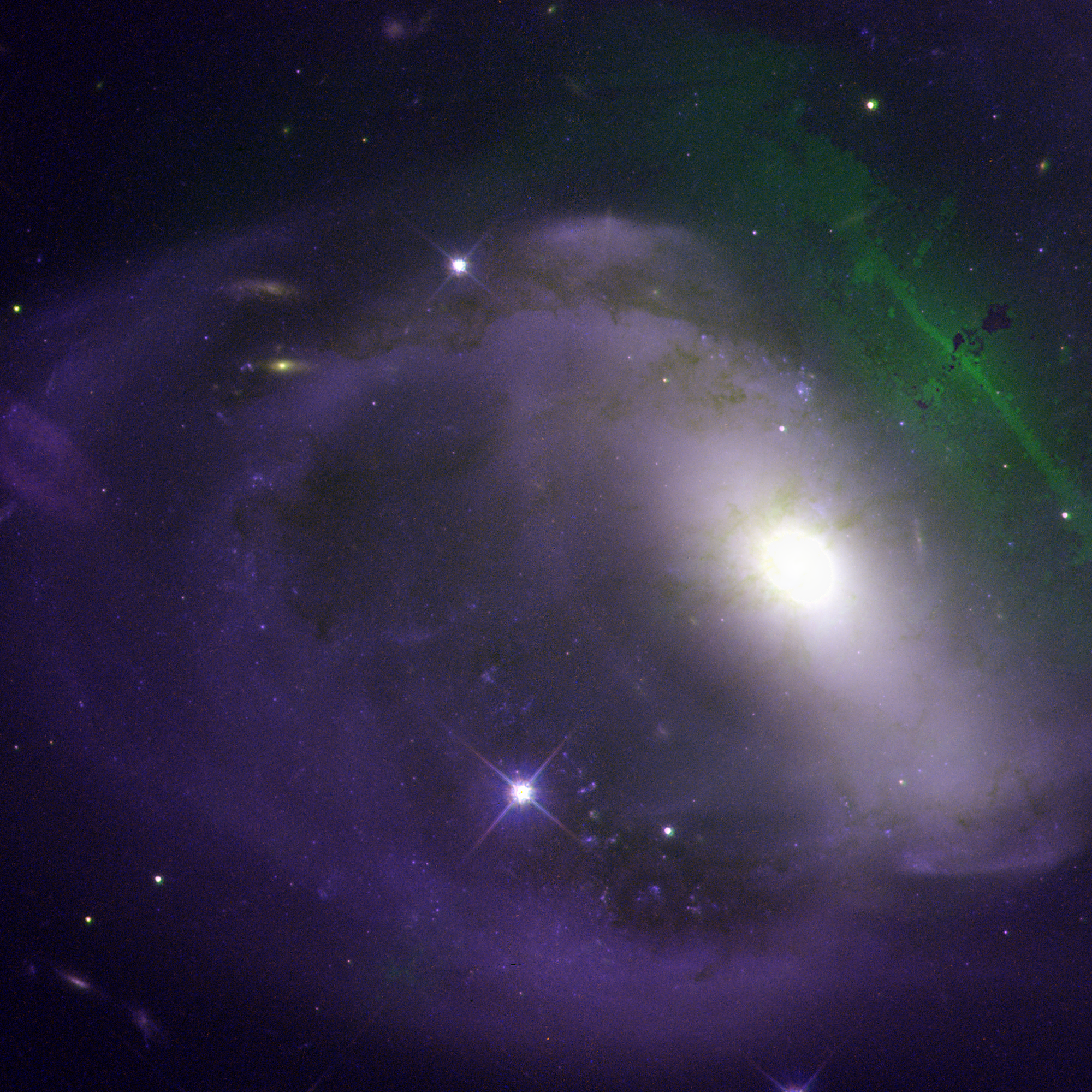
The same group, without the optical.
The same Stephan's Quintet megastack, rendered using only the bands the human eye cannot see — far-IR, mid-IR, and a single radio overlay. The optical channels are zeroed.
The resulting picture is what your eye would see if it were tuned to longer wavelengths. The bound four are warmer than the impostor. The dust is everything.
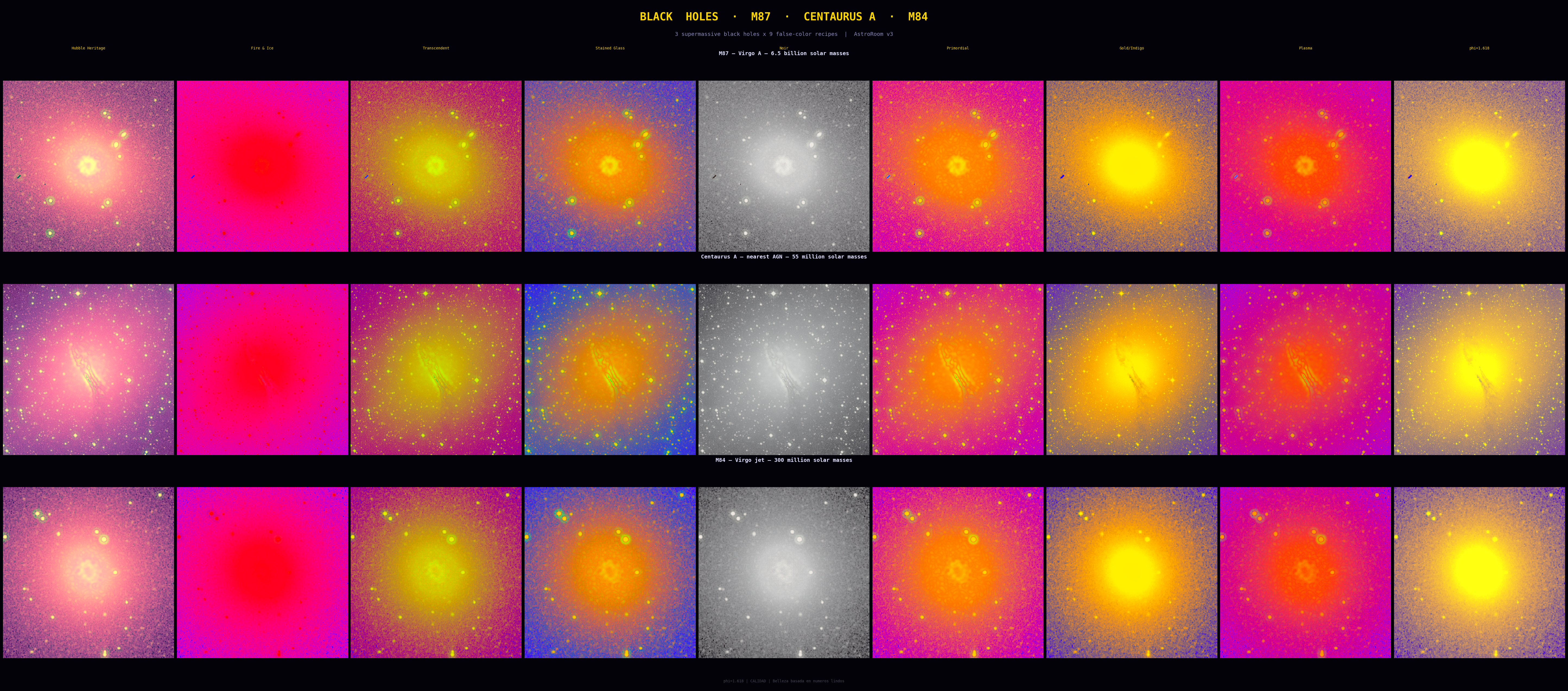
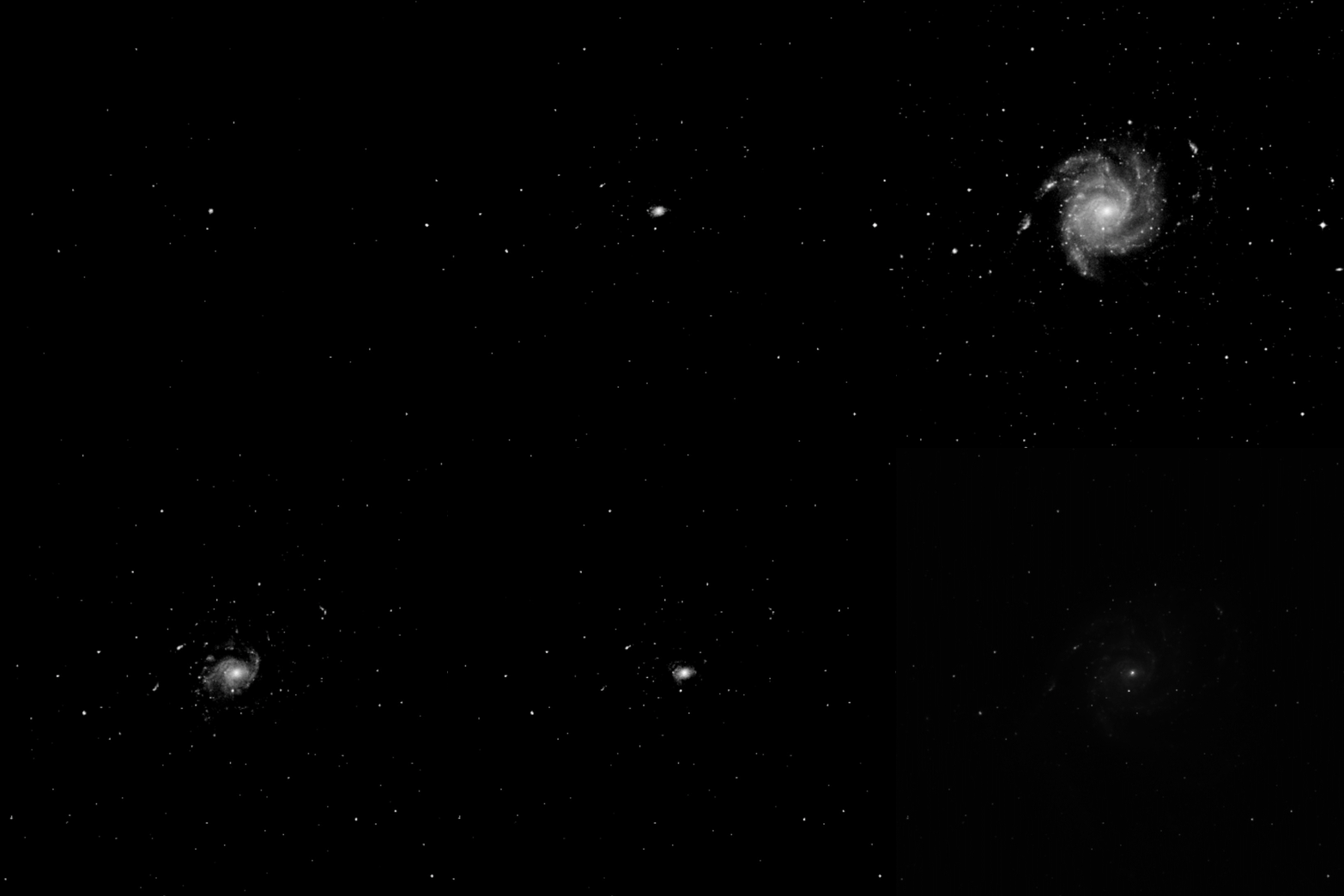
M87, Centaurus A, M84.
Three supermassive black hole hosts at a comparable distance, rendered with the same recipe. M87 dominates with its photographed jet; Centaurus A shows the dust-lane scar from a half-billion-year-old merger; M84 sits quietly with its weaker AGN.
The same recipe across three targets reads what the targets actually do. Without the constraint, comparison is impossible.
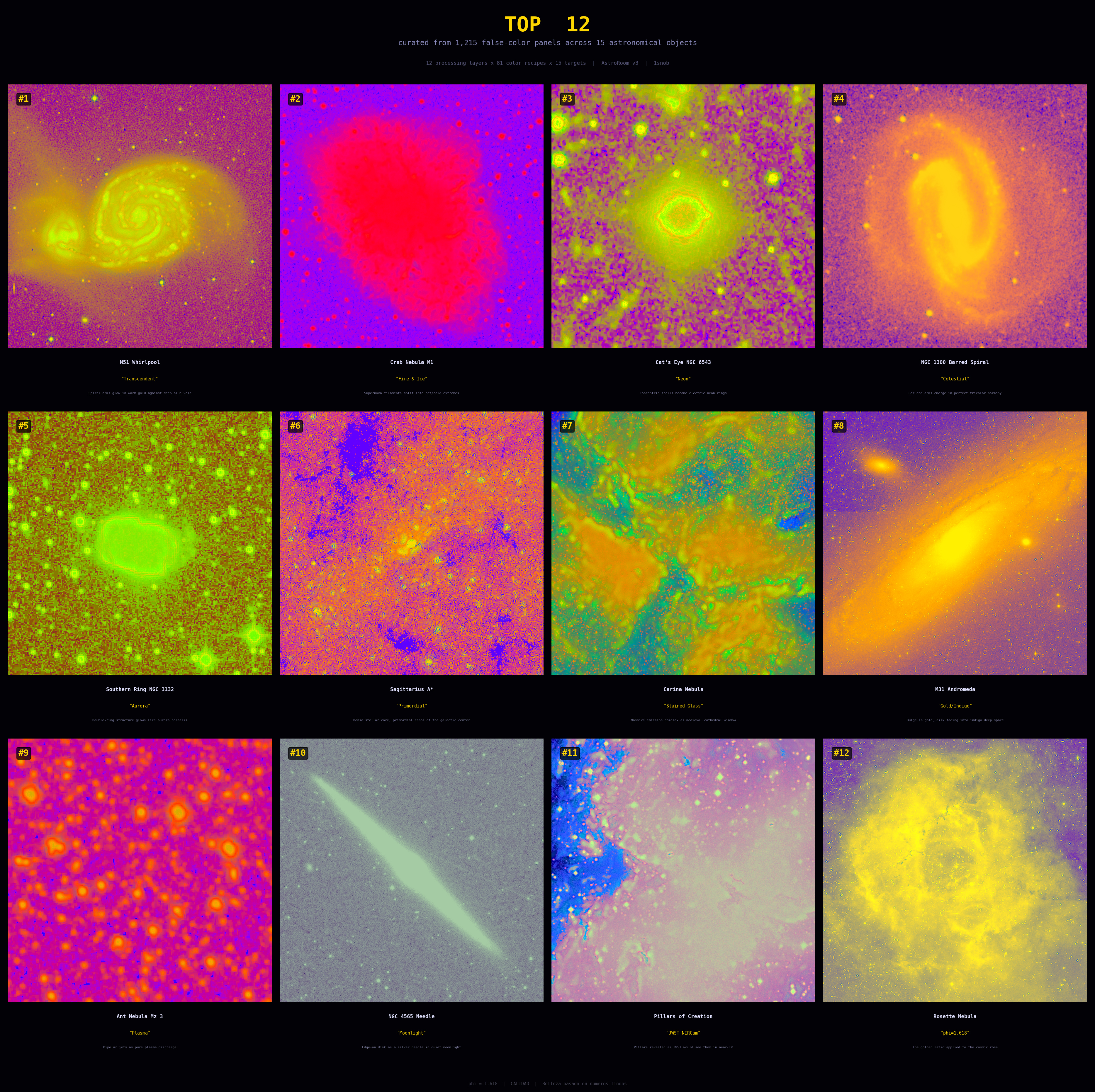
The room's twelve favourites.
A curated mosaic of the twelve plates that earned a place on the wall this Edition. Hand-picked, not algorithmic. The ones the team kept opening on a Friday afternoon.
A more honest cover image than any single hero shot. Twelve answers to the same question.
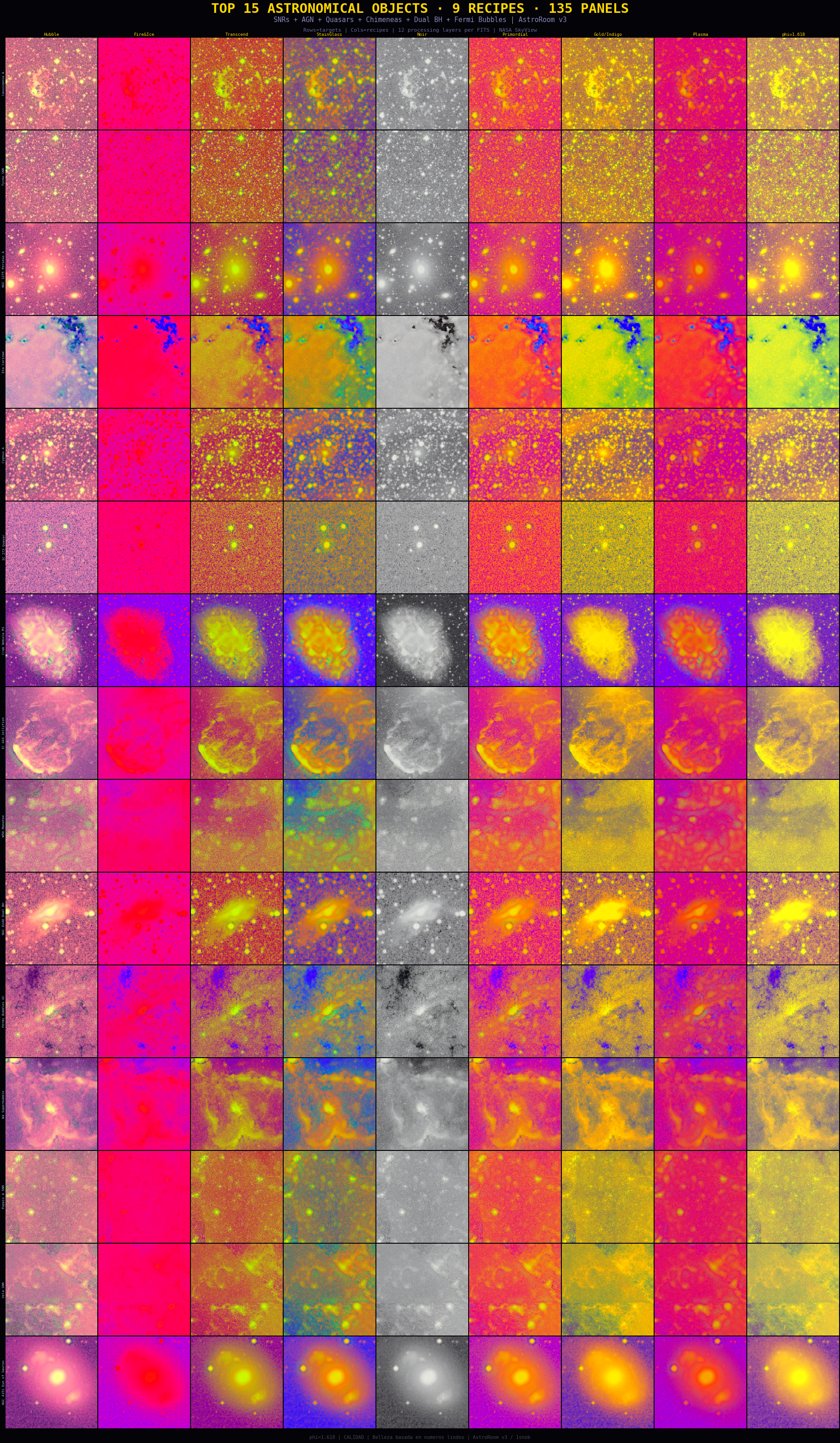
Fifteen targets, nine styles.
A recipe-explorer sheet: the fifteen most-rendered targets in the catalogue, each rendered under nine palette family endpoints. The grid is meant to be read horizontally — pick a target, scan how the recipe changes the photograph.
A good way to learn the recipe library. A better way to argue with it.
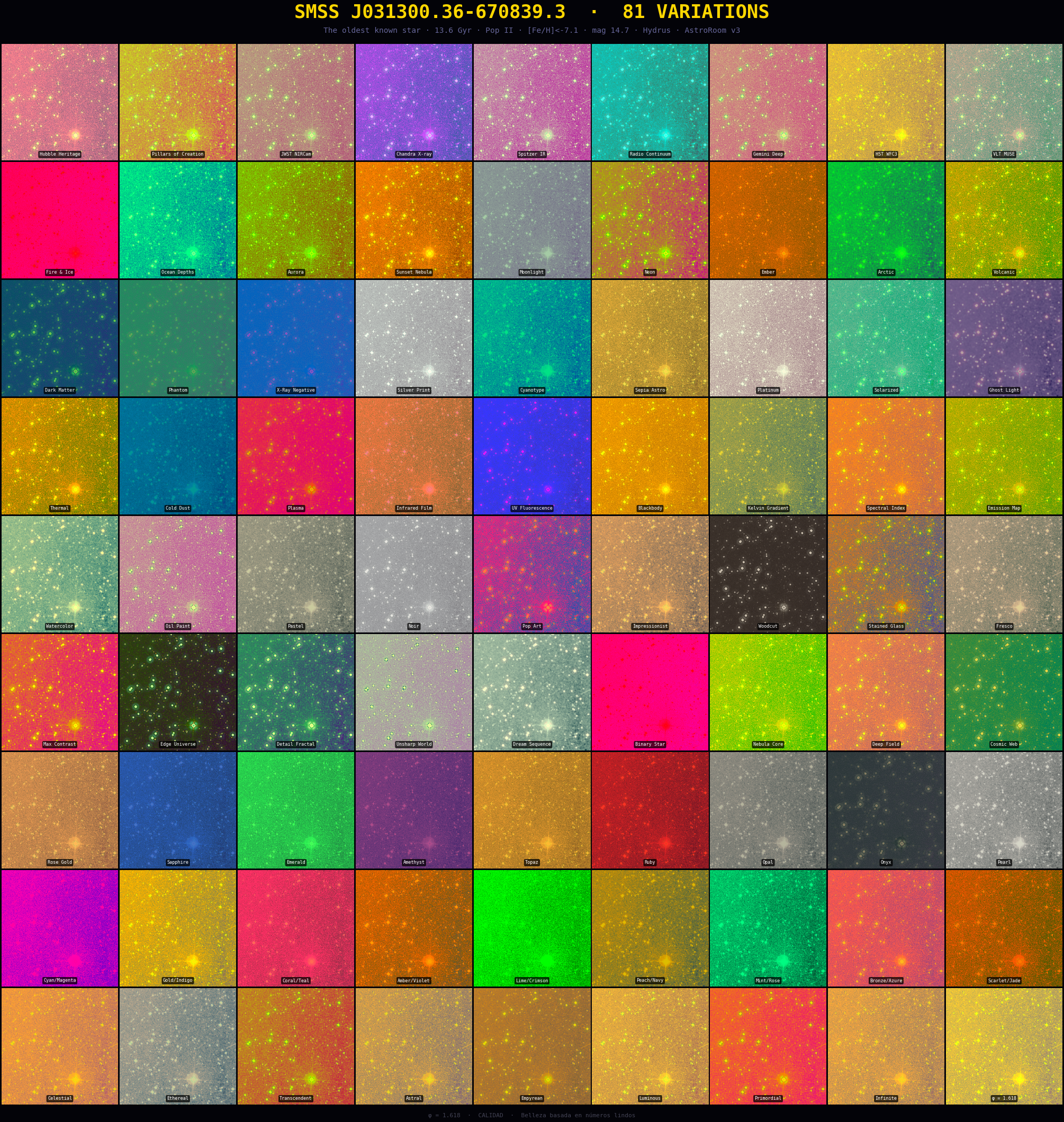
The oldest star, eighty-one ways.
SM 0313, a metal-poor halo star catalogued as one of the oldest objects in the local universe. Run through the full recipe library to see whether the colour you assign changes the photograph's age.
It does not. The colour assignment is editorial. The age is a measurement. Both are on the file, and one of them was always older.
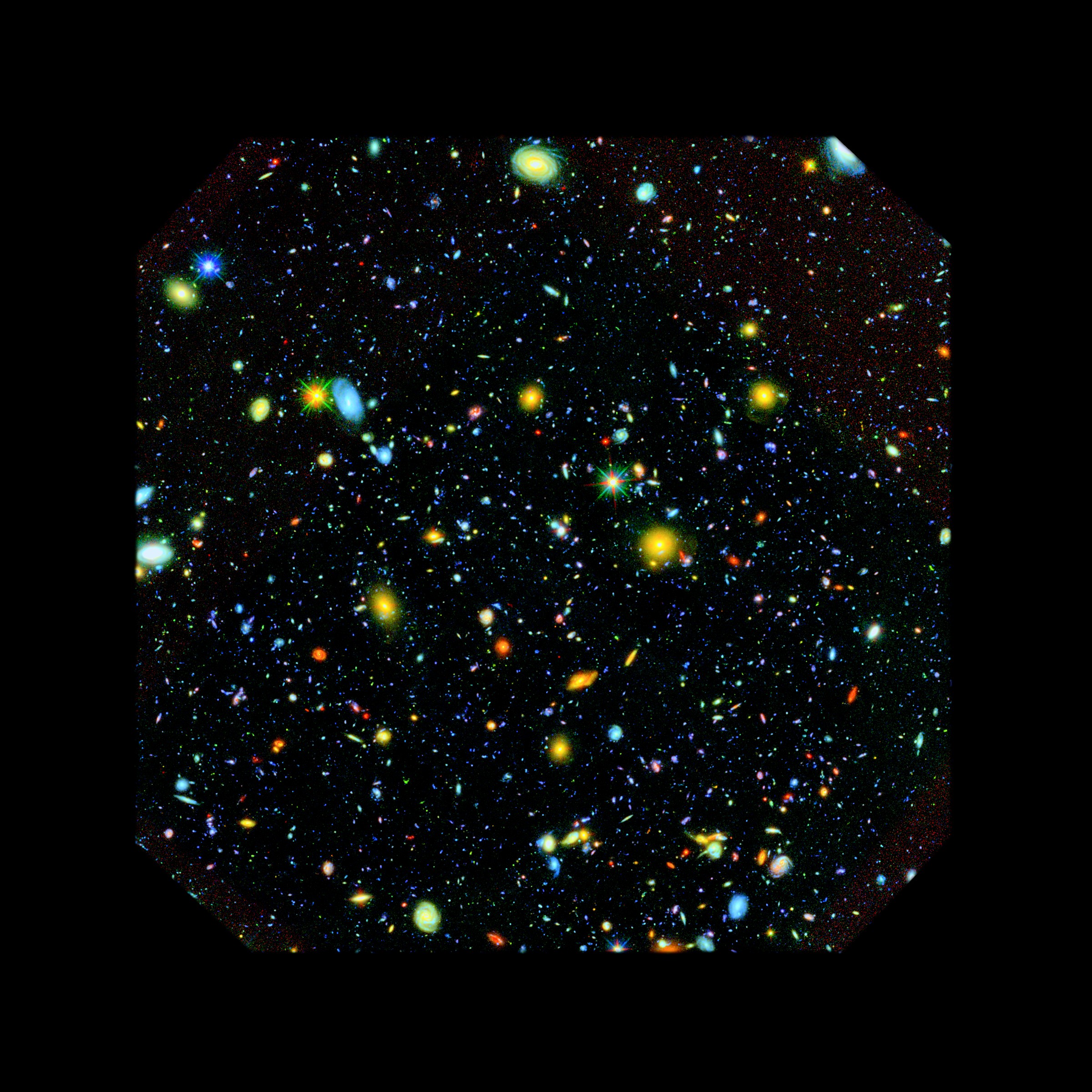
The XDF, iteration seventeen.
The eXtreme Deep Field, restacked seventeen times under different sigma-clip thresholds. Each iteration removes a different population of artefacts — cosmic rays first, then satellite trails, then faint hot pixels. The seventeenth iteration is where the noise floor stops dropping.
Past iteration 17, the gain from more clipping is smaller than the loss in real signal. The picture you keep is the one from this run.
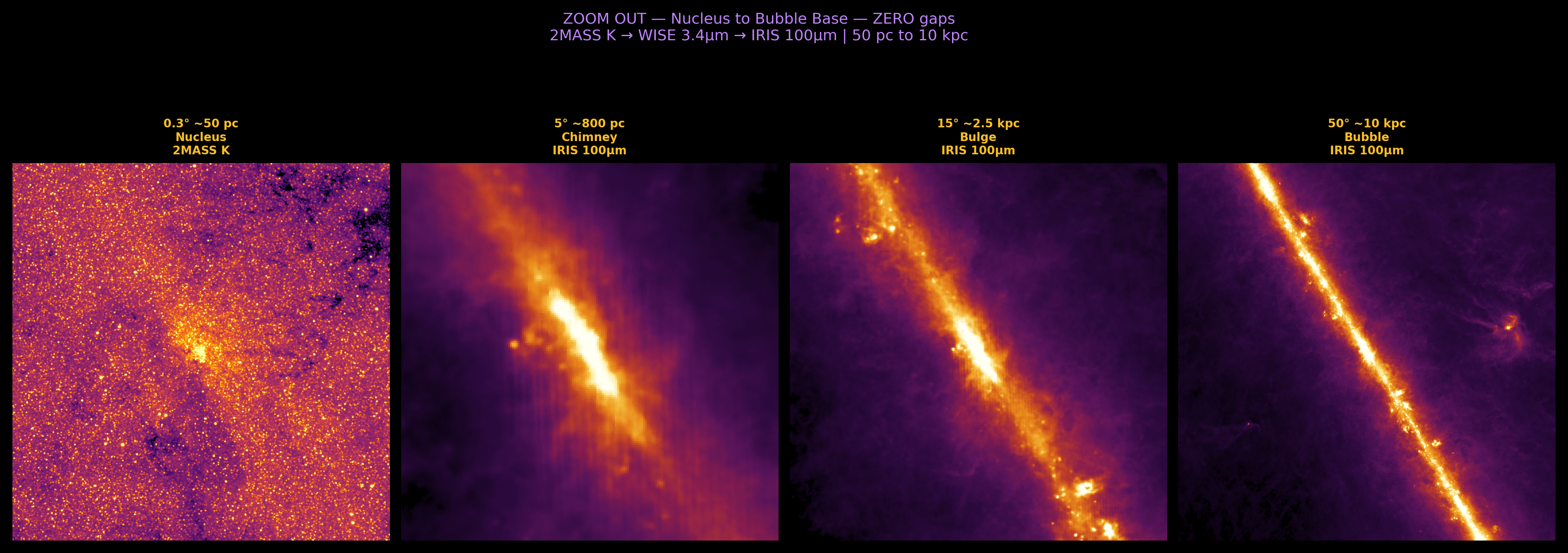
From one degree to one arcsecond.
A zoom ladder of Sgr A*, from a one-degree wide-field context view down to the half-arcsecond Chandra pixel scale. Five panels, five orders of magnitude in angular scale. Each panel is independently developed; the whole sheet preserves the spatial relationship.
The pipeline station that builds this is 07 / Zoom. It takes about thirty seconds.
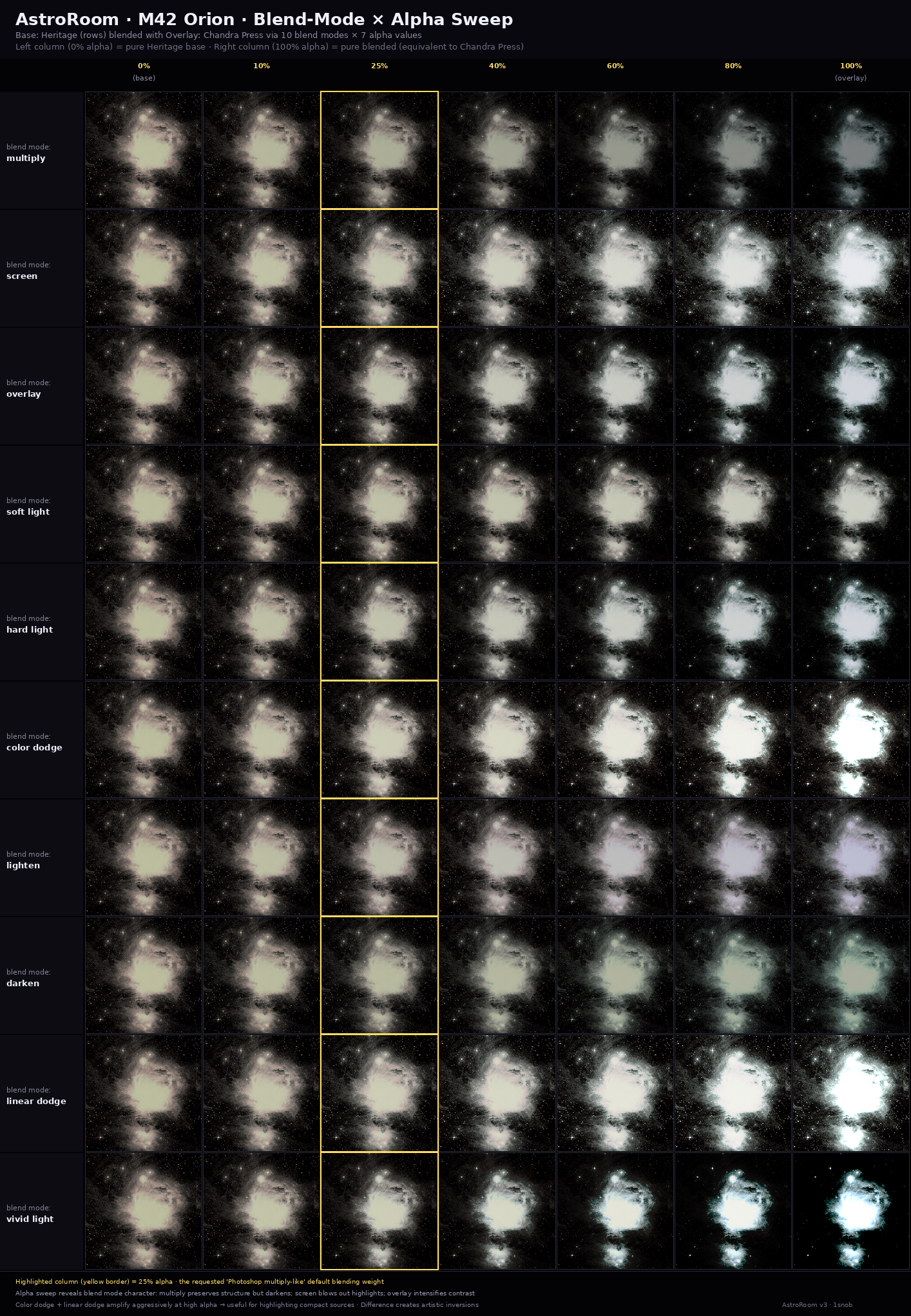
M42 across twelve alpha stops.
An alpha-sweep on the Orion Nebula. Two layers — a deep narrowband H-α and a medium-band optical — blended across twelve alpha values from 0.0 to 1.0. The trapezium cluster reads brighter as alpha rises; the diffuse nebulosity reads brighter as it falls.
A study for the moment when the recipe is the alpha. There is no right answer; there is a setting that matches the question.
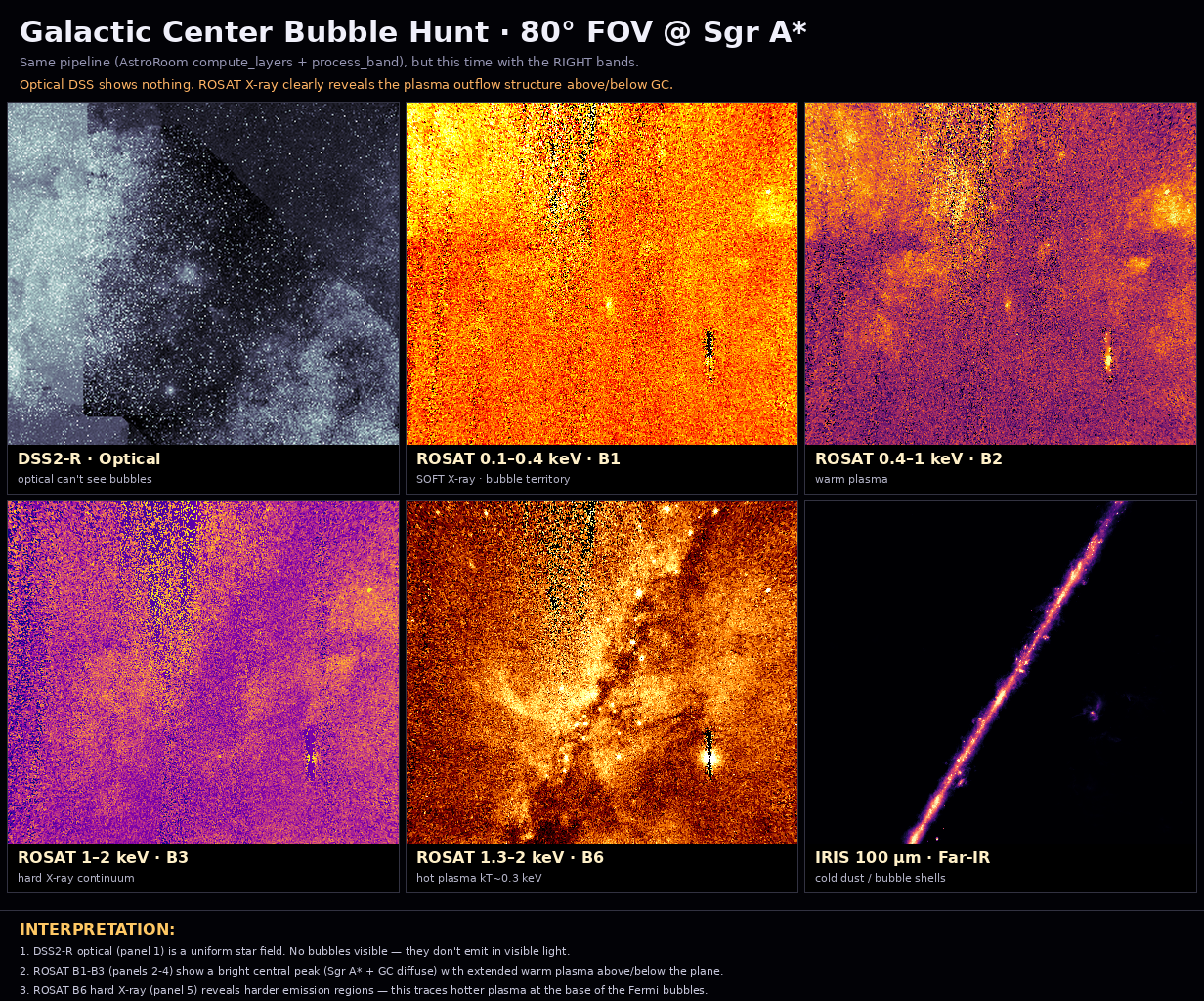
Hunting shells in the Bubble.
The Bubble Nebula — a stellar-wind blown shell around BD+60°2522 — imaged across the four narrowband filters that resolve its structure: H-α, [O III], [N II], and [S II]. Each filter shows a different layer; together they trace the shock front from the inside out.
A structure-hunting study. The point is not the picture; the point is the ionisation map.