The colour of
an X-ray
photograph.
X-rays are invisible. Every published Chandra image is a choice. Here is how the choice gets made, and where the limits are.
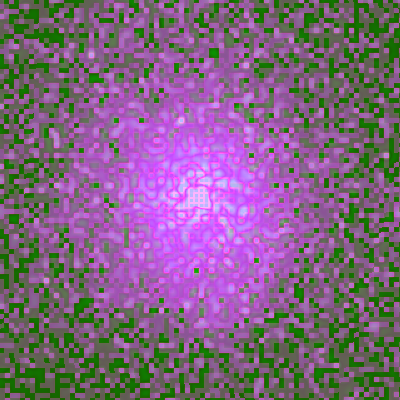
A Chandra detector counts photons and tags each one with an arrival time and an energy. None of the photons are blue. None of them are yellow. The picture you see is a translation. A good one tells the truth about the physics. A bad one tells the truth about a colour wheel.
— 01What an X-ray detector actually records
A CCD on Chandra ACIS-I is a silicon array that absorbs incoming X-ray photons and converts them to a measurable charge. For each event, the instrument records the pixel coordinates, the arrival time to a few microseconds, and the photon energy from roughly 0.5 to 7 keV. The output of a Chandra observation is not an image. It is an event list: a long table of (x, y, t, E) tuples, one row per detected photon.
— 02Where the picture comes from
To make a picture, you bin the event list. You pick a pixel grid on the sky. You choose energy bands — for example, soft = 0.5–2 keV, medium = 2–4 keV, hard = 4–7 keV. For each pixel, you count the events that fall inside it, in each band. That gives you three numbers per pixel: a soft-band count, a medium-band count, a hard-band count. Now you have something you can colour.
— 03How 1snob AstroRoom handles it
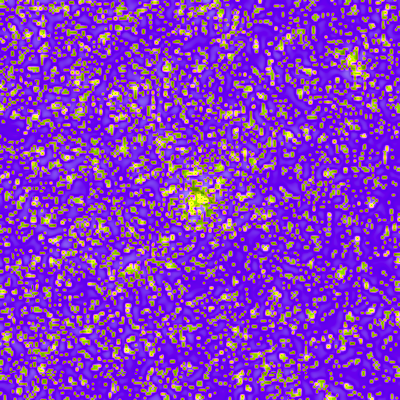
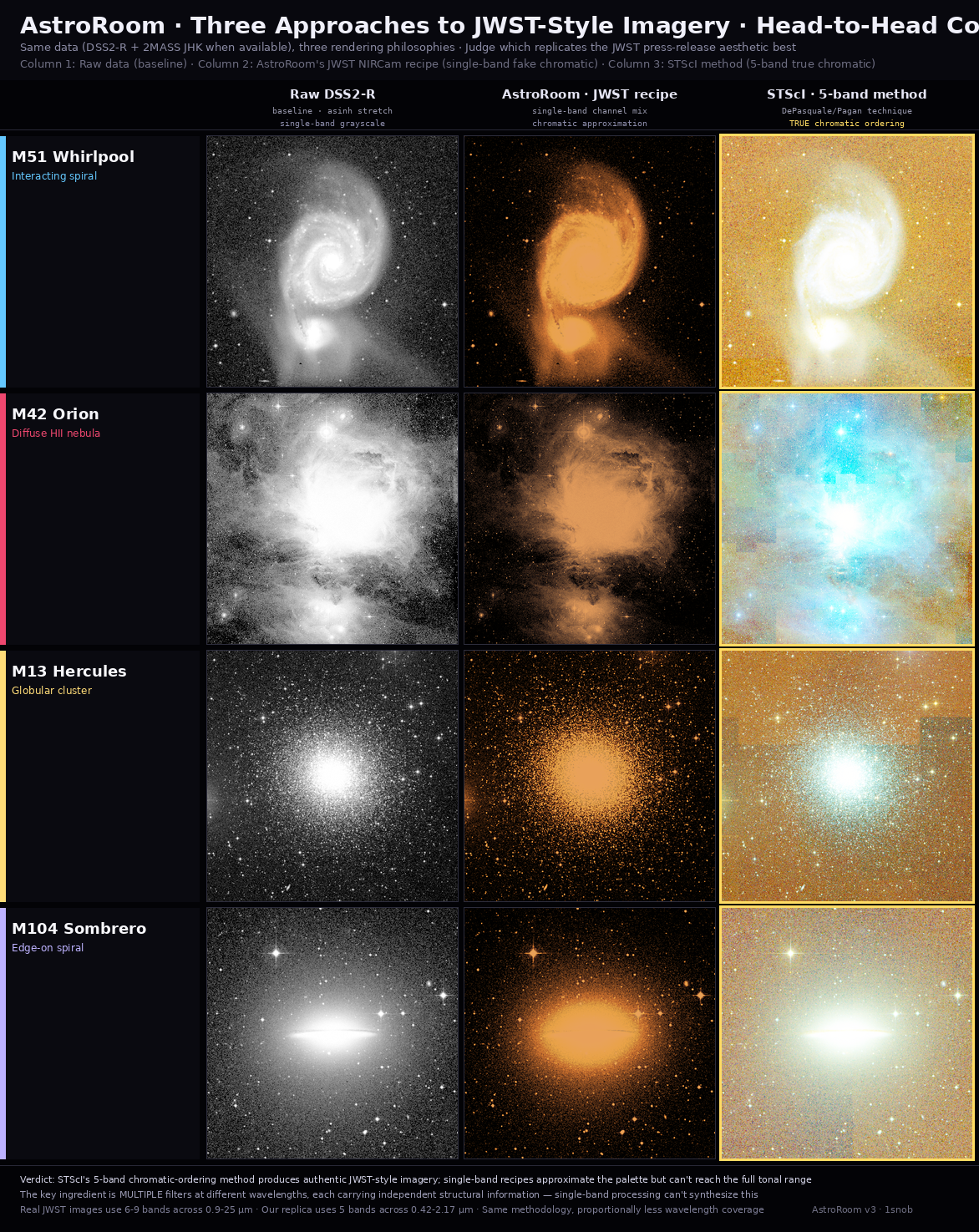
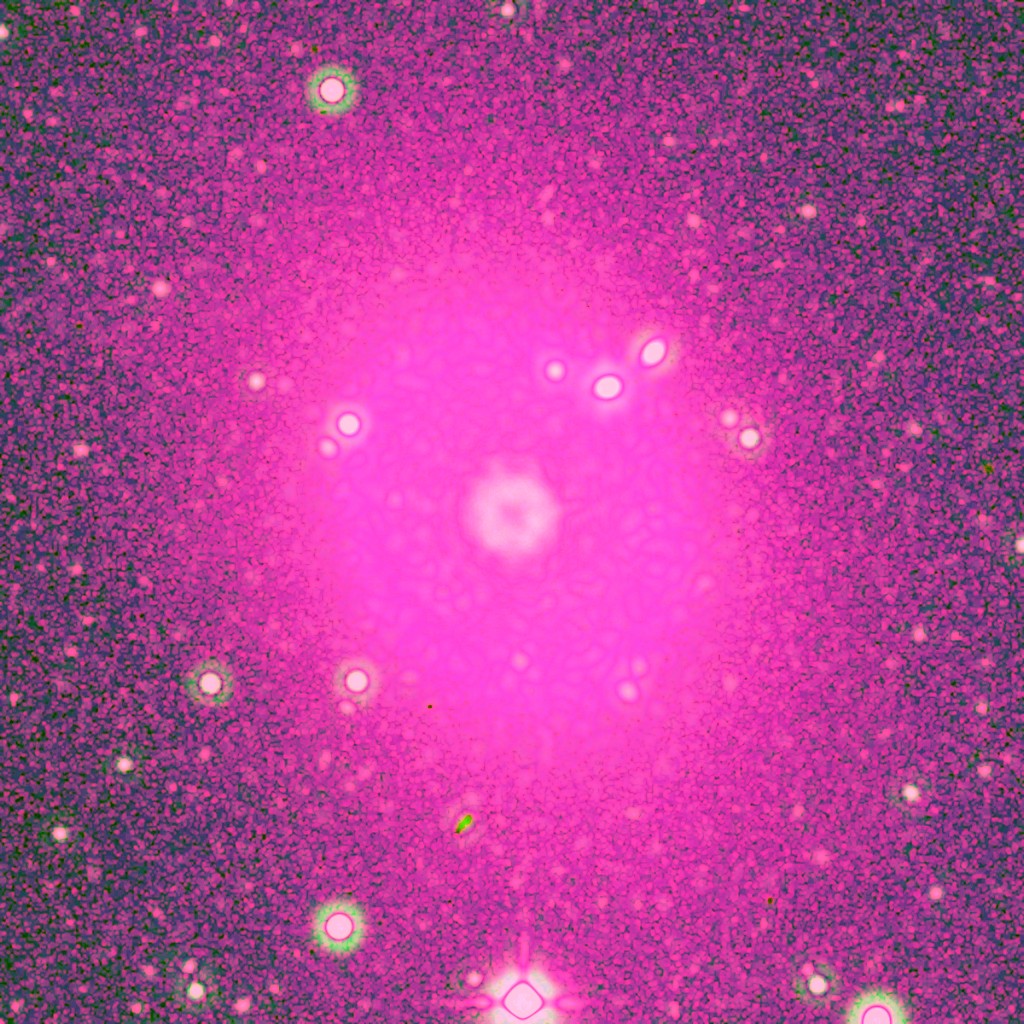
1snob AstroRoom's false-colour engine is a deliberate fourteen-band machine. For any FITS frame — single-band or multi-band — it can produce a composite by choosing one band per RGB channel, applying a stretch (linear, asinh, log, power), clipping the high and low percentiles, and finally compositing under one of eighty-one named recipes. The same frame can be developed under several recipe families: a Hubble Heritage warm-edge palette, an inverse-greyscale that respects the original photometry, a JWST NIRCam mid-IR mapping, a polarisation-hue wheel, a pure spectral false-colour. The recipe library lives in backend/app/services/falsecolor_service.py; the channel mapping in backend/app/services/fits_composite_v3.py.
— 04Where the choices live
The same X-ray observation can be developed into wildly different photographs and all of them are technically correct. The Chandra collaboration favours a soft-blue, medium-green, hard-red palette because it lets your eye read photon energy at a glance. Some publications prefer a warm tone-mapped single-channel because the silhouette is what's important. Some choose pure greyscale because the audience is reading photometry, not aesthetics. None of these is wrong. They are different answers to a question that has no one answer: what is this picture for.
— 05Why this matters for the picture
1snob AstroRoom keeps the recipe attached. Every false-colour composite the system produces is a tuple of (input bands, stretch, clip, palette, recipe-id). You can hand a peer a PNG and a recipe-id and they can rebuild the exact same image from the exact same FITS sources, on a different machine, in a different country, in five years. The choice is a choice. We just want the choice on the record.